
From pharaohs and botanists to settlers and gardeners—how irises became part of Oracle’s heritage
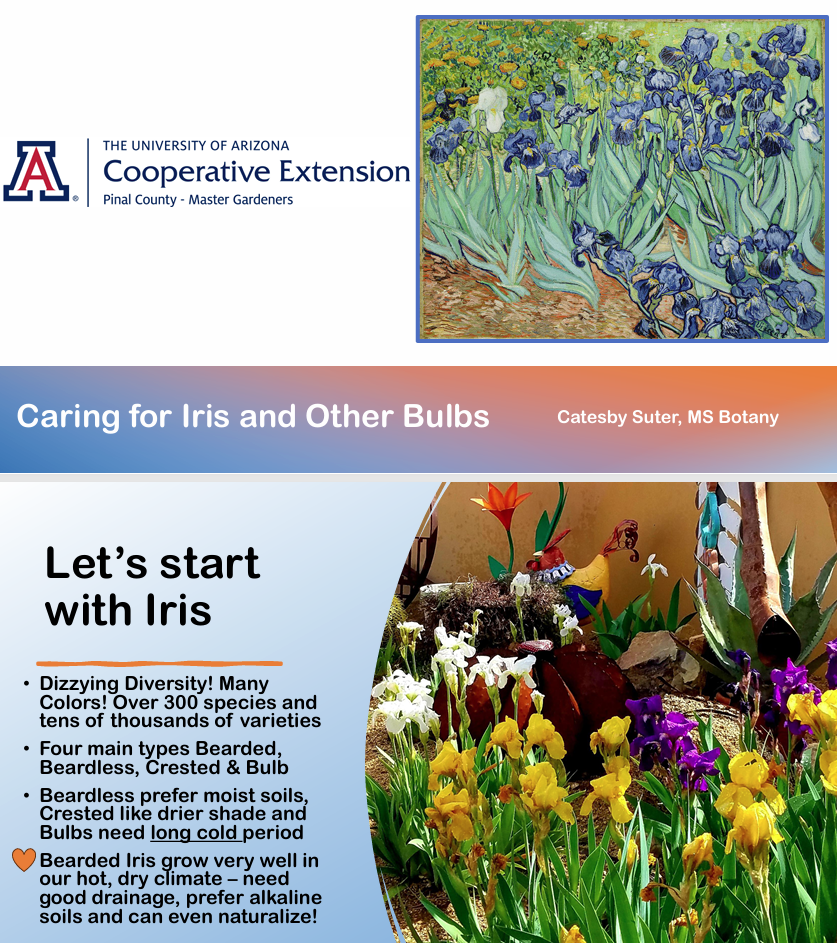
Opening Slides of Caring for Iris
Filmed March 16, 2026, this presentation was hosted by the Oro Valley Historical Society, seasoned Master Gardener and botanist Catesby Suter shares the rich history, science, and practical care of growing flowering bulbs in Arizona’s challenging climate. Focusing heavily on the rugged history and division cycles of the bearded iris—including local stories of naturalized varieties in Oracle, Arizona—the lecture offers essential advice on soil preparation, proper planting depths, and navigating local heat and root competition. Suter concludes with a survey of successful companion bulbs like daffodils, four o’clocks, and society garlic, addressing container gardening, pest management, and the impacts of changing weather patterns on local bloom schedules.
(Volume recording may be low on this video; turn up the volume on your computer and refer to the transcript below.)
Bob Kellar, President of Oro Valley Historical Society: We’re proud to present the speaker today, who comes to us from Oracle. She has a Master of Science in botany from a university here in Arizona and worked for the City of Tucson for many years as an environmental manager. When she retired, she returned to her love of the University of Arizona’s Cooperative Extension and became a Master Gardener. She has been a Master Gardener now for some time—six, seven, or eight years, but who counts anymore? She teaches gardening classes up north at the San Manuel Library and is affiliated with the Historical Society. We’re proud to have her here to talk to us today. Without further ado, I’ll let her speak to us about irises.
Catesby Suter: Thank you very much, Bob. I want to thank everybody for coming today. It looks like we have a pretty good turnout. The first thing I want to point out is that I have handouts in the back. If you’re anything like me, after you finish this class, you’ll be wondering, “Okay, what did she say?” These handouts don’t contain every single slide I’m going to show you today; instead, I picked the ones that I thought had really good information to help you when you’re scratching your head and trying to remember things.

Catesby Suter, March 2026
So, let’s get started with irises. This is, of course, a Vincent van Gogh painting of irises—he did quite a few. One thing that is interesting to me is that you will notice these are purple and white. Oracle has many irises that people have planted over the years, and I can assure you they planted many different colors. However, the ones that have naturalized and don’t get any additional water are primarily purple with just a few white ones. They are all over town and have started spreading out because they are really tough irises. Some of the prettier, multicolored varieties don’t seem to be quite as hardy. While they have survived in people’s gardens where they get a little bit of extra attention and water, they’re just not as tough as the ones surviving in Oracle without any water. I have noticed over the last several years, when water has not fallen from the sky, that these irises aren’t blooming as much. That’s not surprising; when a plant is stressed out from a lack of water, it doesn’t really have the energy to put out a spectacular bloom.
I’m going to talk about some other bulbs today, but I’d like to start with irises. This photo was taken from a friend’s garden—thank you, Kevin. It shows a really nice selection. Irises have a dizzying diversity of colors, species, and varieties, making it hard to wrap your brain around them. There are four main types: bearded, beardless, crested, and bulb irises. Today, I’m going to focus on the bearded iris. Beardless irises like moister, more acidic soil, which represents conditions they aren’t getting here in Arizona. Instead, we’re going to look at the irises that love alkaline soil, can take the heat, and don’t need quite as much water. Those are the bearded irises, and they grow really well here.
Just to make sure we’re all on the same page, this is a bearded iris, and that little fuzzy part is the beard. These serve as guides for pollinator species to be able to get in, reach the pollen, and fertilize the flower. It is the flower’s way of saying, “Hi, this way to the good stuff! Come on, let’s get pollination going.” I also wanted to point out that the iris petals that stand upright are known as standards, while the ones that droop down are called falls. Standards and falls—and that’s all the iris terminology we’re getting into today, though they do have names for every single part of the flower, some of which are ruffled. At any rate, let’s just look at some of the irises.
I want to give a shout-out to the Historic Iris Preservation Society. It is a nationwide organization with chapters dedicated to preserving old irises, the ones our great-grandmothers grew in their gardens. They have an incredible database and will assist you in identifying your irises. I’ve often thought to myself that when we get blossoms from those old irises in Oracle, I would love to find out what varieties they are. Irises have very simple names rather than hard-to-pronounce scientific Latin, which makes them feel a little more comfortable for people who are just getting started. The society combines a love of detective work to figure out what your iris is with a love of growing and preserving older varieties. This is a closeup of a bearded iris with a fuzzy beard, and a beardless iris with no fuzzy beard. The beardless variety still has coloration and distinct lines to tell pollinators, “Hey, get right in here.”
If we look at the history of the bearded iris, we start way back in 1469 BC with King Thutmose III of Egypt. He was a warrior pharaoh who conquered lands and expanded the Egyptian Empire. Along the way, he picked up plants that he liked. I know that when I go on vacation, I am always asking, “What is that plant over there?” with an eye toward whether it will grow here and if I can bring some home to my garden. I’ve been successful a couple of times. Most often, though, I vacation places where it’s cool, green, and rainy, so I’m not able to replicate those conditions at home. King Thutmose went to Syria and brought back the irises he found there. Over time, the Egyptians immortalized this iris in stone, using the rhizome particularly in medicine and perfume making. I was curious about what attracted him to these Syrian irises. The plant is only about 6 inches tall, but it produces a beautiful flower. They have white bearded varieties as well as a wonderful, deep purple bearded iris. These are all bearded irises, and King Thutmose collected them—or, more likely, he sent someone else to do it, being a pharaoh. He had beautiful, extensive gardens.
The next historical mention of the iris comes many years later when the Greek physician Dioscorides traveled the ancient world focusing on the medicinal uses of plants. The very first entry in his book is the iris. This image comes from a copy of a copy called Medicus Graecus, which was prepared for a Roman princess long after he was gone. They used iris to help people sleep and to provoke tears. I don’t know why people back then needed to provoke tears—nowadays, if we need to cry, we just watch something sad on TV or read a sad book. Apparently, people needed to cry, so they would use iris rhizomes. Personally, if the irises died, that would be enough to make me cry!
Next is Carl Linnaeus, who is a very familiar figure to me. He was an early Swedish botanist—in fact, he’s called the father of modern botany. What a great guy who loved plants. His father was a botanist too. When Linnaeus was a child and would get upset or throw a temper tantrum, they would hand him a plant to calm him down. Pretty soon, he would forget all about why he was upset and just start analyzing the plant; he was a very happy kid. I can relate to that—when I feel sad and somebody brings me flowers, I feel so much better. Linnaeus named the iris genus after the Greek goddess who travels to earth on a rainbow because irises come in so many colors. By his time, people had already begun breeding different irises to achieve specific characteristics, like a desired color, height, or the ability to bloom more than once. Bearded irises were called German irises because a friend sent Linnaeus one from his garden in Germany. Because Linnaeus didn’t know the deep historical background or about Thutmose, he named it Iris germanica. Today, it has over 60,000 varieties, so if someone asks me to identify a specific iris, I don’t always know it.
Moving on to France, a gentleman named Jean-Nicolas Lémon was only 19 years old when his father died and left him a nursery. He started breeding irises and soon became a leading purveyor of German iris. His most famous introduction is ‘Madame Chereau,’ which is a really spectacular iris.
Because I mentioned France, I should probably mention England too. In the 1880s, Sir Michael Foster was an iris pioneer who was incredibly passionate about the flower. Whenever he knew someone going on a mission abroad, he would ask them to bring back or send him irises. For 20 years, he collected and bred different varieties, but unfortunately, he didn’t keep any records. Because of this, we don’t know what he crossed to end up with some of his beautiful flowers. One variety, named ‘Sir Michael’ in his honor, was developed in 1925 to recognize all of his contributions.
Now, let’s look at what we were doing here in the colonies. The Prince family were pioneers of early American horticulture. In 1724, Robert Prince and his son William established a nursery in Flushing Meadows, New York. It was located close to the ports, allowing them to ship their irises wherever they needed to go. The climate there was cooler in the summer and warmer in the winter, creating excellent growing conditions. Pretty soon, they had a great botanical garden established, which they named the Linnaean Botanical Garden and Nursery. Looking through their old catalogs, I saw that they had irises listed: 20 species, two of each, meaning you got 40 irises for a buck and a half. Today, that equivalent purchasing power would cost about $66, but getting 40 irises is still a pretty good deal. Typically, if you want a single modern iris rhizome, you’ll pay about $15, though prices can go up depending on how rare it is. Unfortunately, the nursery closed after the death of Robert’s great-great-grandson.
Grace Sturtevant was America’s first lady of iris. She founded the American Iris Society and bred many beautiful varieties. Her variety, ‘Shekinah,’ is a yellow iris that can survive in warm climates. It is the great-great-grandmother of all the yellow irises you see today, which is wonderful to know.
In Arizona, Sharlot Hall was a poet, journalist, and the first woman appointed to Arizona’s territorial government before it achieved statehood. She was also a big iris fan. One of her jobs for the territorial legislature was to serve as the state historian, so she collected a lot of items, and a museum was later established in her honor in Prescott, Arizona. In 2006, the Prescott Area Iris Society contacted the Historic Iris Preservation Society to establish a garden there. They feature all types of irises dating from Arizona’s pre-settlement era up to 1943, the year she died. Old irises are their specialty. Their bloom time is coming up in April, which makes for a great road trip. In July, if you saw something you loved during the April bloom, you can go back to the Sharlot Hall Museum to buy those exact rhizomes for your own garden. They will give you the official names so you’ll know exactly what you are growing. How fun would it be to grow irises that have been in Arizona for such a long time?
If we look at Oracle, where I live, this photo was taken right outside the Oracle Historical Society. You can see some of these purple irises that have received hardly any attention over the years. For the last three or four years, a friend of mine, who is also a Master Gardener, and I have been going up there to water them and try to bring the population back so we can get more reliable blooms. They are beautiful. I figure history isn’t written by the people who carry the plants—the settlers’ wives who said, “I will go with you to this place way the hell out there, but I am bringing my irises with me.” They brought them along, and now they are established and naturalized all over Arizona. If you hike out to old historic ruins where nothing else remains, irises will often still be there, alongside a few other plants that have endured over time. Oracle homeowners have added bearded irises to their yards, and someone even planted them along all the footpaths in town. Up by our old elementary school, in an area now called the Secret Garden, they have an entire hillside covered in irises. It hasn’t bloomed in a few years, but when it does, it’s spectacular. We have them all over Oracle, and we’ll talk a little bit about how that happened.
At the Oracle Union Church, one of Oracle’s founding families—the Ramsays—was involved. The Ramsays have been in Oracle ever since they received a homestead grant way back when. In 1965, Agnes Ramsay had an iris-loving friend in Tucson who donated 45 different varieties of bearded iris to the Union Church and its cemetery. They are scattered all over the cemetery. They aren’t blooming right now, but they’re still there, tucked into little nooks and crannies all around the church properties.
I also found out about a lovely lady named Alice Murphy. She really loved irises. She was born in Tucson, and her family spent their summers in Oracle. Her dad, Nathan Plumer, apparently founded the Arizona Bank and Trust way back when, and there is a street in Tucson named after him. He loved cars but didn’t care for irises. He used to like racing his cars down a particular dirt road; when they finally paved it, they asked him for a name suggestion, and he said, “Let’s name it Speedway.” Alice was a budding plant lover from childhood. As a kid, she would sneak into the kitchen, grab dry beans, and go out to plant them in the garden just to see if they would grow. As an adult, she bought a summer house in Oracle. After living there for a little while, she realized the soil was awfully hard, so she had multiple truckloads of topsoil brought in to improve the property. She fell in love with irises. At first, she wanted one of every kind, but since there are 60,000 varieties out there, she eventually settled on just growing the ones she knew would thrive: bearded irises. She soon had over 300 different varieties. Unfortunately, when she died, the people who acquired the house were not interested in irises. They told the neighbors and anyone else who wanted them to come dig them up and get them out of there. Because of that, I have friends around Oracle who are still growing Alice Murphy’s irises today, which is wonderful.
I also have to give a shout-out to her pets. Alice Murphy raised award-winning Chihuahuas. One was named Little Dumpling, who went on to be the star of a Disney movie called Pablo and the Dancing Chihuahua. You can find it on YouTube, though it doesn’t run on the Disney Channel anymore. It’s about a little boy from Mexico named Pablo who sneaks across the border, and his little dog follows him. It’s a very cute show, and the dog actually dances whenever the boy plays his pipe. When Alice Murphy rented out her Oracle home, she demanded a security deposit—not for the house, but for her trees! She wanted to make sure that if you rented her house, you were going to water and take care of her trees. If you cut any of them down, you would lose your $100 deposit. Eventually, she couldn’t remember the names of all 300 of her irises, which is completely understandable. If you have irises and don’t know the variety, you can call them a “NOID,” which stands for “No ID.” Personally, I prefer calling them “UFOs”—Unidentified Flowering Objects. It sounds much better! I think she made her irises available to her neighbors because, as we will discuss shortly, irises need to be divided. They get crowded as they keep growing, and a tiny patch soon becomes a massive area. You can find these irises all around Oracle.
Let’s talk a little bit about growing irises. Aren’t they beautiful? I believe this specific one was one of Alice’s irises because the current homeowners told me it was already there when they bought the house. Irises are highly adapted to our climate, flowering in the spring and naturalizing easily. Fortunately, rodents mostly leave them alone. I say mostly because when it’s hot and dry and there is nothing else to eat, they may decide your irises look pretty good. You can see how these rhizomes sit very close to the surface; irises do not like to be buried deeply.
How do you know if a plant is adapted to your climate? The USDA has developed plant hardiness zone maps. Here in Oro Valley, we are in zone 9a, which means our average lowest winter temperature drops to 20 or 25 degrees. The current map from 2023 replaced an earlier one from 2013, and the differences are notable. If you look right around Flagstaff, the blue zone indicating colder temperatures was much larger in 2013, and there used to be blue areas in our local mountains that have gradually disappeared. These maps are based on 10 years of climate data, proving that our climate is getting hotter and drier.
When you buy a plant, you always want to check the tag for these temperature zones. I often go to the nursery, fall absolutely in love with something, and check the tag. If I don’t, and I take it home, it might freeze and die during one of our occasional cold winters, and I hate that. I always make sure my plants can survive the cold. There used to be a movement to label plants based on heat tolerance as well, but that was largely abandoned. I really think we need to resurrect that so plants are explicitly labeled with how much heat they can take.
There are many different types of flowering bulbs, and I use the term “bulb” as a broad descriptor. You have rhizomes, like irises. You have this little beauty called a corm, which is flatter and produces little baby corms at the base. You have true bulbs, like a traditional tulip or daffodil. Finally, you have tubers. All of these are underground storage systems developed because these plants evolved through alternating wet and dry periods. During the wet season, they store extra water and energy to utilize during the dry season. Spring-flowering bulbs adapted to dry summers, while summer- and fall-flowering bulbs adapted to dry winters. Some bulbs are adapted to irregular wet and dry periods, which mirrors the weather we experience nowadays, allowing them to flower more than once a year. There are bearded iris varieties that rebloom, and I have some growing in a pot in my yard right now. I’ll let you know at a later date if they actually bloom a second time!
So, what do flowering bulbs like? This is another one of Alice’s beauties; I talked to the lady who has it in her yard, and she confirmed she got it from Alice Murphy’s old house. You want to plant your spring-blooming bulbs in the fall once the temperatures drop below 90 degrees. I believe I included this schedule in your handout. For summer-blooming bulbs, you want to plant them in the spring once temperatures rise above 55 degrees.
Choosing the right location is critical. All types of bulbs require excellent drainage. If bulbs get too wet, they will mold and rot, which usually kills them. You must ensure you have great drainage. If you pick out a spot that you think will look fantastic in your yard, dig a hole, fill it with water, and the water just sits there without draining down, you have to find another spot. Find a different plant that can handle wet feet for that location, because your irises will fail without good drainage.
They also need six to eight hours of sun to produce a good flower. That said, afternoon shade is highly appreciated in the summer. Just like us, the plants get very hot out there. You also want to feed your soil before planting. Creating a beautiful flower takes an immense amount of energy, and the plants must pull those resources from the ground. Amend your soil so it is rich enough to produce beautiful blossoms. You should feed the soil again right after they finish flowering because they have expended so much energy putting on a beautiful display for you. They’ve used up their nutrients, so give them some more and feed them again. Finally, water whenever the top few inches of soil feel dry. You can check this simply by scratching your finger into the dirt, or by watching for wilting, which is a major telltale sign. If you’ve had an iris patch for a while that used to give you spectacular blooms, but suddenly you are getting fewer flowers or no blooms at all, it is time to divide them.
In your handouts, I’ve included a list of flowering bulbs that grow well in our specific zones. Oracle has many areas classified as zone 8b because the varied topography causes cold air to sink like water into the valleys. For summer-flowering options, you can grow rain lilies, society garlic, canna lilies, daylilies, and agapanthus—I have grown all of these in my yard. For the cooler seasons, you can successfully grow daffodils, grape hyacinths, freesias, bearded irises, and gladiolus. This image shows the gladiolus, and right over here are the rain lilies. The temperature of the soil is incredibly important to the bulbs and rhizomes you are planting, so always pay attention to that. These varieties are all perennials and will continue to grow and bloom year after year.
Please make sure you only plant healthy bulbs and rhizomes. If you buy bulbs and they look moldy, do not plant them. You will be disappointed when they die. Throw them out and ensure you get a nice, fresh, healthy-looking bulb—or take it back to the nursery and demand your money back. If you store bulbs for too long, they will dry out. You can check if an old, wrinkled bulb is still viable by using the float test: drop it in water. If it is still healthy and dense, it will sink to the bottom. If it has dried out completely, it will float. Throw the floaters away.
If you can’t plant your bulbs right away, store them in moist perlite or peat moss in a cool, shady area, or keep them in the refrigerator. If you use the fridge, do not store them next to your vegetables or fruits—especially apples and pears. As they ripen, they give off ethylene gas, which will kill irises and other bulbs. If you happen to have a dedicated extra refrigerator, I count you among the truly wealthy and happy people! I have an extra fridge myself and it feels great because I have plenty of room to store questionable, non-food items like flower bulbs.
Lastly, why don’t we just grow these flowering bulbs from seed? The problem with seeds is that it takes a very long time, and you can never be certain of what you’re going to get. Bulbs and rhizomes represent the plant’s way of reproducing asexually. When they multiply this way, they create an exact clone of themselves, copying their DNA perfectly. If the parent flower was purple, the offspring will stay purple; if it was a specific type of tulip, it will remain identical. You are welcome to plant seeds if you want to experiment—in fact, that is exactly how breeders create all these unique varieties. They cross-pollinate the flowers, wait for the seed pods to develop, plant the seeds, and then wait the several years it takes for a tiny seed to mature into a bulb and send up a flower. Only then do they find out the results of their cross-pollination to see if they’ve generated something spectacular or something disappointing. That is the main drawback of seeding: it takes a long time, and the results will not match the parent plant.
Pick your good spot, like I said, with good drainage and prepare your soil. Dig down about 12 inches. Yeah, you’re going to need a place where you can do that. It is hard to find sometimes. Maybe you’ll be like Alice Murphy and import your own topsoil so you can get that 12 inches and work in some compost. What you’re doing is you’re improving the soil; you’re providing good organic material with all the nutrients in it that will help your plant grow. Like I said earlier, if you have poor drainage, please pick another site. You can add sand or perlite, but it’s not always guaranteed to work. Allow your soil to settle down for a week. You want to fertilize or compost when you’re planting and after flowering. Most bulbs will benefit from low nitrogen fertilizer. The three numbers here have to do with nitrogen, phosphorus, and potassium. They’re on every fertilizer bag. It’s required by law. If you don’t find it, keep looking.
You are looking for something that has fairly low nitrogen. Many of the fertilizers that they sell you for your yard, for your lawn, are very high in nitrogen. But if you plant that fertilizer and you use that with your bulbs and your irises, what happens is you get beautiful, luxurious growth with no flowers. If you’re growing tomatoes in your garden and you use the same fertilizer you use for your lawn, your tomatoes won’t put out any flowers either. It’ll postpone the flowering period for your tomato by as much as two or three weeks. For tomatoes, especially in our climate, they need to get the flowers out before it’s so dogone hot. So, try to stay away from high nitrogen fertilizer for your bulbs. This one is 3-5-8, and this is an organic fertilizer here. They have a lot of different ones. It’s really important when you put the fertilizer down, especially, that the fertilizer doesn’t touch your bulb or your rhizome because that can create a burning area. So, if you just scatter that fertilizer on the surface and then water it in, that’s the preferred methodology if you’re using fertilizer. I use a lot of compost, and compost is naturally fairly low in nitrogen, and it works really well.
Okay, you want to plant the things that we will call true bulbs. They actually look like a bulb, a tulip or a daffodil. You want to plant them according to their size. So, the depth of these are according to your size. And this is one of the handouts I gave you guys. Your rule of thumb is you’re going to plant two to three times the bulb diameter or height depth. Your rhizomes and tubers, except for irises, you’re generally planting those two to four inches deep. Iris need shallow planting, and they like just a little bit of their rhizome exposed. If you can’t remember, if you can’t find this slide, you can also go online. Paul here is recording this, so if you go on the Oro Valley Historical Society’s web page, this ought to be there unless we have technical difficulties. So, crossing our fingers, we won’t.
Another resource I really like is the Sunset Western Garden Book. Mine dates back to the 80s, and it’s still got great information. So, if you can find a Sunset garden book someplace, like at a thrift store or something, buy it. I found one at the Golden Goose that was $10 and I’m like, “Holy cow, brand new they are over a hundred.” So, that’s why I’m suggesting hunt your thrift stores down. I gave that 2012 Sunset Garden book to the San Manuel Library where I do a lot of my classes because they come from a fairly poor area. It’s a great library, but they don’t have a lot of the gardening resources. So, over the years, a lot of my old garden books have migrated over there so that they have the resources they need. Anyway, Sunset Western Garden Book.
One thing to think about is bulbs that are coming from cold regions. You may not be able to grow them here because they just cannot take the summer heat or the nasty rodents. So, after you’ve planted or divided your irises or your other bulbs, water. That water settles the soil and will stimulate your roots to start growing. If it doesn’t rain, continue to water them. Remember how I told you in Oracle there are irises that never get any water? Well, they don’t bloom too often either. So, in your yard, you have the control and you can water them so that you get blooms more predictably.
If you have a problem with your iris and you’re asking yourself, why doesn’t my bearded iris bloom? Well, perhaps it is not yet established. I have a really good friend who heard I was doing an iris talk and went out to her yard and dug up a bunch of her irises and divided them. Yes, she did it completely out of season. Thank goodness irises are tough. She gave them to me to provide to you guys. So, for after the class, I have some bags of iris, and if you make a donation, you can just pop over and get one. My point is these guys are not going to bloom this year. They’re going to have to wait until next year.
The other thing is we are already warming up. And when these guys go in the ground, they don’t have a whole lot of roots because many of them were disturbed during the whole transplanting process. So, without a lot of roots, you are going to have to water more frequently. You’re going to have to really baby these guys over the summer, and then hopefully by next year they will have established and you’ll start getting your blooms.
Another reason they’re not blooming is they could be overcrowded and they need to divide. Maybe they’re planted too deeply or maybe they’re getting competition, either from other irises because they’re crowded or from other plants. My oak trees are beautiful. In my garden, I used to just plant right in the ground, and I went to dig in that ground, and I couldn’t get my shovel in. There was a network of roots there. The oak trees are like, “Yes, this is terrific. Keep the water coming.” And they formed such a thick mat. So, if you were to plant something right on top of another plant or maybe in a pot with other plants, it’s fighting with the other plant, competing a little bit. You can get away with it for annual plants because those aren’t going to last very long. So you can do these combinations in a pot that I always admire that I can never replicate. But part of the problem with doing that long term is you start to get competition because there’s only so much room and so many resources.
Okay, so we already talked about fewer flowers, smaller flowers, or no flowers. That’s how you can tell it’s time to divide. When you do, now is the time to start sharing with your friends. Either that or you’re going to end up with irises all over your yard, which may be what you want, and that’s fine. But eventually, you will have more iris than you have room because that’s just the way they grow. So, be really careful when you get ready to separate these guys. If they don’t come apart easily, don’t force them. Some of the rhizomes that are in these bags, there’s at least one that has two sets of leaves coming out of it, and it just wasn’t ready for me to cut those in half. They need enough rhizome to be able to store their food to put up new leaves.
So, here we’re going to talk about dividing irises. It’s best to get the area nice and wet, wait a few days after it’s really soaked, and then get in there. I use a pitchfork to try to get in there because sometimes it’s just so tangled. You’re starting a little bit away, and you’re going around the outside of your area in a circle and slowly you start easing these up out of the ground.
Iris become overcrowded, and they get a lot of competition for nutrients and space, and it usually takes about three to five years. I have friends who have never ever divided their irises. They don’t get a whole lot of blooms, and then they ask me, “Why aren’t these things blooming? What’s wrong with them?” And I’ll say, “Well, they probably need to be divided.” And they don’t like to hear that because that’s work. So, let’s take a look at what is happening. Why are they getting so crowded in there? All right. So, you have your first stalk here that comes up, and it puts a flower out, and that would be called the mother rhizome. Part of its recovery effort is also making two daughter rhizomes at the same time. Two more. And then the mother rhizome does not bloom anymore. But then these daughters become mothers and they make two, and then they don’t bloom anymore. So over time, you’re getting more and more mothers who are no longer blooming and many daughters who become mothers, and so it gets very crowded in that area.
So here we are. We’ve got this lovely iris rhizome. And yes, you can plant this entire long thing, but really you only need a bit of the rhizome and this leaf. You’re looking for roots and a shoot out the top. And we call this a node. So, you can divide this into two or three pieces. You see, when this area is too close together, I just bury those together. But it’s important to be sure each section you plant has some roots on it. If there are no roots on it, I wouldn’t plant it.
[Audience member question/comment about the mother rhizome]
Catesby: Nope, she’s done.
Audience member: “Should I flag the mother, so I know who?”
Catesby Suter
Catesby: Well, you will know who’s who because the mother doesn’t even put leaves up anymore after that. Oh, okay. So, this section right here, probably a mother in there. A lot of times over time, this part will become very sunken and kind of wrinkly. That’s an older mother.
All right. So, you will notice this strange shape here. One of the things you’re doing when you’re making this little rhizome node to plant is you’re reducing the amount of leaf that you have up there. Because we pulled this out of the ground, it doesn’t have a whole lot of roots. It no longer has enough roots to support this long top. So, we cut it like this. The other reason we do this is because rain falling on it, or if you’re watering it from above ground, will not catch anywhere. It’ll just run right off, so it’s not going to get moldy. Not really a huge problem in our region, but iris folks are anyway, they’re a little bit stuck in their ways, and so this is the way irises are cut. They’ve always done it this way, and this is the way to do it. Okay, so these are all cut that way.
So anyway, once you’ve harvested this like this, this is a new fresh cut that you’ve made here to divide. And you’re doing it wherever there’s kind of a narrowing or a constriction. This cut needs to heal before you put it right in the ground. So you rest them in the shade someplace where it’s not too hot, hopefully, and they will dry out. Do you do the same type of thing when you are separating succulents or cactus? Whenever you’re making that cut or you’re pulling the cactus out of the ground, you let it sit for a week or so before you put it in the ground. This allows a scar to form right there, and it prevents it coming in direct contact with the soil. The soil has many great organisms in it. It has others who are not so friendly, and you don’t want the not-so-friendly organisms to get in there and cause your little area to rot.
So before you plant, feed the soil. You dig down, you work in your compost, just like you were doing when you’re preparing for your fresh planting. Water the area, let it settle for about a week while you’re waiting for these guys to heal up. Inspect each divided segment. If you find any that look like they’re odd holes in there or look a little old and wrinkly like those poor moms, you just cut that part off. You take a mound, and you spread your roots out like this, and you cover it with about an inch of soil. Typically, you leave this little piece of the rhizome exposed.
Okay, so I can tell you that before I knew anything about irises, I just planted them and I covered the whole thing up, and they still made it. I abused them. But what I’m telling you are ways to be sure you have maximum success and really good-looking flowers.
Okay, we talked a little bit about doing this out of season. Sometimes you’ll get a present and it wasn’t the exact right time of year, like now you’re going to get presents that aren’t the right time of year. Well, you proceed as if it were the right time of year. You cut back the leaves if you need to. You plant them as usual. You give them a whole lot of extra care to keep their stress level down. Don’t expect blooms for a while—at least a year, maybe more depending on how established they were able to become.
If you get them in the summer, in the middle of the summer when it’s a hundred and something outside, I would store them if you could. Find a place in your refrigerator, or maybe your friend’s refrigerator, away from the fruit, and keep them maybe in some perlite. Perlite is that little white material you see in a lot of potting mixes or a lot of times when you buy a plant. Perlite or peat moss or something like that that can hold water but not wet—kind of like a damp sponge, about that much water. And then you cross your fingers when it cools down and plant them.
Don’t completely bury the iris rhizome. That’s what the Tucson Area Iris Society says. Okay, they’re our closest group. Tamp down the soil. Space them about 12 inches apart. They will become crowded in about four or five years. Use that low nitrogen fertilizer once or twice a year. If you want showstoppers, start feeding in February, or start feeding now and repeat every couple of weeks until the blooming starts. Fish emulsion is a really good thing to utilize, or compost. Compost is going to last longer, so you wouldn’t have to repeat it every two weeks.
Deadheading. At some point, your flowers will have quit blooming, and it’s time to deadhead. You can remove just the entire stalk or remove the top part of it. This is a daffodil here, and this little swollen area on the stem is where all the seeds would be produced. The reason you’re cutting these back is, you know, a plant’s drive is to reproduce, either through rhizome or through seeds. And they will take their energy reserves, and they will put them into the seed if you allow it. So, we want those energy reserves going into the bulb. So, we’re going to take off the stalk. And you can remove the entire one, or you can cut it just below the ovary where all the seeds form. But that’s the idea. You’re not going to let those seeds steal any more energy out of the bulb or the rhizome. And it goes the same way.
Wait till you remove your leaves until they start turning yellow and brown because those leaves, while they’re green, they’re photosynthesizing. They’re making food reserves, and they’re sending them down to the rhizome. So, okay, sometimes you might have to cut those. Pretend someone was going to see you and you hadn’t seen them for a while, and you’re looking out and you have a bunch of straggly-looking irises. You know, cut them back. Sometimes you have to, especially, you know, if they say, “Oh, you’re a master gardener.” Yeah, right. We got to be careful.
Okay, so let’s talk about some of the other bulbs that we can grow. Daffodils. My favorite part is the rodents don’t like them in general. So, yay, I plant daffodils. Daffodil, jonquil, and narcissus are all related. These bulbs are hardy to a remarkable minus 30 degrees Fahrenheit, so clearly they’ll be fine here. You’re going to plant them two to three times their bulb height when the soil cools down again in the fall. These guys also naturalize really well, and sometimes you don’t have to re-divide them for a long, long time. So, that’s kind of another fun thing. These guys really should be replanted after three weeks of being out of the soil.
I’m just going to hit this one more time because it’s important to remember why bulbs fail to bloom. They’re either planted too deep or too shallow. They were planted too late in the fall, and they didn’t have enough roots to get some blooms in. They were overcrowded. I have friends who have daffodils in a pot with another plant, and they want to know how come they don’t bloom. Well, she’s watering the other plant as often as it needs to, but it’s one of these plants that doesn’t need a lot of water. The daffodils need more. So, either you overwater a plant that’s adapted to dry conditions, or you put your daffodils in their own pot. Don’t cut your leaves back too early because maybe you did that last year, so you didn’t get as much energy in that bulb. They need really good nutrient-rich soil. Maybe when you planted that xeriscape plant in there that didn’t need enriched soil, that daffodil is not happening. Or you planted it with somebody that likes even more water, so you’ve overwatered it.
Audience member: What are good companion plants for the irises?
Catesby: I’m sorry. I have no information in that category. I went through my file cabinet, and it’s empty right now. I like to keep my irises in their own pot, and I like to keep my daffodils in their own pot. I do have daffodils growing in my thyme. I have creeping thyme, and that makes a really nice ground cover, and the daffodils come up through that. I have had them planted in a bed of vinca and had them come up there as well. Although the vinca has a really invasive root system, so I had to pull all the vinca out. So, experiment, see what you can find out. I have grown grape hyacinth in my yard, and it is very happy. I have it in a pot with some society garlic as well, so there’s a companion plant there. I’ve had more luck with the grape hyacinth than I have with the other hyacinth. These are hardy below zero, and they naturalize really easily. These don’t naturalize as well; these will need subfreezing cold if the winter’s too mild. These guys can take a mild winter. However, rabbits will eat the foliage if there’s nothing else to eat. So, for a while, I had a really ugly—I put chicken wire around my grape hyacinths. Anyway, it kept the rabbits out.
Okay, some people love tulips. And if you love tulips and you live in Arizona, you should know that the summer heat will cook those tulips in the ground. So, you’re going to have to dig them up after they finish flowering and store them in your friend’s refrigerator or your refrigerator. You can grow them in a pot, and you can move the pot inside after they’re done flowering, and it’s during the heat of summer. I have a friend who had a next-door neighbor up in Show Low, and he was from Holland, and he imported all these bulbs. He must have planted a hundred tulips in his yard, and nothing came up. So, it just gets too hot. He had volcanic soils up there, a lot of rodents. These things apparently taste really good to rodents. So, I would really advise, if you need tulips—some people need them—grow them in a pot. Yeah, deer love them too. Yummy. Squirrels like them too. Yeah, there are a lot of critters who are a fan of those.
Okay, so store all your bulbs in paper bags. See, these are in plastic bags because I didn’t have that many paper bags; this is just for transport. Take them home, take them out of the bag because they need to breathe, and plastic doesn’t breathe very well. Don’t store them with your fruits, your apples, pears, because that ethylene will kill them. They mold easily, so don’t keep them too wet in your refrigerator. Your standard chill requirement if you’re growing tulips is 12 to 16 weeks at pretty cold temperatures. Don’t freeze them. I mean, that sounds like a great idea, but don’t freeze them. The freezer in your refrigerator is not great for plants because it’s very dry up there, and it freezes them and they dry out. So, yeah.
Oh, four o’clocks. These are fun. Four o’clocks reproduce really well from seed, and they have these great little rhizomes, and they get to be about this tall in my yard—sometimes taller because they’re getting irrigation. They bloom very reliably over the summer, so they’ve done really well for me, and I can tell you yes, they will also bloom in partial shade. I mean, what’s not to like except that, remember how I said they reproduce by seed and by rhizome? You know what that means? They’re reproducing a lot, and so they can take over a bed with no problem at all. I like them, so I just dig out the ones I don’t want and keep the ones I do.
Gladiolus do pretty well here too, and they have this very strange—this is called a corm. You see how the new little baby pieces start? They start really small like that. These are hardy to 10 degrees. They bloom in the late spring; some bloom in the summer, some bloom in the autumn. So, when you buy your gladiolus, it’ll tell you what season it blooms. You’re going to plant these less deep when your soils are real clayey. I have some clay spots in my yard that I reserve for plants that like it really wet. Your sandy soil, you’re going to probably plant these a little bit deeper because sandy soils drain very fast.
So, you want to divide when you’re getting fewer blossoms or smaller blossoms. And this is the old mother, and the mothers produce two daughters. So again, this guy will not bloom again, but these guys will. And they also produce all these little baby cormels. You can totally plant those, but it’ll take a long time for them to get to be big enough to flower.
Audience member: I have a bed and I put mulch on it. Is that good?
Catesby: I’m a big believer in mulch. Mulch is great. It keeps that soil surface cool. It slows down moisture loss. It’s just a really good thing to do. You can still plant it—still plant it with the mulch on top, yeah. And the difference between compost and mulch, because it can be confusing, is your compost goes into the soil. You’re working that into the soil. Your mulch goes on top.
Audience member: Do you have a favorite mulch?
Catesby: They have these cocoa hulls, and I planted them where I used to sit out in the evenings because it smells like chocolate. But I have also used whatever my yard has provided me. So, I have a husband who has a chipper. Yay. And so he chips up everything. I have used leaves. We bought a couple of straw bales for a cute little October kind of decoration for Halloween, and those have slowly been taken away and put into my beds as straw. And straw breaks down pretty fast. So, use what you can in your yard, or you have to go and buy it. And there’s really no wrong mulch to put down. Some people use rock as mulch, which is all right, but I don’t think it adds anything to the soil. When you’re using organic material for the soil, it’s breaking down slowly, and so it’s also feeding your soil.
Compost has already decomposed some. So, my husband is a master composter. He composts everything, and I have a little container in the kitchen where all the kitchen scraps go in. Then those go out to a great big bin with all the other—and you usually call your kitchen scraps green material. You mix this with dried material. Maybe that’s leaves that have fallen in your yard or chipped materials. You can use cardboard. You can use newspaper. Rip it up so it’s kind of small, and it’ll break down faster. Newspaper will blow away, so that’s okay to use in your compost pile, but not necessarily for good mulch in your yard because the wind blows a lot. Your neighbors will not thank you.
Okay, society garlic. This is one of my faves because it looks beautiful and green year-round. It looks a little bit like a green onion, has just the faintest bulb on the bottom, and where this starts to get wide, that’s right where the bulb starts. And that’s about how deep you plant these. These, once they start flowering, they have a really long flowering period. You’re burying them up to the area where it begins to narrow. See, it blooms spring, summer, winter, and fall. Doesn’t bloom in the total dead of winter, but it will bloom in some of the milder winters that we’ve had. And these guys will grow in a pot until they can’t hardly breathe in the pot—they’ve filled the entire pot. And then I separate them, and I put them all around.
Come on there. Okay. Canna lilies. These are beautiful guys, and these also do really well around here. They have these long flower stalks, and when the stalk finishes blooming—because it’ll start at the bottom and then it’ll bloom more at the top—when it’s all spent and finished blooming, you take it all the way down to the ground and you cut it back. New stems will continue to form until it gets to be sometime in the late autumn or early winter, when it will just kind of take its rest for the wintertime. And that’s when you can start dividing them and moving them to new spots. You can divide them in the spring: dig it, cut the rhizomes, and then allow them to heal over and then replant. I did that last year, and I did it out of season. I did it in the winter, so we’ll see. I saw green shoots the other day, so I have high hopes.
Daylilies do really well here, too. They take a little bit of time to establish. They’re hardy to 20 degrees. They have different bloom time types. They will either bloom early in the spring, or later in the late spring going into the summer, and some of them have a real extended bloom period. They’re called a daylily because this flower lasts one day, but they have so many flowers that you don’t really notice. You want to plant it in the fall or the early spring. There are many different colors of this. They have evergreen varieties that stay green year-round—no flowers, but maybe it stays green. We have semi-evergreen varieties, and then deciduous varieties where this all turns brown at the top and you wait for it to come back in the spring. And it probably takes two to three years to really get a good bush shape like this that’ll grow.
No space in your yard? Fine, pots. I like to grow bulbs in pots. If you are trying to plant something that rodents really like to eat, they’re not going to be able to get through your pot wall. You might have to plant in a taller pot, so the rabbits don’t find it; we’ve done that. You can move it pretty easily, so you can give it the afternoon shade if you need to.
So, this is a recap. How do we keep our flowering bulbs looking their best? Well, we select adapted varieties, or we take some from our neighbors who have successfully grown them in their own yard. That’s a real clue: if it worked for them, it’s probably going to work for you. Plant them in areas with good drainage and six to eight hours of sun. Add your compost or mild fertilizer twice a year, and that’s how you keep them really good bloomed. Deadhead your spent blooms. Retain the leaves to feed the bulb. Remove the leaves once they turn brown. Divide them when they’re crowded. Water when the top one to two inches of soil is dry.
And that being said, like I said, there are irises growing around Oracle. No one has added compost or fertilizer for them. No one has deadheaded their spent flowers. No one has removed their leaves when they turn brown. No one has divided them when they’re crowded. But they don’t bloom like they used to because they’re not getting the water like they used to. Water and rain conditions have really changed, and that’s sad. But that’s it for today, and we have more questions.
[Audience member asks a question about a specific flower variety]
I have not had luck with those. You know, I live in a place with a lot of wind, too, and that wind just trashes the flower. I grew poppies for a while—the old-style poppies, you know, the kind they get the stuff out of—and the poppy flower would last, oh, ten minutes, and the wind would blow and it just breaks your heart because these were really pretty. They shot up nice and tall above everything else and then put out this spectacular bloom, and then the wind came around. So, you know, if you really want to give it a try and see, I would try it first in a pot because you can control your soil. I’d also check online; I have the feeling that it probably likes more acid soil than alkaline soil, so you can buy specialized soil for that or potting soil and keep it a little bit. Yes, ma’am.
Audience member: How do you expect this year’s climate to impact the bulbs?
Catesby: Well, it’s certainly hot early. You expect them to bloom earlier. I’ve got irises blooming now, which is early. So, they’re blooming a little bit early. The ones that are doing well are under irrigation. The ones that are doing less well and haven’t bloomed at all don’t get any irrigation, or very little. So, I would expect the bloom period not to be as spectacular or as long and expect it to be earlier. Sometimes it’s early. You know, the plants generally try to hook up to daylength to determine their bloom period, but there are always a few that get confused, I’ll say, and then they bloom out of sequence. So, you may get them blooming earlier.
Well, thank you all very much. And if you’d like an iris, thank you. I couldn’t do it if you guys didn’t show up, so thanks for that.
Off-screen: The Valley Historical Society thanks all of you. Thank you.
Catesby: And I thank the Oro Valley Historical Society because if they hadn’t invited me here, I wouldn’t have been able to give you my talk.