
Visit the Pusch House Museum to see the display where science, history, and curiosity collide!
The Oro Valley Historical Society is proud to feature the remarkable meteorite collection of Jim Kriegh – a local legend, civil engineer and a retired University of Arizona professor, whose passion for discovery led to finding one of the largest stone meteorite strewn fields in the world which was extensively studied and documented. It is the Gold Basin strewn field located in northwest Arizona, and you can see it on display at the Pusch House Museum at Steam Pump Ranch!
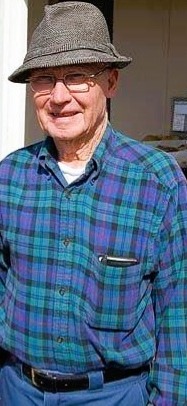
Jim Kriegh – Founder of the Town of Oro Valley and Co-founder of the Oro Valley Historical Society (1928 – 2007)

Meteorite-Display-Top-Shelf-Close-Up
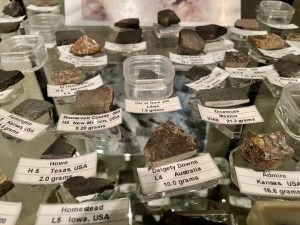
A Sample of Jim Kriegh’s Meteorites Displayed at the Pusch House Museum
Meteorites are pieces of other bodies in our solar system that make it to the ground when a meteor or “shooting star” flashes through our atmosphere at speeds of 15 to 70 kilometers per second (roughly 32,000 to 150,000 miles per hour).
Meteorites are about 4.56 billion years old, formed when the first solids took shape in our young solar system. Most originated as asteroids in the Main Belt, the region between Mars and Jupiter. In recent years, scientists have even identified meteorites that came from Mars and the Moon. Meteorites come in many varieties, from iron to stone and fascinating types in between.
Meteorites are usually named after a town or a large geographic landmark closest to the fall or the find. Meteorites that are found after a meteoric event has been witnessed are called a fall, while those found by chance are called a find.
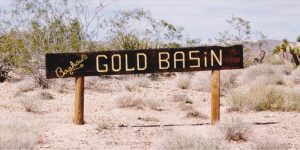
Bashaw’s Gold Basin Sign – No longer standing
In 1995, while looking for gold through metal detecting, Jim Kriegh discovered a huge meteorite field in Gold Basin, Arizona (Mohave County).
Jim took fragment samples to the University of Arizona’s Lunar and Planetary Laboratory. Dr. David Kring identified them as L4 chondritic meteorites. Later studies showed the fragments to be classified as L4-5-6. David asked if Jim would volunteer to map the area in secret so that the field would remain undisturbed by other hunters. This Gold Basin project remained secret for two years!
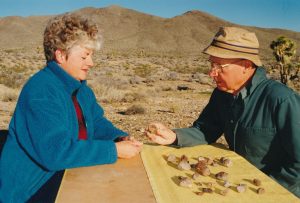
Twink Monrad and Jim Kriegh Examining Meteorites.
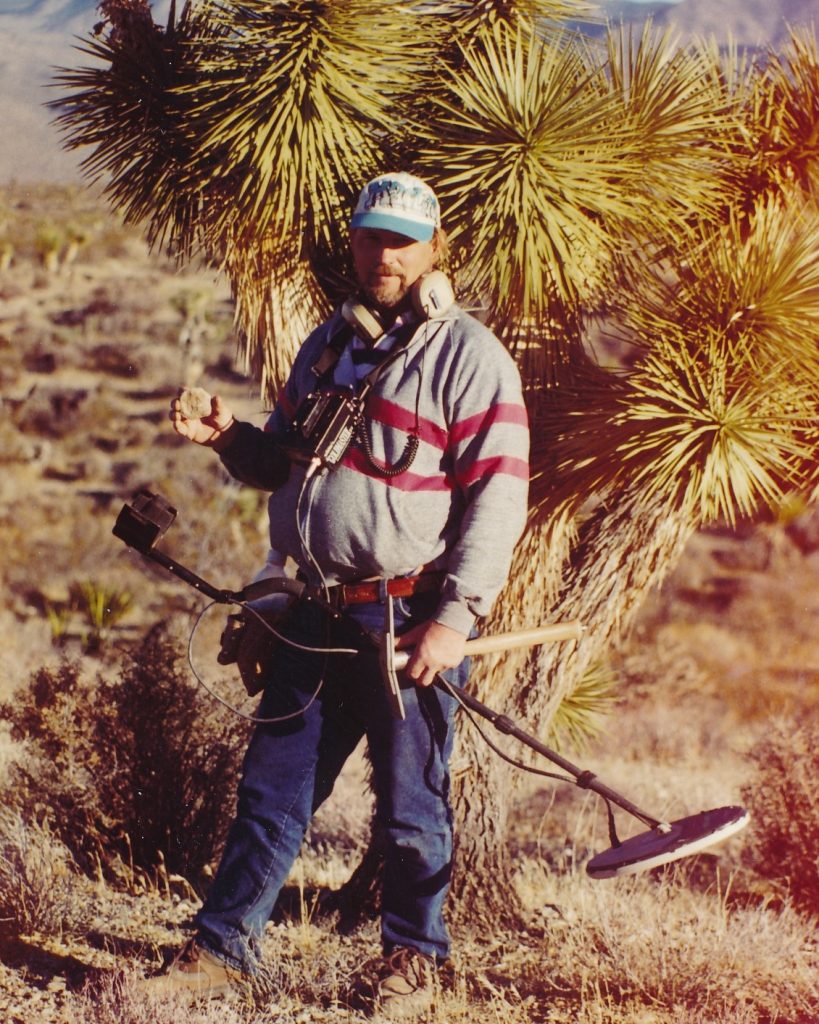
John Blennert, Ready to Dig with his Detector, Pick with Magnet Attached, and his Leather Pouch.
In field studies of the Gold Basin area, a team including Jim Kriegh, John Blennert and Twink Monrad recovered more than 2,000 meteorites, and they weighed, and labeled each one! These meteorites fell to the earth as long as 15,000 years ago and are 4.5 billion years in age. Tests show that the parent body was an asteroid at least the size of a car that exploded over the Gold Basin area about 15,000 years ago, near the end of the Ice Age. Many fragments rested on the surface, but most were buried beneath the desert floor.
Some of the meteorites went to the Smithsonian, others were kept by the University of Arizona to study, and the majority were returned to the team of three.
Jim’s discovery was announced in 1998 at the Tucson Gem and Mineral Show. Jim became a celebrity as everyone (authors, dealers, scientists, collectors, and rock hunters) wanted to meet him and trade for Gold Basin meteorites. Jim did trade some of his meteorites for ones from around the world and accumulated a large collection. He set aside some of his collection and donated it to the Oro Valley Historical Society.
There are numerous shows happening throughout Tucson. Find more information at these sites:
Tucson Gem, Mineral & Fossil Showcase (city-wide) – January 27 – February 14, 2027
The Tucson Gem and Mineral Society hosts their 72nd Annual show February 11 – 14, 2027
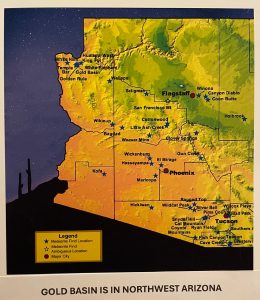
Gold Basin Map of Northwest Arizona
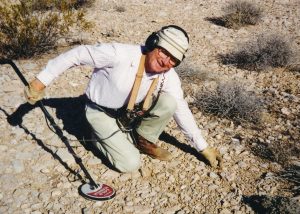
Jim Kriegh Doing What He Loved! Photo taken by O. Richard Norton
Photo Credit: Jim’s photo was taken by O. Richard Norton, a close friend of Jim’s and former director of the Flandreau Planetarium at the University of Arizona. O. Richard Norton also wrote Rocks from Space which can be ordered through Amazon.
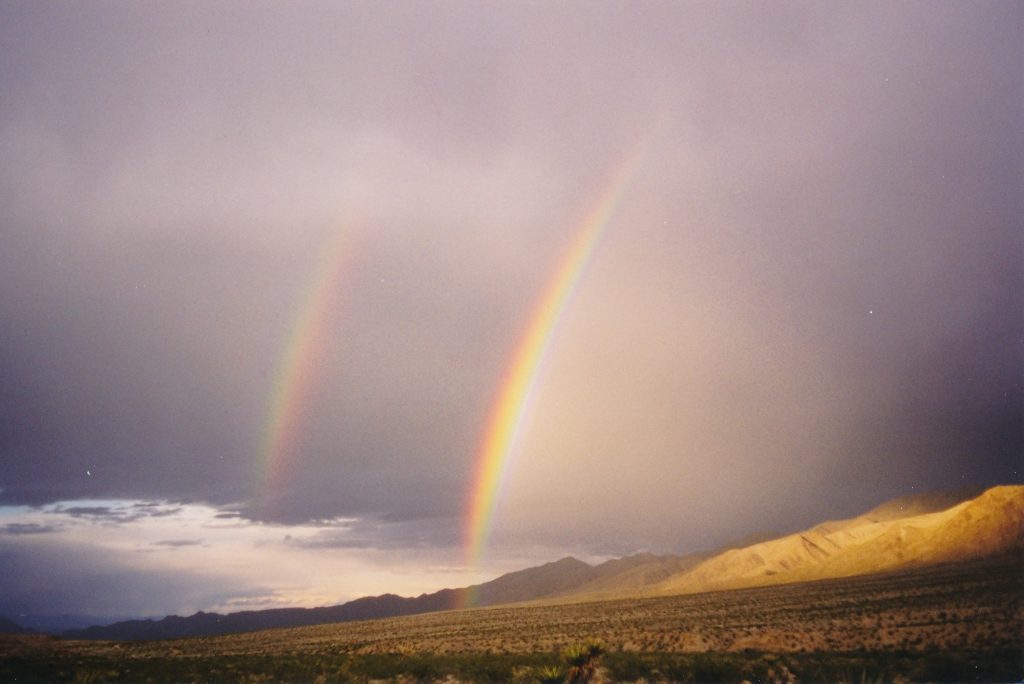
The Team Followed a Double-Rainbow and Found Gold…Gold Basin, that is!
Bob Holmes: We are privileged to be here today in Oro Valley, Arizona, just north of Tucson with the original finders of the Gold Basin strewn field.
Jim Kriegh: I first became interested in meteorites when I listened to Dr. David Kring from the University of Arizona Lunar Planetary Lab discuss meteorites at a gold club meeting which I was attending. It became quite apparent after listening to him that I may be able to hear meteorites with the metal detector that I was using to find gold. So, I started paying attention to the hot rocks, rocks that we often found and threw away. But I started saving these rocks and looking at them a little longer. The first meteorite that I found was actually one I found down in Greaterville when I was looking for gold that was identified by Robert Haag. And upon cutting it and seeing the metal inside, I had some idea what to look for. So later on, John Blennert and I were up with a friend in Gold Basin, Arizona, which is northwest of Kingman. I started saving the hot rocks. In cutting these Gold Basin rocks and seeing two of them were potential meteorites, David Kring said, “Yes, they are.” And we started wondering if there were two, if there were more. So, John and I headed back up to the Gold Basin area and started looking again for gold and meteorites. And we kept finding a few, not too many, but as we moved in one direction, which was east of where we were, we started running into a lot of the meteorite rocks, and we learned to start recognizing those rocks.
John Blennert: We stumbled on the realization that people were complaining about the pesky hot rocks up there. And that was why the area was not so much favored for hunting nuggets. And as we started hunting around, we’d find a little group of potholes. And it was kind of interesting to find all these meteorites stuck down in the holes or up on the lips, or we started finding that they dig them out of the holes and drop them into the nearby bushes. And it was kind of a little gold mine for Jim and I and Twink. Finding these things in other people’s detector digs was pretty cute.
Jim Kriegh: After John and I went back and discovered yes, there were more meteorites, Twink Monrad joined us and we started looking for the meteorites and trying to do what David Kring explained to us that he wanted us to do to try to map the potential strewn field that existed from these Gold Basin meteorites. So, we started keeping track of the location. We measured how deep we were finding them and just in general expanding the area, advancing the area until we had learned that this meteorite strewn field was over something like 15 miles long and 5 miles wide. And today we know it’s bigger than that. It’s a lot larger than that. But we will never determine just exactly what the boundaries are because of geological restraints.
Twink Monrad: After Jim and John ascertained that there was a Gold Basin meteorite field, I was invited to start going along with them and help map the field for the University of Arizona. Unfortunately, I was brand new at metal detecting. After I got fairly good at finding the Gold Basin meteorites, I was actually lucky enough to find two different meteorites in the strewn field. The first one was the Golden Rule, which was an L5. And then I discovered another meteorite which was named Golden Mile, and it’s an H4.
Jim Kriegh: I’m going to look at some of my notes that I took and made when we were actually finding the meteorites. And I noticed on my eighth trip that I had found 129 pieces that totaled 6,430 grams. And then a few times later I’d found 140 pieces. They totaled 3,369 grams. So, as we expanded the field, we ran into areas where the meteorites were obviously just scattered all over the given area. And that we were finding a lot of the meteorites. Another one where I found 79 pieces, but they only weighed 2,224 grams. This tells you that they were varying in size. We could find some large ones that would add up the total weight, or we could find a lot of relatively small ones.
John Blennert: After the announcement of the strewn field, we had many multiple hunts up there where we got to meet a lot of different gold prospectors and meteorite hunters. Got to expand out, and I know I tried to maintain a map for Jim for all the finds I had when I was up there with all the different hunters. It was kind of interesting trying to weigh these things and get everybody to cough up locations because some of these guys get pretty secretive about what they were finding and where they were finding it. But we continued to log them for quite a while and try to compile the map, which is what David wanted. Got to meet some really, really interesting people all over the place. As time went on, we continued to expand the field. I like to jump out a pretty good distance and just see if I could bang out a half mile or a mile or quarter mile sometimes, sometimes even more just to see where these things were at. It was kind of fun. Every once in a while, you hit a void and I come back thinking, man, that’s the end of the field. But just press on a little farther and you get back into them again. It seemed like there were little hot spots and little voids pretty much the whole thing. I get bored hanging in the same spot too long. I just kind of like the thrill of the hunt.
Twink Monrad: After a time, we realized that many of the Gold Basin meteorites were fragmented and could be pieced together as a puzzle. Here’s an example of one of our probably 500-gram meteorites which was found in 10 or 12 pieces, and we glued it together.
Jim Kriegh: You know, I just look and think back to the last few years how lucky we’ve been to find this new meteorite strewn field and as a result of all the people that we’ve met and how nice it’s been to become associated and meet so many people. I sure think these things are butt ugly. But, after a while, the nuggets were getting in the way of my meteorite hunt.
Twink Monrad: Another aspect of this has been watching so many of our people we’ve met find their first meteorites. Each of us found our first meteorite there, and even the scientist at the U of A working with us found his first meteorite with us.
Twink Monrad: At the end of all of this, he [referring to Larry Lebofsky can answer technical questions. I just know how to find rocks.
Off-screen Larry Lebofsky: I will do my best to answer your questions.
Twink Monrad: Okay. Jim Kriegh, as you may know, and I’m going to be reading the intro because this actually happened 30 years ago this Thanksgiving. And I’m not getting any younger, so I’m going to be reading. But I did write it the other day. Jim Kriegh, as you may know, was the father of our town of Oro Valley. He thought of the idea to annex or to incorporate. After retirement as a professor of civil engineering at the University of Arizona, he started the hobby of metal detecting for treasure.
In 1995, he discovered a huge meteorite strewn field. And I will tell you how all this happened. Starting in the early 90s, I began going rock hunting and metal detecting with Jim Kriegh and his friend John Blennert. We had previously joined the Desert Gold Diggers Gold Club. During the September 1995 meeting, a scientist from the U of A Lunar Planetary Lab was the speaker, Dr. David Kring. He said that while we were all out looking for gold with our metal detectors, we should be looking for meteorites. And he brought a few to show us. In November that year, Thanksgiving actually, ’95, John, Jim, and Christy, Jim’s dog, went to a place called Gold Basin, where the gold club had several mining claims for all the members to use.
While there, Jim noticed some brown rocks, which sounded like gold, but were not gold. Remembering David’s talk, he brought some of these rocks home and took them to show David Kring at the U of A. David said, “Those are meteorites. Are there anymore?” And Jim said, “Well, I think they’re all over the place.” And David said, “Well, if that’s true, that will really be exciting.” So, Jim and John and Christy went back up to get some more to show David that there were more.
After that, David asked if they would volunteer to map the strewn field as volunteers for two years in secret. Jim and John said yes and asked if a third person could join them. So, I became part of the team. We were told not to tell anyone about this discovery, as they wanted a map drawn of the field and the finds where they were lying. Naturally, they didn’t want the field disturbed by the dozens of meteorite hunters that would show up after this was announced to the public. We agreed, and the adventure began.
Jim bought a large RV for this project so that we could all stay a week at a time for two years. We went up once a month for the two years. We completed the two years, and at the end of the time we had mapped the field 6 miles by 12 miles. I have Jim’s hand-drawn map on the table behind us with some other meteorites if you get a chance to look at it later.
This was before cell phones. People had Garmins, but nobody had cell phones. So each night, on a topo map, being a civil engineer, he would mark where we found the things. But there became so many that he had to devise a system of numbering them and making circles with numbers so that the U of A would know where every single piece came from, as I’ll show you when we look at the pictures pretty soon.
Since that time, other hunters have mapped a larger area. David Kring always said there should be basketball-sized meteorites somewhere in the lake or across the lake. And just about eight or nine years ago, some meteorite hunters went from Mesquite, Nevada, down south and found basketball-sized meteorites on the other side of the lake. So, think how many are in the lake. In fact, if you think about meteorites falling all over the world all the time, most of them go in the ocean, I would think, mathematically speaking.
University studies showed that this asteroid was the size of a car and it exploded above the Earth, showering the area with pieces of all sizes. We found that at least 65% were buried. So we had to dig many out of the ground. We had heavy handpicks with a strong magnet attached. When we heard a noise underground, we would dig with our picks, and the meteorite would jump onto the magnet. I have my pick and my magnet back there with the meteorite on it, so you can see how that worked.
A test showed that the meteorite fell 15,000 years ago at the end of the Ice Age. I would love to talk to a geologist sometime as to why they’re sitting there, what happened during the Ice Age. That’s all very fascinating too. I have not made that study yet. Meteorites are always named after areas on a map or a geographical thing. So, this was named Gold Basin. It’s in northwest Arizona.
In February 1998, during the gem show, the U of A announced this discovery to the public, and all of the meteorite dealers, hunters, authors of books, scientists, and collectors wanted to meet Jim Kriegh. They were all here for the gem show from all around the world. Who knew there was a meteorite underworld that I had never ever heard about? That’s why when they asked us not to tell anybody about the find, we looked at each other and said, “Who are we going to tell anyway? Who would care?” That was interesting.
They were here, and they all wanted to trade their meteorites, the dealers, for the Gold Basins that we had because they had none. So, all three of us gained large collections that very first year. Later, when it was announced, those who were hunters wanted to join us in the field. And so, for many years after that, we had further adventures showing folks how to hunt Gold Basin. And we had lots of good times doing that.
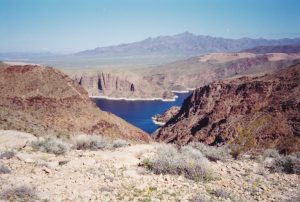
Beautiful Blue Office View at Gold Basin!
Since Jim Kriegh’s death in 2007, I remain in contact with the meteorite world via the internet. We also get to see each other in person at the Tucson Gem Show each year. I have a collection of color photos to show you from my photo album, which I hope you will enjoy. Since this is about the whole adventure, you will not only see meteorites but also the beautiful scenery at Gold Basin, which is a high desert plateau in a Joshua tree forest. Since I’m from the Sonoran Desert all my life, I had never seen a Joshua tree forest. It’s absolutely beautiful.
When I’m through with all these pictures and an 8-minute video you’ll see after the pictures, Larry Lebofsky will answer questions.
This is a photo taken by a professional photographer of two Gold Basin meteorites and one of the prettiest gold-on-quartz pieces that Jim and I found when we were up at Gold Basin. The gold piece is about an inch and a half high. It really looks like the gold is dripping down the sides when you look at it up close.
Bashaw’s Gold Basin Sign
This is where you enter Gold Basin. The sign was there 30 years ago, and I know just over the 15 years or 20 that I kept going there, it has fallen down and disappeared. Gold Basin, if you’re going from Kingman to Las Vegas, that’s Highway 93. Not too far past Kingman, you see a sign that says Pierce Ferry Road. If you turn right on Pierce Ferry Road, it takes you to Greg’s Hideout Road. Turn left on Greg’s Hideout Road, and the meteorite field is on both sides of Greg’s Hideout Road all the way to the lake.
I looked up Greg’s Hideout the other day. A man named Tom Greg had a ferry on the Colorado River in the early 1900s. Why they call it his hideout, I don’t know.
On the first trip that I went on with them, they took a generator and a rock saw because they wanted to pick up any rock that sounded like a meteorite and cut it open to make sure we knew exactly what to look for and listen for, so we weren’t picking up things that were not needed.
There’s Christy, Jim’s favorite wonderful dog. And of course, I made her a nice scarf to wear. Christy. This was a typical find. You might come back to the truck with a few meteorites and a couple pieces of gold. Especially John Blennert, he was a well-known gold hunter in the state. He found more gold than the rest of us put together. That one piece of gold with a hole in it, he actually ended up giving me. I still have that.
This was the initial campsite, and we worked out of there for a long time. There are some creosote bushes and some chollas, but other than that, I’ll show you later the cactus that is…
Twink Monrad: This was a Joshua tree near the campsite. So pretty.
Okay, this is David Kring in the center. He was our scientist. He would come up to visit us a couple of times a year to see how the project was going and stay with us. So, it was fun because he would take us out at night. I can’t remember, Larry, the comet that was going by in the late 90s had a Japanese name and it was two words. But anyway, he’d go out and show us things in the sky that we didn’t know about ourselves. That was nice.
Every evening, John and Jim would weigh every meteorite that we found each day, write it down, put it in a bag, and make a notation of where it was found because that’s what the university wanted us to do. That beautiful scale I just recently gave to Jim Kriegh. So, he has it—Kevin Kriegh has it.
Jim Kriegh Doing What He Loved!
Photo taken by O. Richard Norton
A typical evening, we would have more than this—this is just one group out of one bag, probably weighing them. There’s John Blennert writing and making his notes on the ones he’s weighing. A picture of Jim out in the field: you can see between his fingers, with his left glove, there’s a little brown meteorite. They show up better in pictures than in real life, so you really need a metal detector because they’re not that obvious, which I learned after taking pictures. For some reason, they just stand out more with an old-fashioned camera. These were before cell phones, don’t forget.
And there is Christy. We never knew if she was looking for meteorites or just wandering around. She’d run after jackrabbits, that’s about it. I always kept the table looking nice with the meteorite and flowers. There I am, ready to go find some.
And John Blennert—you can see the Joshua trees. You had to be careful not to walk into them. With your hat on, you might get stabbed in the eye. So, you had to be really careful because you wanted to look at the base of all the trees too with your detector.
Okay, John and Christy. You can see the Joshua trees and the dirt roads. We did the mapping of an area each day, walking around. Over the two years, we repeated the same roads and walks and found them every time. That just shows you how easy it is to miss things when you’re actually looking.
I guess that would be me 30 years ago and Jim Kriegh. You can see some of the ground. Some of it was dirt, and a lot of it was desert pavement, just full of rocks.
Now, this is an example I just looked—colored. There it is. Now, the sun is on it, so even the camera didn’t catch the rest, but not much, as you can see. But they sure sound off like gold, as Jim said, with a metal detector. Pieces we found after the two years were given to study, some of them 5 inches in diameter.
This is an example of a nice one. We found the other piece on the left 10 or 20 feet away. So, tell me, how does that happen?
A gal found her first meteorite. She has a nice smile. In fact, this is Suzanne Morrison, who has a business—Raining Rocks. If you ever want to see her shop, she’s actually moved to an old house right now, but Raining Rocks is on the internet. She’ll be open during the gem show and by appointment now.
For about 10 years, a man from California would come to the gem show and hold a meteorite auction. Many of the dealers got their goods there to sell. People would bring in things they wanted to sell and buy, and it was a fun auction. Every year, I’d have Safeway or some store make a big cake, one of those huge ones. I showed a picture of Gold Basin. She decorated it with the Joshua trees. Then I came home and made chocolate truffles and put them on the cake because that’s what it looked like when we first started hunting before we picked them up.
Even now, sometimes people will come up and say, “I still have that meteorite I got in a cake.” That was a lot of fun.
Here’s a gorgeous picture of Lake Mead. Grand Canyon West—the acrylic bridge that they built out over the canyon—you can walk on it every week or two. They were getting built on and off for however long we were there.
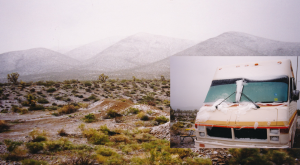
A Little Snow Wouldn’t Slow this Team Down!
In the 12 years we hunted there, it only snowed once. By 10:00, of course, it all melted, and everybody went out again. There were some other people staying up there, too. Here’s a gorgeous shot of the Joshua trees in one area near us. No roads or paths go through there, but it was so pretty.
This was that same snowy day. Must have been a rainy day or maybe after—well, no snow. Must have been a rainy day.
Now we’re starting into some of the flora up there. They have red fire barrels—those are red fire barrels that we don’t have down here. They grow up in that area. Most of the cactus you see up there has extra fur-like covering because it’s a high desert plateau, so they need to keep extra warm. Here’s a prickly pear that’s pretty in May. And here are more of the fuzzy ones.
The Joshua trees we discovered don’t bloom every year, but when they do, they’re gorgeous. That’s some kind of mounded barrel cactus. You see barrels that mound themselves, but this is an actual mounding barrel plant. We never quite knew what this was. It was out in the middle of nowhere. Must have been an old miner’s outhouse. Don’t have any idea. One of those old critters. John saw a couple that weren’t friendly, but I only saw this one.
Each of us was lucky enough to find meteorites in the Gold Basin field that were a different fall from Gold Basin. That’s what happens when you fine-tooth comb an area over and over. Apparently, this is one they named Golden Rule. A Golden Rule that I found—beautiful. You can tell how orangey-brown the Gold Basins were. This is darker, so that means this is a fresher fall. It turned black coming through space, right, Larry? So, it wasn’t a fresh fall, but it was much fresher than the Gold Basins. It was not corroded or oxidized like they were. So, I got that named after me…
Transcript of this interview is captured above on this page directly under to picture of the double rainbows
Twink Monrad: …gold “Golden Rule” for me in the books. There’s the inside of it.
And here’s that pretty gold quartz that you saw earlier. Jim and I were walking up a very narrow wash between two steep canyons just to get to the next area to hunt. He stopped and said, “Oh, I think I hear a really big meteorite.”
So, he said, “Here, why don’t you dig it?” I got out my pick and didn’t jump on the magnet. Well, that’s because it was a piece of gold. We kind of shared that, but he eventually gave it to me. I now have that gorgeous piece at my house. And as they say, off into the sunset.
Now I would like to show an 8-minute video. Lynn, can you help me do that?
Lynn Zoyiopoulos: Sure, I can try. Now I feel pressure!
Twink Monrad: This has sound to it, so I guess I’ll just sit and watch it with you. It’s from 2003 during the gem show. Somebody came to my backyard in Oro Valley and taped this.
Twink Monrad: (after the video ends): If you have any questions, Larry Lebofsky can probably answer them. If it’s technical about meteorites or anything else, let us know.
Audience member 1: Is there a crater associated with this?
Larry Lebofsky: There is no crater. The meteorite fell about 15,000 years ago. It is assumed there was an airburst, which created a long ellipse through the atmosphere. Larger fragments were found on the north side…
Larry Lebofsky:…The side of the lake is the fact that the meteorite probably came from the south toward the north. Smaller pieces fall first due to the atmosphere, and the bigger ones make it through better.
Audience member 1: During the video there, you were holding various specimens, and you said this is an H4 or an L5. What does that mean?
Larry Lebofsky So basically, there are these are all what are called ordinary chondrites for like 95% of all the meteorites that have fallen to the earth that we have collected are basically silicates. They’re rocky stony meteorites. That’s why they’re called ordinary. And a lot of them contain what are called chondrules which are melted spheres of material, more silicate material that melted at the very time that the solar system was formed. So, they’re called ordinary chondrites. All of them contain some amount of iron and L implies low iron and H implies higher amount of iron in the silicate material in the minerals.
Audience member 1: It’s like a saturation classification. How many of the chondrites or it’s the amount of metal?
Larry Lebofsky: Amount of metal. So has nothing to do with the chondrites. It’s a separate classification. So basically, L implies low iron and H implies higher iron. And the number has something to do with how much it’s been heated probably on the original body. Something like that’s like an L3 or H3 or whatever it is will have more distinctive chondrules in it where something at the five or six or seven will have been heated somewhere early on in its life and so you won’t see as distinctive or as many chondrules in it.
Audience member 2: So, when you’re using the metal detector, is it iron that it is detecting?
Larry Lebofsky: Okay. So, the H and the L have to do with the iron that’s actually incorporated as part of the minerals in the, you know, whether it’s pelagic clays or whatever it might be, olivine. If you look at the meteorites in the back and hold them, move them around, you will see little specks of iron and that’s iron nickel and those are the first things that condensed out of the solar system when the solar system, the nebula was condensing out to make the protoplanets and then the planets. Basically, the iron is the first stuff to have condensed out. And so, what you’re seeing is literally the first condensates, the raindrops, whatever you want to call them, when the solar system formed about 4.567 billion years ago, give or take a few million years.
Audience member 3: You said it dispersed about 15,000 years ago, but what would the age of the actual piece have been in the solar system?
Larry Lebofsky: Okay. So, the ordinary chondrites formed into the original asteroids in the asteroid belt 4.5667 billion years ago, give or take a million years. I think the age of the actual breaking of the asteroid into pieces from Gold Basin is I think 15 million years ago. I think, don’t quote me, don’t go writing this up or anything, but probably about 15 million years ago. So, for a long period of time there was a smaller asteroid wandering around the asteroid belt that eventually became a near-earth asteroid and eventually 15,000 years ago ran into the earth or the earth ran into it depending on who was going faster and what direction they were going.
Audience member 4: The smaller that are, say, you know, the size of a basketball–
Larry Lebofsky: That’s not a small one, but yes?
Audience member 4: Are they, well you hear on TV, about you know, “it’s the size of a school bus or Volkswagen” and it might fit, it might not, but those smaller than a Volkswagen, are those tracked?
Larry Lebofsky: Better now than they used to be. Yes, so there are a lot of people who are monitoring. You just go out and see a fall occurring, so a fireball, whatever it might be, and so they start coordinating the visual observations. But also, there are people who have developed programs to use weather radar, and so you can track these things with weather radar, and yes, you can track them back to the main, primarily the main belt asteroids.
Audience member 5: Two questions. One, you indicated that this particular meteor–
Larry Lebofsky: –Meteorite if that’s on the ground. Asteroid in space or meteoroid in space, meteor in the atmosphere, which is the glow of light, and meteorite on the ground.
Audience member 5: Well, when it was a meteor and it exploded.
Larry Lebofsky: Correct.
Audience member 5: What would cause it to explode?
Larry Lebofsky: Have you ever done a belly flop?
Audience member 5: Yes.
Larry Lebofsky: Okay. So, you have something that’s going 40–50 kilometers a second, which is probably faster than you drive on I-10 by a little bit. It basically hits the atmosphere and there’s a lot of atmospheric pressure. And in fact, the glow you see, and I got this wrong for 30 years, the glow you see of a shooting star or whatever it might be is bow shock. It’s this thing coming through the Earth’s atmosphere really, really, really, fast and you heat up the air because it can’t get out of the way, and that pressure is very, very large, and it’s that what basically breaks the thing up.
Audience member 5: Last November, I was out in our backyard, and I happened to see a shooting star. I was very fortunate to see it split into two. One kind of curled off and the other one kind of went, it didn’t take the straight line, it kind of angled off, right? I thought, “Wow.” Of all these meteorites that have been found, have there been any elements that we don’t know what they are? Are they all iron?
Larry Lebofsky: They are the elements are the same elements that we have here. There are some rare or unique minerals that you will find in these things simply because, like, you know, you don’t — the iron nickel in the back there, yes, you would find that on the earth if you had a drill that you can go down to the core of the earth. So there are minerals in the meteorites that you don’t see on earth, but all it’s the same elements because the earth is made out of them.
Audience member 5: Gotcha. Well, I guess we can make that assumption that all the planets are made out of them. And yes, if you found something that we didn’t know about, then perhaps there’s a planet out there that we don’t know.
Larry Lebofsky: Well, I think I mean, we’ve been studying the Earth. We’ve been studying planets around other stars there, and we think we know how–again, you’re getting out of my field of expertise of how the elements were formed. And so, it is unlikely that you would end up finding any new elements in any of these things because any of the really, really heavy elements are probably radioactive and would decay into something else very quickly. But don’t, again, don’t quote me on that one.
Audience member 6: You made a very interesting comment that those samples that you found went to the Smithsonian. What made the samples that went to the Smithsonian different than the ones you had?
Twink Monrad: When the field was first discovered, the university told us that the Smithsonian somehow needs to obtain samples of all the meteorites that are found at that time. That’s what we were told. And so, they sent them a whole shoebox full. And one Jim found like the size of a big baked potato that, you know, he hated to send it. I mean it wasn’t ours. It was the U of A’s that they were maybe going to give back to us, but we didn’t know that. But so, we found out later that none of these have actually been on display at the Smithsonian because I know it’s a big deal to change a museum display. And then also we had to get permission to hunt near the lake because it’s called the Lake Mead National Recreation.
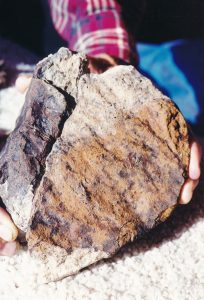
Large Meteorite at Gold Basin
Twink Monrad: –Area and you cannot take guns or detectors or pick up anything from the recreation area. So, the Smithsonian gave us permission to hunt on the recreation area. And again, why the Smithsonian? We were never told. That’s just what was said.
Larry Lebofsky: It’s basically, basically the policy is that if it falls on your land, you own it. If it falls on public land or government land, it belongs to the government. So, they have the first rights to it. And then as she says, you have to have permission to hunt in certain areas. So yes, you couldn’t go out on Lake Mead and start dredging. I think it would be frowned upon very quickly. Yeah.
Audience member 1: You were saying that the H & L is like high iron and low iron. Are there meteorites that are like all iron and hardly any nickel?
Larry Lebofsky: In general, wherever you find iron, you will find nickel with it. I think there are some rare meteorites that are really, really high in nickel or really, really high in iron, but that’s getting out of my knowledge base. So, but yes. And then, of course, you do find meteorites that don’t have bits of iron in them. They are not attracted to a magnet like the ones in the pack. And let me clarify something I usually do when I go out to classrooms or various places.
The meteorites are not magnetic. They are attracted to a magnet. So, in other words, if you take a magnet and put it against it, it will stick. As I say to little kids when they’re holding an iron meteorite, which is really heavy, if you put this on your parents’ refrigerator to hold up their shopping list, you will break your toe when it falls on your toe. So, be careful with this. But yes.
Twink Monrad: I wanted to add something about the government land. The Gold Basin field was discovered on BLM land. It is legal to pick up rocks and meteorites and gold on BLM land. And luckily that’s where this was found. Part of the land up there was private. It was railroad land and a couple of private. So, Jim, with his topo map and his civil engineering background, we knew where we could go and where we couldn’t. And we had permission though to camp on the recreation area. That’s where you saw our RV most of the time because of the Smithsonian’s permission to do that too.
Larry Lebofsky: No questions from this side? Is it only on this side of the room? Yeah. Thank you.
Audience member 2: You have a slice of your meteorite of your necklace right there?
Twink Monrad: Yes.
Audience member 2: If we had a magnet, would it—
Twink Monrad: Yes. Yeah, even a refrigerator magnet, a piece this big, it’ll stick to it. Yes.
Larry Lebofsky: Any other questions? Any other answers? Yes.
Audience member 3: Almost all meteorites that have been discovered on Earth, have they all dated back to 4.6–4.5 billion years old?
Larry Lebofsky: There are—I’m actually writing up a brochure about that right now—is that the meteorites that come from the asteroid belt, so from the asteroids, are pretty much 4.5667 billion years old, give or take a little bit. I think the uncertainty is like a million years or so.
Now, there are meteorites that are younger than that, and those are from objects that were big enough for the iron to go to the core because it’s heavy, right? You know, gravity takes the denser stuff, and it goes to the core, and then you end up with a crustal surface that’s a basalt or something like that. Those can be anywhere from about 4 billion years old down to 2 billion years, or I think 200 million at the youngest. And all of those are from either the Moon or Mars.
Audience member 3: So, it’s based on content though to estimate how old it is?
Larry Lebofsky: That is correct. Yeah. I mean you can radioactively date the minerals in there and that’s what you get. But yeah, so basically—and those are ones that have no flakes of iron in them because all the iron has gone to the core.
Twink Monrad: I know that the 15,000 years the U of A came up with for the Gold Basin fall was done with the beryllium test, whatever that is.
Larry Lebofsky: Yes. So radioactive decay of beryllium into something or from something to beryllium, I’m not sure. But yes, it was not carbon. They said it’s not. Yes. Not carbon is only good for trees and other good things like that. You have to use uranium, thorium, or something on that order for the really old stuff.
Audience member 4: I have this image of you slowly walking for eight hours. How much time did you spend every day, you know, just waiting?
Twink Monrad: Well, yes, we went out by—we even went in the winter when it was so cold that you had to turn the volume in your earphones up all the way just to hear something your detector might hear. So, I found out I was a lot stronger than I thought I was because I wanted to keep up with the guys. We would go out after we’d eat breakfast at 6:00 or so and get out by 7:00, or in the winter whenever it was light, or in the summer earlier, and hunt till noon. Come back to the RV and actually fix lunch and then go out in the afternoon till 4:00–4:30, and then come back and everybody kind of take showers and cook dinner.
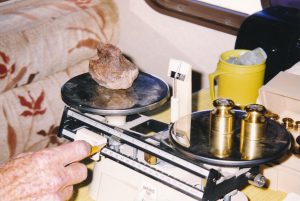
All in a Day’s Work – Weighing a Meteorite.
And then in the evening you saw what we did with the weighing and making the map and everything. So yes, we did. If I would get tired, you know, I’d just sit down and lean against a Joshua tree for a while and then get up again. And I’m not quite sure what the guys did, but I did need to rest once in a while. But yeah, we were out—you know, when you were out with the car, you just made the most of your time, and it was fun. It was just a lot of fun.
Audience member 4: I’m just curious, that’s a hobby, the metal detector. How much is that?
Twink Monrad: How much do they cost? Well, you can get an inexpensive one for $250, but they won’t hear gold or meteorites really unless it’s an iron meteorite. Anything will hear an iron meteorite in any cheap one. But now they’re coming out with more sophisticated computerized ones. The ones you saw us use, we had to manually turn the knobs to ground balance them every time we went out and kind of change it if the land changed. So we got good at that. But the ones now—I just got—and those were about $500 30 years ago. But about 10 years ago I got one of the new computerized lightweight ones. It only weighs 2½ pounds. These were heavy that we were carrying, 2–2½ pounds, and I paid $1,700, but now they have more going for $2,000, $3,000, $4,000, $5,000.
And people are finding gold, and not that you need to pay off your detector, but like I have a very expensive serger and sewing machine, so I can appreciate the ones that want to spend a lot of money on a detector because guys that do that, they’ll go out and do that every day in the parks. We find a lot of jewelry and coins in parks and playgrounds, plus the ones that just do gold hunting. So anywhere from $200 to $10,000, and you can go online and just read about all of them. They’re all for sale online.
Audience member 5: Is our planet hit by meteorites all the time?
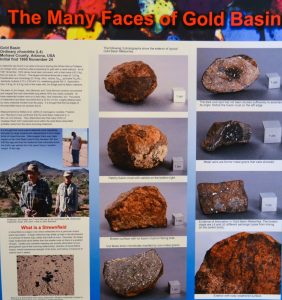
Designed by Maria Schuchardt and written by Dolores Hill (Lunar and Planetary Laboratory University of Arizona).
Larry Lebofsky: Our planet is hit by— Well, the meteorites do not care where they land. They basically land all over the place. And there are tons of meteorites that fall every day of various sizes. We don’t see all of them simply because they fall in remote areas or over the oceans or wherever it might be. But yes, they continually fall, and the only reason you find them in certain areas is because they’re not in the middle of a jungle or in the ocean or inaccessible locations. But you can find them just about anywhere.
Twink Monrad: I guess we all have our fish stories or whatever stories. I have one more meteorite story. A gal who was over here from England—this was before COVID—she wanted to come and do some meteorite hunting. So, another hunter and I took her up to Holbrook, and she found one. Holbrook had a fall in 1912—that’s really interesting, whole other story.
So, she came back to Tucson after the Holbrook hunt. She said, “Well, I’d like to do some more meteorite hunting.” And I said, “Well, there’s a meteorite that fell by Cat Mountain out on the west side of the road.” And nope, there’s only been one Cat Mountain basically found, and people keep looking for more Cat Mountain. We could go out there, but I said everybody and their brother comes for the gem show, and everybody goes to Cat Mountain, and nobody ever finds it. So we probably won’t find any—but we’ll go. So, I took her, and another man named Frederick was with us. And within–
Twink Monrad: –15 minutes I was in a little wash. I saw what looked like a meteorite. And that day we were just using a magnet on a stick because she didn’t have a detector, and I didn’t want to make a big deal out of it. We just wanted to go look. Okay.
I touched my magnet to it and it stuck. Well, that doesn’t mean it’s a meteorite. But I picked it up and looked at it, and I knew it was a meteorite. So I set it back down in a little indentation, and she took pictures. So it was all documented. So, I actually got credit for finding a third meteorite, and they named it Golden Gate Mountain because I thought they were in the view of Golden Gate Mountain. So, all my meteorites have the word gold in them. And that was just amazing that I found it. But the U of A classified it, and it’s a meteorite. But we only found one, and of course we’ve been back and have not found any more. So, it may have just washed down the wash. I don’t know.
Audience member 1: It’s a hobby, and if you want to do it, where can we go to verify that it is?
Larry Lebofsky: Oh, that is a hard question to answer these days, right?
Twink Monrad: The question: how—where did you get your meteorite classified if you think you have a meteorite? And it is difficult now because maybe you saw the meteorite TV show series called Meteorite Men. It’s still on YouTube if you want to see any of them. And one of them is about Gold Basin. It was after Jim died, and I got to go up and watch them film it and answer some questions for them.
So after—it’s one of those reality shows. It was real, but during the show they say, “Wow, this one could be worth $10,000.” And they went on and on during the show like that. And so people started mailing or bringing rocks to the universities all over the country, and wherever else you would take them—all over the world, I suppose.
And they were inundated with people. And I didn’t mind [inaudible]—I loved it—but the universities, you know, are busy, and that costs a lot of money to actually get out all that equipment and test it. So, plus the people would say, “I want it back.” Well, they would mail it to them, and it’s not a meteorite. Well, the U of A is not going to mail all this stuff back to people. So basically, if you call the U of A now—and maybe other schools—it says, “And we do not classify meteorites.”
Now, if you know somebody—well, like me, for instance, or Larry, or anybody that can say, “Yeah, that’s probably a meteorite”—we would call the U of A and tell the people we know, we think a meteorite’s coming in, will you look at it? And they will. But unfortunately, that’s what happened.
Larry Lebofsky: Yeah. But it’s actually even worse than that. One of the people at the University of Arizona was threatened with bodily harm because he basically said, “Yes, I had a meteorite. I gave it to you, and you gave me back an ordinary rock. You stole my meteorite from me.” And that basically shut down the U of A, in general, from doing, you know, random “bring in a meteorite for me.”
I think, if I’m not mistaken, Dave Kring told me that he saw something like a thousand rocks that people brought in before Gold Basin was brought in, and it was the first meteorite that was confirmed. But he saw literally a thousand rocks that looked like meteorites but weren’t before he actually confirmed that it was a meteorite.
Twink Monrad: Okay. I promise this is my last story, but it’s kind of funny. Whenever somebody would call Jim Kriegh up and say they found a meteorite, he would invite them over—and you saw how nice and patient he was, a nice man—bring it over, and he would talk to them, tell them why it wasn’t, give them a real one, and send them on their way.
Well, he would always call me—I was just three houses away. And so one day he said, “Someone wants to…” So I came down—I went over to Jim’s house. And first I need to preface this: there was a meteorite that landed on a car in Peekskill, New York. It landed on a red car—just to give you the… to ruin the story. Okay.
So the man showed Jim a rock, and it was a black rock, like it had some red jasper on it, and it was black. And so on the way out, I was walking home, and I walked out with the man, and I said, “So what made you think this was a meteorite?” Really nice—I said it nicely.
And he said, “Well, on the internet there’s a black rock with a red streak on it, and this looks just like it.” So, he had seen the Peekskill rock with the red streak on it—a picture of it. So that was kind of funny. I said, “Well, I guess you did well then by checking it out.”
Larry Lebofsky: Any other questions? Well, I guess I’ll let you say thank you—and thank you very much. Good questions and good answers.