From Pusch to Procter/Leiber — Discover the Next Chapter at Steam Pump Ranch
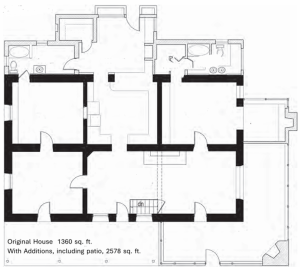
Floor plan of Pusch house (dark lines) and additions by Procter and Leiber families.
1940: Betty and Hank moved into the Pusch Ranch House, where they later updated the bathrooms, expanded the kitchen, and enclosed the porch.
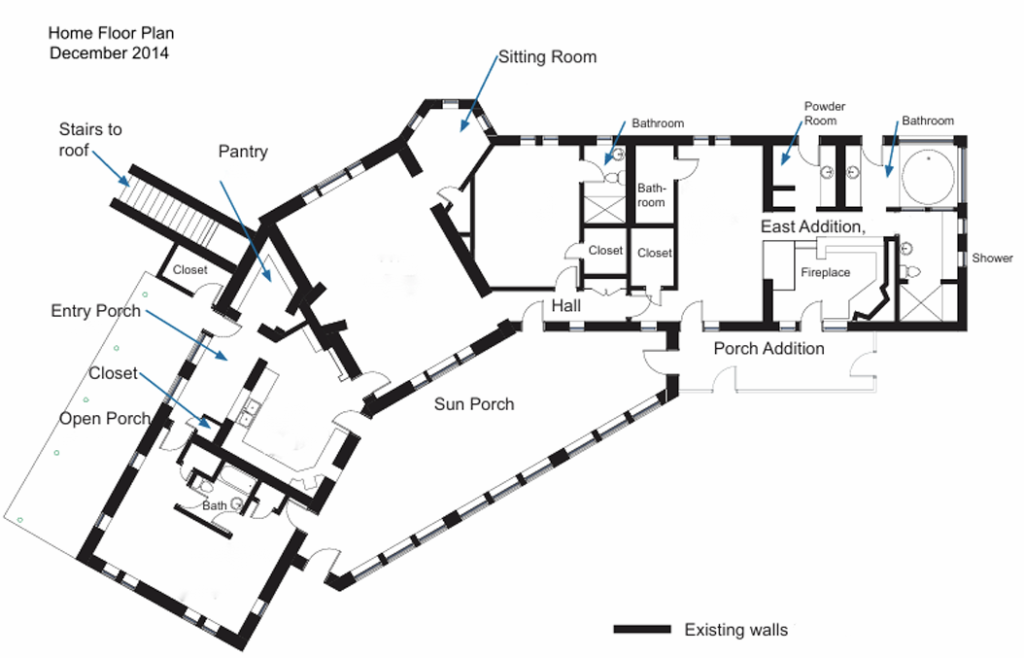
Floor Plan of Procter-Leiber House with additions done by John and Cheryl Leiber.
The Procter-Leiber House is one of Steam Pump Ranch’s most distinctive historic structures—a Spanish Colonial / Mission Revival home built by Jack Procter for his family in the late 1930s and early 1940s. The original design featured a single angled wing, stained concrete floors, and a flat roof with stair access, as described in the historic record: “stained concrete floors, and a flat roof with stair access.”
After Jack’s passing in 1972, his son John and daughter‑in‑law Cheryl moved into the house and undertook a significant remodel. Their work reshaped the home for modern living and professional use. During this renovation, they added the second angled wing, along with:
These additions complemented the earlier second‑story library noted in the historic documentation.
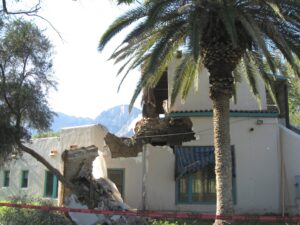
Procter-Leiber House Second Story Collapse 2008
When the Town of Oro Valley acquired Steam Pump Ranch in 2007, the Procter‑Leiber House had already undergone decades of change. After the Leiber family moved out, a severe monsoon storm in 2008 caused part of the second‑story addition to collapse. Emergency stabilization removed the remaining non‑historic second story and reinforced the original first‑floor walls.
Today, the Procter‑Leiber House remains the only historic building at Steam Pump Ranch that has not yet been restored. As the record notes, “It has taken almost 24 years to complete the restoration of all the historic buildings, except the Procter‑Leiber house.”
Future restoration work is planned so visitors can once again step inside this remarkable home and experience the layered history of the Procter and Leiber families.
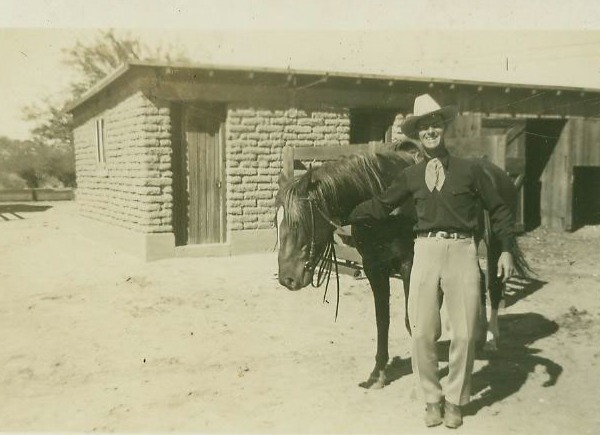
Jack Procter with Horse in Front of Horse Barn
John “Jack” Monroe Procter helped shape Tucson’s business, civic, and social life during a period of tremendous growth. A banker turned hotelier, ranch owner, and community leader, Procter was drawn to the romance of the West and played an important role in establishing the traditions that continue to define Tucson and Oro Valley today.
John “Jack” Monroe Procter was born October 4, 1891, in Oakville, Kentucky. At nineteen, he moved to El Paso, Texas, where he lived with his cousin Lee Orndorff and Lee’s wife, Alice. Jack began his professional career there as a bank cashier, learning the fundamentals of banking and establishing a business career that would eventually take him far beyond the banking industry.
In 1916, Jack married Elizabeth “Libba” Simmons (1899–1966). By the 1920s, the couple was living in Eastland, Texas, with their daughter, Elizabeth “Betty,” and later their son, John Jr., known as “Sonny.” Jack had advanced to the position of bank vice president. During the 1920s, the family moved to Pasadena, California, where Jack transitioned from banking into the management of Hotel Constance (now Pasadena Hotel & Pool) , an Orndorff Hotel Company.
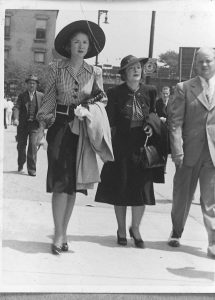
Libba and her daughter, Betty (left)
In 1932, Jack and his family relocated to Tucson when he became manager and vice president of the Pioneer Hotel, one of the city’s premier hotels of the era. The Procter family lived in an apartment within the hotel, making the Pioneer both Jack’s workplace and the family home for over twenty years.
Jack’s position at the Pioneer placed him at the center of Tucson’s growing hospitality and business community. His connections with hotel guests and business leaders would eventually extend beyond Tucson and into the surrounding countryside.
During the late 1940s and into the mid-1950s, Jack also owned and managed the El Presidio Hotel, located at Broadway and Fourth Avenue.
For Jack Procter, perhaps no place was more personal than Steam Pump Ranch.
Originally homesteaded by the George Pusch family, Steam Pump Ranch encompassed approximately 1,120 acres when Procter acquired the property through a series of transactions between 1938 and 1943. The ranch marked a new chapter in its history and became the setting for Jack’s vision of Western life.
Jack constructed a modern home and numerous outbuildings, including a garage, bunkhouses, chicken coops, and a tack room. Ranch hands oversaw the day-to-day operations and livestock, which included prize bulls, horses, and chickens.
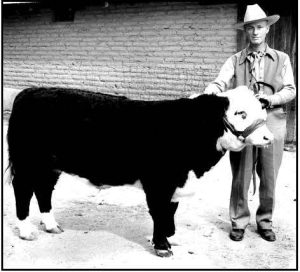
Jack Procter and Prize Bull, 1941.
The ranch also became an extension of Jack’s hospitality business. Wealthy visitors and celebrities were drawn to Tucson by the romance of the West, and Jack welcomed many of them on Sundays to Steam Pump Ranch to experience what he proudly called the “western lifestyle.” He referred to the ranch as his “favorite diversion.”
The ranch’s expansive lawn became a gathering place for parties and barbecues, while its agricultural operations provided food for the Pioneer Hotel. Chickens supplied meat and eggs and produce grown at the ranch was sent to the hotel—an early example of a local “farm-to-table” operation.
Today, the surviving buildings and landscape of Steam Pump Ranch offer a glimpse into this important chapter of Jack Procter’s life and the history of the Oro Valley area. Many of the remaining historic resources are part of Steam Pump Ranch, which was placed on the National Register of Historic Places in 2009.
Jack Procter’s influence extended well beyond the ranch. From his arrival in Tucson in 1932 through the 1960s, he was actively involved in the growth and development of Tucson and Arizona.
His civic and professional service included:
The Tucson Airport Authority was established in 1948 to promote air transportation and commerce in Arizona and to oversee the airfield’s runways and facilities. Procter’s involvement reflected his broader interest in the infrastructure and institutions that would support Tucson’s future growth.
During World War II, he also served on the Bond Sale Committee, further demonstrating his commitment to the community and state.
Jack’s love of the West also found a lasting expression in the Tucson Rodeo.
In 1942, Procter joined actor and singer Gene Autry and other local leaders in helping expand the annual event. The rodeo became an important part of Tucson’s identity, bringing together the city’s ranching heritage, Western culture, entertainment, and civic life.
During the years when Western films were being produced at Old Tucson, Hollywood stars—including Gary Cooper, Jimmy Stewart, Michael Landon, and Debbie Reynolds—participated in the rodeo parade.
For the Procter-Leiber family, the connection to the rodeo did not end with Jack. His great-grandsons, and now his great-great-grandchildren, have continued the family tradition by participating in rodeos throughout the region, including the Tucson Rodeo.
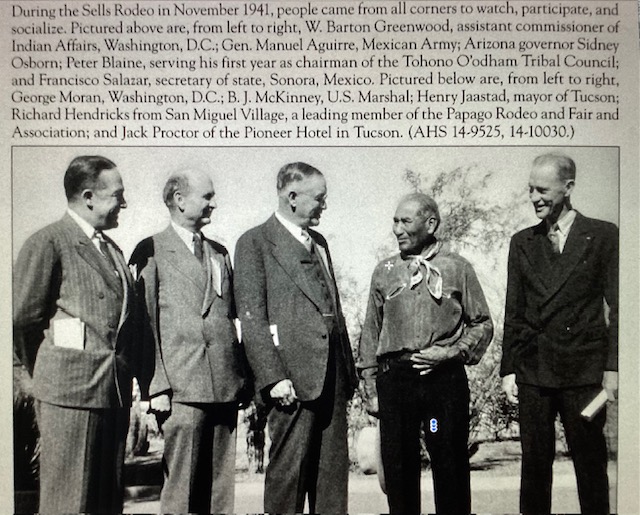
Sells Rodeo – November 1941. Jack Procter far right.
Jack retired during the 1960s and gradually sold portions of the vast Steam Pump Ranch property. He remained in his home on the ranch, however, until his death in 1972.
By then, only a portion of the original ranch remained. At the time of Jack’s death, approximately 56 acres were left, including what is now considered the historic core of Steam Pump Ranch. He bequeathed the remaining property to his grandsons, John and Henry “Butch” Leiber (scroll down the page to learn more about the Leiber family.)
In 2006, the Town of Oro Valley acquired the remaining 15 acres through a Pima County bond dedicated to historic preservation. Three years later, Steam Pump Ranch was placed on the National Register of Historic Places.
What remains today is more than a collection of historic buildings. Steam Pump Ranch preserves a tangible connection to Jack Procter’s life, his vision of Western hospitality, and a transformative period in the history of Oro Valley and Tucson.
Jack and his wife, Elizabeth are buried at Evergreen Memorial Park Cemetery in Tucson (Plot: Block 34, ID: 52150434 and 52150433. Refer to findagrave.com for more details.
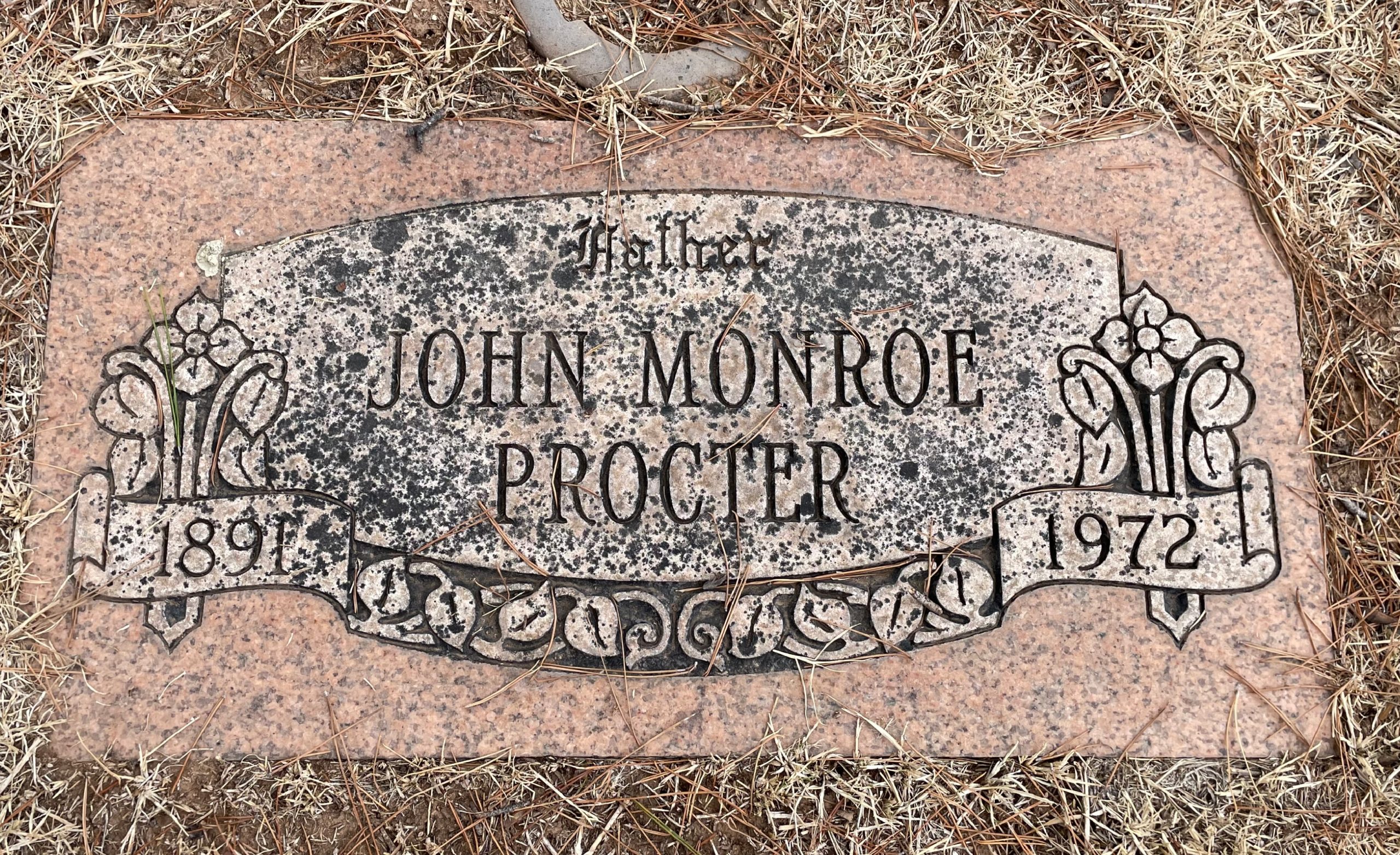
Gravesite Marker John Monroe Procter, Evergreen Cemetery, 1891-1972
Jack Procter: A Tucson and Oro Valley Mainstay, by Devon Sloan as featured in OV Style Magazine, October 2026, page 9
Books and research papers prepared by James A. Williams
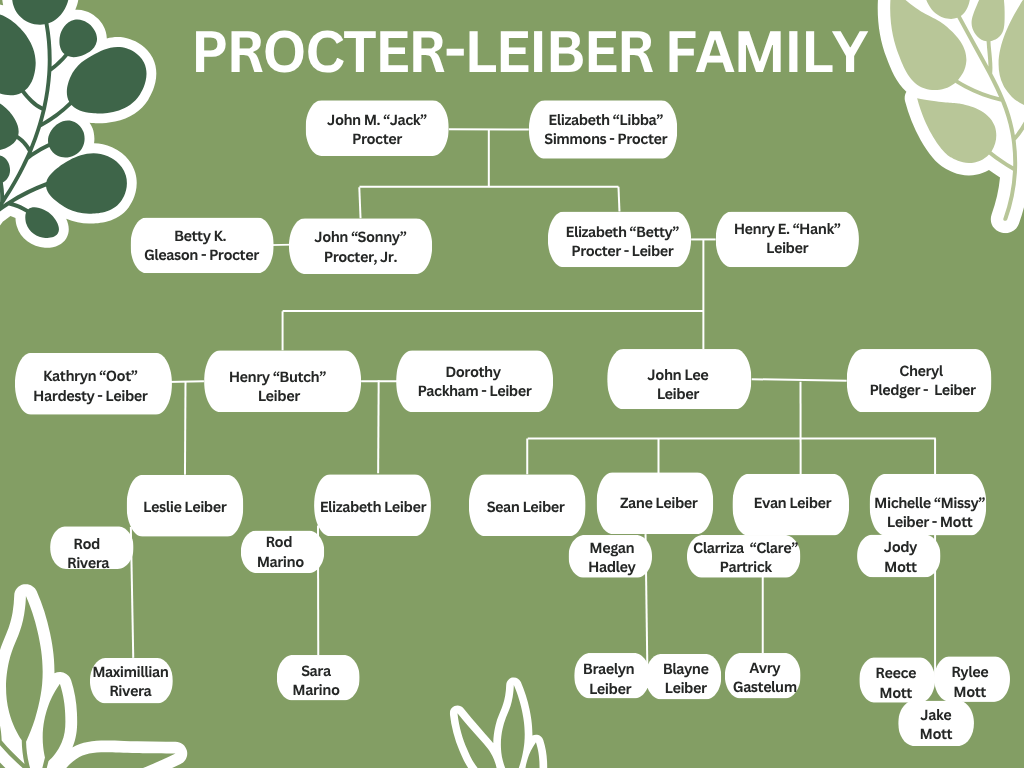
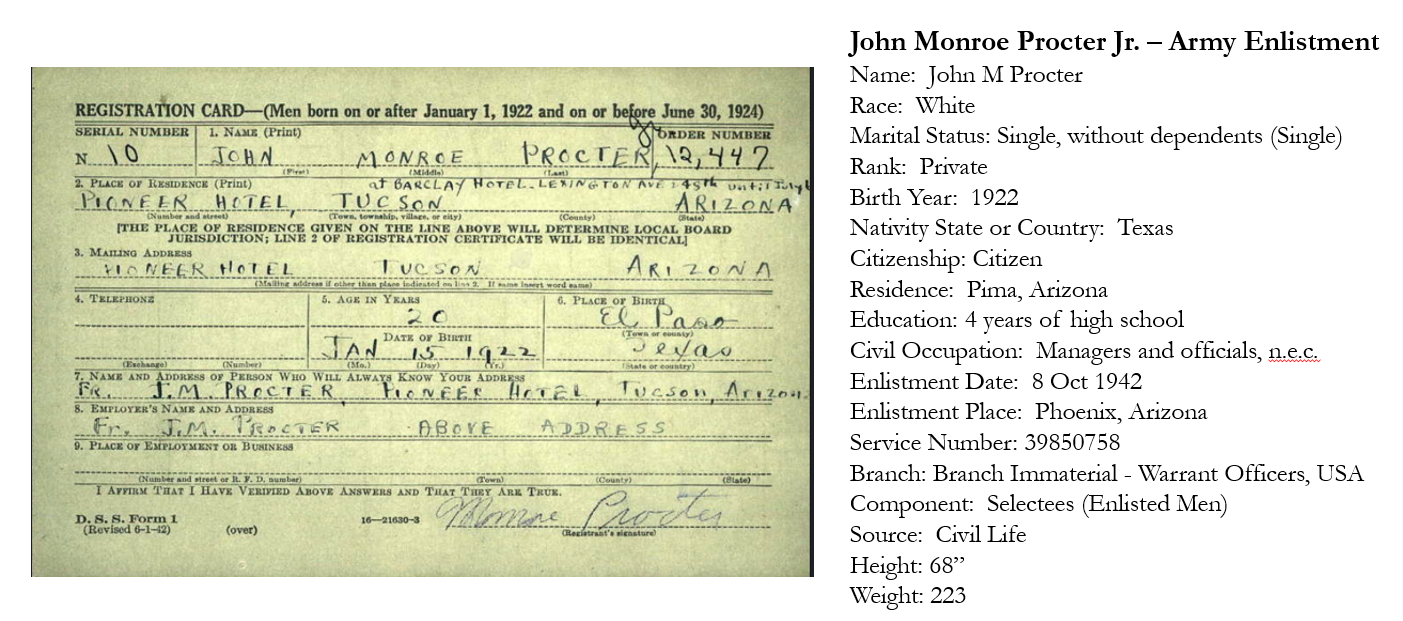
John Monroe Procter Jr. Draft Card and Army Enlistment Information
John Monroe “Sonny” Procter Jr. was born in El Paso, was drafted into the Army in 1942, and married Betty Kathleen Gleeson in 1949, where they lived at Steam Pump Ranch.
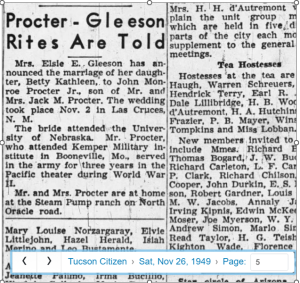
John Monroe Procter, Jr. Marriage Notice to Betty Gleeson – Tucson Citizen, Sat, Nov 26, 1949
Sonny passed away in 1992 and is buried between his father and Mendota “Minnie” Ravenscroft (former head housekeeper at the Pioneer Hotel) at the Evergreen Memorial Park Cemetary in Block 34, Section A – no headstone is present.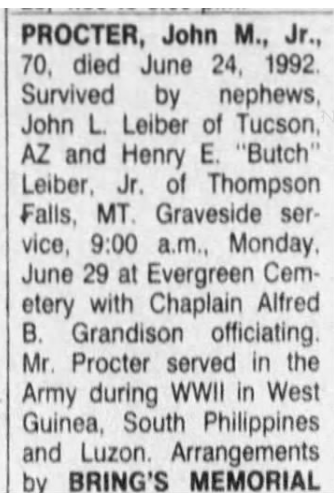
John Monroe Procter Jr. Obituary 1992 – Arizona Daily Star
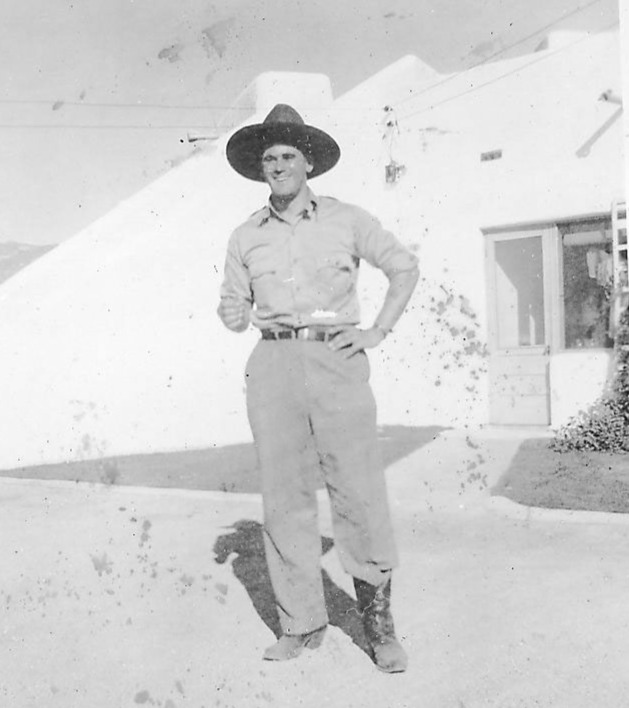
Elizabeth Camille “Betty” Procter‑Leiber was born on August 8, 1918, in El Paso, Texas, to Jack and Elizabeth Procter.
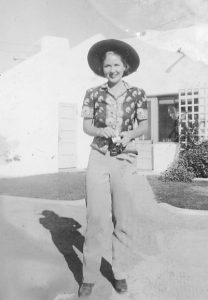
Betty Procter in Front of Procter-Leiber House.
Her childhood carried her across the Southwest—from Eastland, Texas, to Pasadena, California—before the family settled permanently in Tucson in 1932. Her father, Jack Procter, had accepted the position of manager at the prestigious Pioneer Hotel, a role that placed the Procter family at the center of Tucson’s social and cultural life.
Betty attended the University of Arizona, where she joined Kappa Kappa Gamma and quickly became known for her charm, beauty, and lively spirit. In 1938 she was crowned Queen of the Harvest Festival Dance, a highlight of Tucson’s social calendar. She also modeled for the elegant Cele Peterson clothing shop, becoming a familiar face in local fashion and society circles.
During her college years and well into adulthood, Betty managed the Pioneer Hotel gift shop, where she specialized in Native American pottery and jewelry. Her expertise and discerning eye helped shape the shop’s reputation for high‑quality regional art. Surviving catalogues and receipts from vendors—including DeGrazia Studios, Seligman’s of Albuquerque, and Native Products Company of Santa Fe—reflect the breadth of her work and her connection to Southwestern artisans.
Betty met Henry E. “Hank” Leiber, a celebrated University of Arizona athlete and National League All‑Star for the Chicago Cubs and New York Giants, during his frequent visits to Arizona.
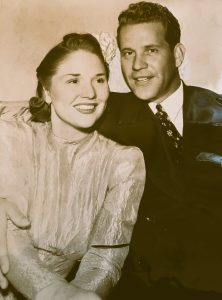
Hank Leiber and Betty Procter Engagement Photo MLB Press Release, November 17, 1940
Their courtship led to an engagement in November 1940, and—on the drive home from the Rose Bowl that same season—a spontaneous stop in Yuma became their wedding day.
After Hank’s baseball career ended in 1942, the couple made Tucson their full‑time home. From the 1940s through the mid‑1960s, Betty and Hank lived in the historic Pusch House at Steam Pump Ranch, where they raised their two sons, Henry (“Butch”) and John Leiber.
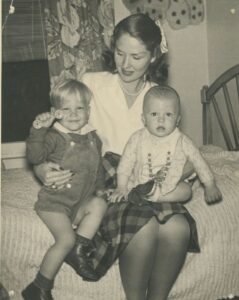
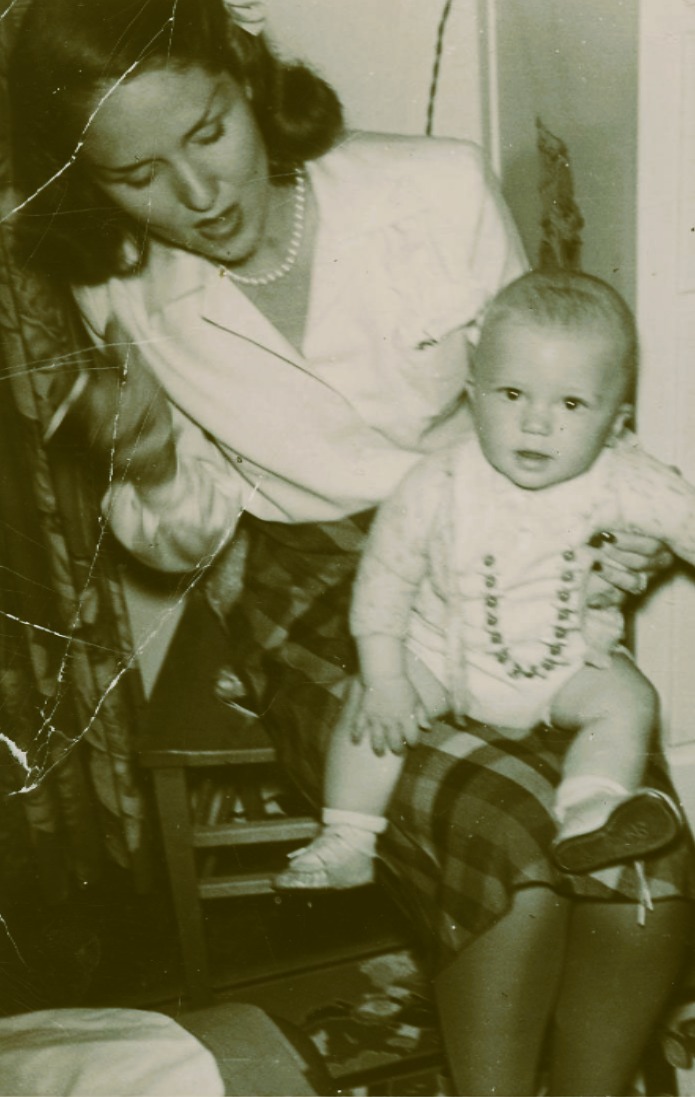
Betty Procter-Leiber with Toddler Sons – Henry “Butch” and John
During their long residence, they made numerous upgrades and expansions to the ranch house, blending comfort with respect for the property’s historic character. Their years at Steam Pump Ranch remain an important chapter in Oro Valley’s early community history.
In 1963, the Leibers moved to the 49er Guest Ranch and Country Club development, one of several real estate ventures Hank helped establish. Betty continued her involvement in Tucson’s social and cultural life, balancing family, work, and her passion for golf, in which she held several amateur titles.
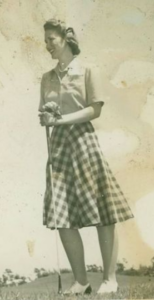
Betty Procter‑Leiber passed away due to an aneurism on February 17, 1978, at the age of 59, and was interred at East Lawn Palms Cemetery.
Betty remains a notable Tucson social figure and a key part of the Steam Pump Ranch story. Her legacy lives on through her family and the historic places she helped shape.
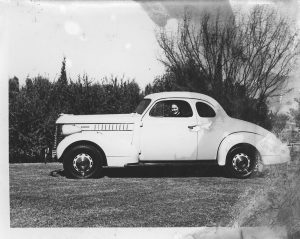
Betty Procter-Leiber in Late 1930s/Early 1940s Car
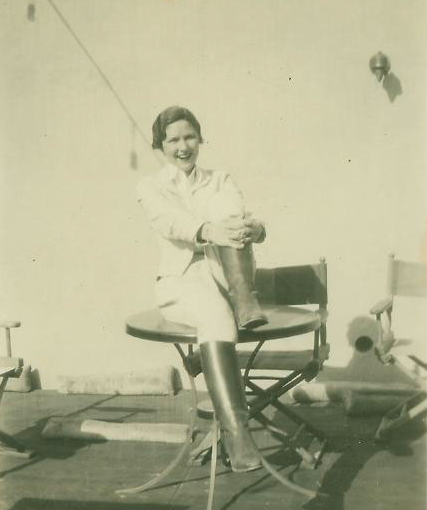
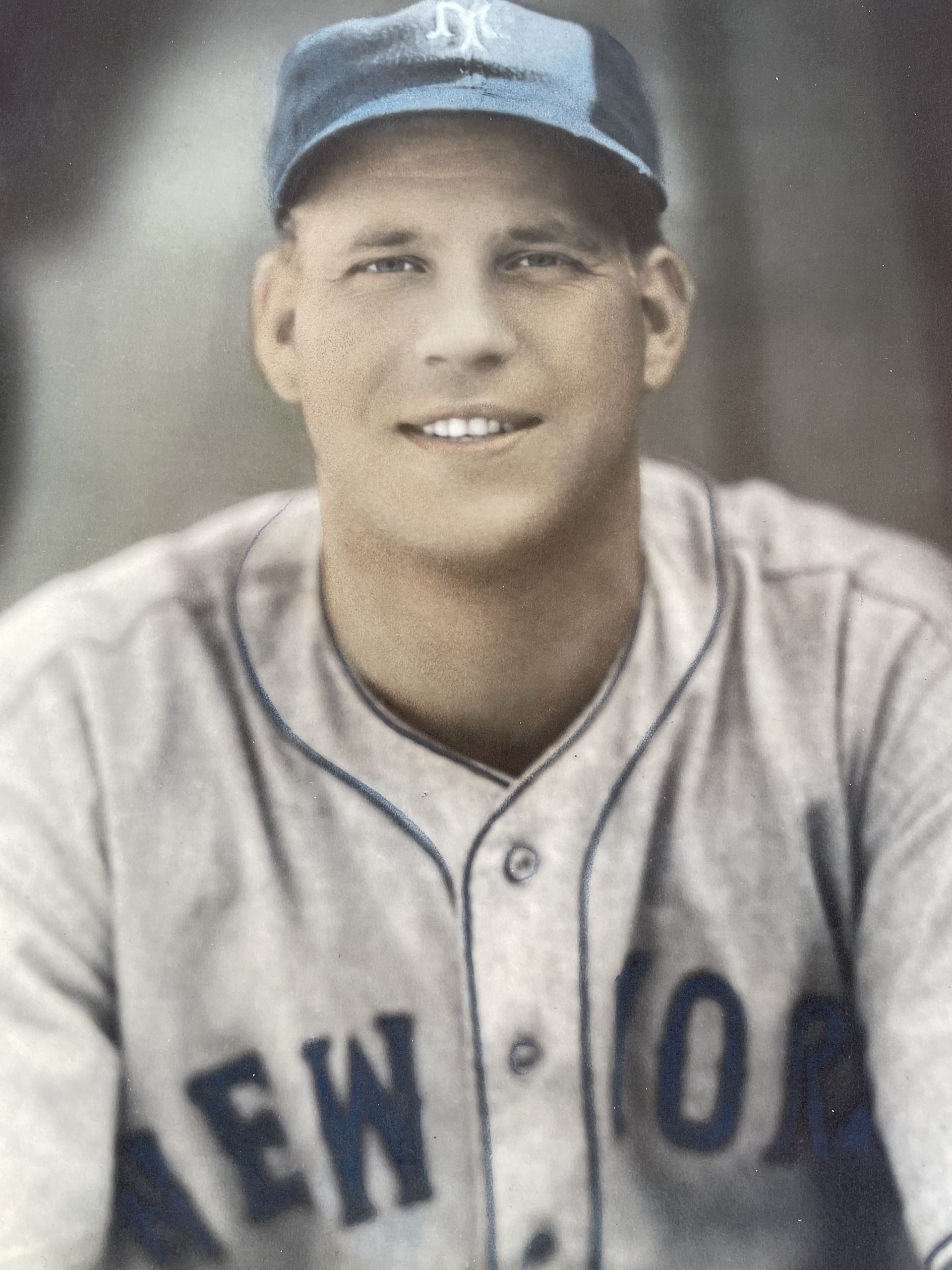
Henry “Hank” Edward Leiber left his mark on Arizona in more than one arena. A gifted athlete who excelled in three sports at the University of Arizona, Leiber went on to a ten-season Major League Baseball career with the New York Giants and Chicago Cubs. After baseball, he returned to Tucson and built a second career as a successful real-estate developer and community leader.
His life connected Arizona’s athletic heritage with the growth and development of Tucson and Oro Valley during the middle decades of the twentieth century.
Henry Edward Leiber was born January 17, 1911, in Phoenix to Henry F. and Hattie M. Leiber.
At Phoenix Union High School, Hank established himself as an exceptional all-around athlete, earning All-State honors as a center in basketball. His athletic talents continued at the University of Arizona, where he lettered in football, baseball, and basketball.
In football, he earned All-Southwestern honors for his play at fullback during his final two seasons, 1930–31. His University of Arizona coaches included J.F. “Pop” McKale and Fred Enke.
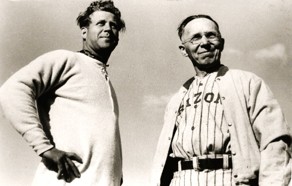
Hank Leiber and JF Pops McKale, 1941
Although he excelled in several sports, baseball ultimately became his profession. Before enrolling at the University of Arizona, Hank had already played semi-professional baseball. His talent attracted the attention of New York Giants manager John J. McGraw, who offered him a contract when Hank was only seventeen. His father insisted that he finish his education first.
Hank ultimately left the University of Arizona just 12 credit hours short of completing his degree, choosing instead to pursue his baseball career.
In 1932, Hank reported to the New York Giants’ spring training camp in Catalina, California. McGraw sent the young player to the minor leagues to gain experience, and Hank quickly demonstrated that he belonged in professional baseball.
After batting an extraordinary .427 for Nashville in 1933, he was called up by the Giants late that season.
By 1935, Leiber had established himself as a major-league star. In his first full season, he hit .331 with 22 home runs and 107 runs batted in. He played in the 1936 World Series and, in 1937, hit .364 against the New York Yankees in the World Series.
Leiber was known as an aggressive hitter who crowded the plate. That style made him vulnerable to serious injuries. In 1937, a pitch from Cleveland pitcher Bob Feller struck him in the head, causing him to miss most of the season. Despite the injury, Leiber returned in time to play in the World Series.
In 1938, the Giants traded Leiber to the Chicago Cubs. He responded with two outstanding seasons, hitting a combined 41 home runs in 1939 and 1940. His performance earned him selection to the National League All-Star team in 1938, 1940, and 1941.
His baseball career was ultimately cut short by another serious head injury. On June 24, 1941, Leiber was hit in the head by a pitch from Cliff Melton. He returned briefly to the Giants in 1942, but he was no longer the player he had been before the injury. He retired from Major League Baseball following the 1942 season.
10 seasons in Major League Baseball
813 Major League games
808 hits
410 runs scored
101 home runs
518 runs batted in
.288 career batting average
.973 fielding percentage
3× National League All-Star — 1938, 1940, 1941
New York Giants (1933–38, 1942)
Chicago Cubs (1939–41)
Wikipedia – Hank Leiber Athletic Career
After retiring from baseball, Hank returned to Tucson and entered the real-estate business full time.
In fact, he had begun investing in real estate during his playing days. Hank sent part of each paycheck to his father, who invested the money in Phoenix-area farmland. By the time Hank’s baseball career ended, the land had increased significantly in value.
That early investment experience helped launch a successful second career. Leiber worked for James C. Grant Realty during the 1940s and opened his own firm, Leiber and McCarthy, in the late 1950s.
His business interests coincided with Tucson and Oro Valley’s rapid postwar growth.
Hank Leiber became one of the developers of the Oro Valley Country Club Estates, helping transform land north of Tucson as the area began developing into a residential and recreational community.
He also helped develop the Forty Niner Country Club and owned and operated the 49er Guest Ranch until it closed in the early 1960s.
For Leiber, development was more than simply a business opportunity. Friends and colleagues remembered him as a smart and conservative businessman who understood the potential of the region and recognized that land would increase in value as Tucson grew.
His work in real estate helped shape the landscape of the communities north of Tucson during an important period in the region’s development.
Even after his Major League career ended, Hank Leiber remained closely connected to baseball.
In the late 1940s, he joined Roy and Oliver Drachman and Hi Corbett in purchasing the Tucson Cowboys of the Arizona-Texas League. Hank served as manager of the team and even pinch-hit a few times.
His interest in baseball extended beyond the Cowboys. Leiber also played an important role in bringing spring training baseball to Tucson during the 1950s, helping establish the city as a destination for professional baseball and reinforcing the sport’s place in Tucson’s identity.
For someone whose own playing career had taken him from Arizona to the major leagues and back, helping establish professional baseball in his hometown was a fitting continuation of his lifelong connection to the game.
Baseball was not Hank’s only sporting passion. A scratch golfer, Leiber won the 1950 club championship at Tucson Country Club. He was also an avid outdoorsman and held memberships at the Tucson, Oro Valley, and 49er country clubs.
His love of sports remained an important part of his life long after his professional baseball career ended.
Hank Leiber was active in numerous Tucson-area organizations and clubs. He was a member of the Mountain Oyster Club, the University of Arizona Presidents Club, and the Tucson Conquistadores.
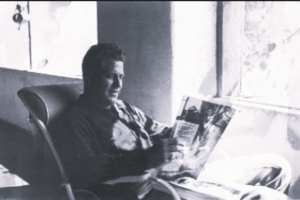
Hank Leiber Reading a Magazine in the Sun Porch of the Procter-Leiber House.
He was also a founding member of Tucson Big Brothers, reflecting a commitment to young people and community service that extended beyond his professional accomplishments.
His athletic achievements earned further recognition in 1963, when he was inducted into the Arizona Sports Hall of Fame. The Hall’s records identify him among its early inductees as a Phoenix Union/University of Arizona major-league star outfielder.
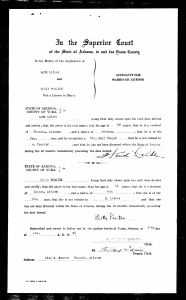
Hank and Betty’s Marriage License
Hank married Elizabeth “Betty” Procter on December 30, 1940. Betty was the daughter of John “Jack” Procter, the Tucson businessman and owner of Steam Pump Ranch.
Together, Hank and Betty raised two sons, Henry “Butch” Jr. and John Lee.
The family connection between Hank and Jack Procter would become an important part of Steam Pump Ranch’s later history. When Jack died in 1972, the remaining historic core of the ranch was bequeathed to his grandsons, John and Henry “Butch” Leiber.
Hank’s family therefore became part of the continuing story of the property and its preservation.
Hank and his wife, Betty are buried at East Lawn Palms Cemetery in Tucson (Plot: Mausoleum of the Good Shepherd, Unit 10, Crypt 204 ID: 38028044. Refer to findagrave.com for more details.

Hank Leiber Sign Located North Side of Garage Building at Steam Pump Ranch
A grandson of Jack and Libba Procter, John Lee Leiber, and Cheryl Pledger both graduated from the University of Arizona and married in 1968. They moved into the Barbecue/Caretaker House (the building where caretaker Carlos Rivera also lived) at Steam Pump Ranch to care for Jack, who passed in 1972. John and his brother Butch inherited the ranch, which at that time was around 350 remaining acres. The land extended from near First Avenue to the north to the CDO wash.
John and Cheryl remodeled Jack’s home increasing its size with a west porch, an enclosed sunroom, an expanded kitchen, a new a primary suite, and a rooftop office for John’s law practice. For family enjoyment, they added a basketball court, a built-in swimming pool, and an RV awning. Additional structures included a tack room and boarding stables on the north end of the property.
John and Cheryl raised four children – Sean, Zane, Evan, and Michelle “Missy” – on the ranch. Zane Leiber followed his grandfather, Hank, into pro sports, playing for the Chicago White Sox in 1993.
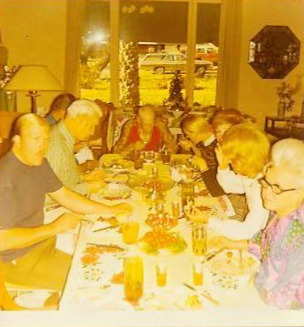
Procter-Leiber Family Gathering Christmas, c. 1972.
The family lived at Steam Pump Ranch until 2007, when the property was acquired by Pima County and the Town of Oro Valley, but remained in the greater Oro Valley area.
John Leiber passed away in 2025.
Watch an interview with John & Cheryl Leiber from February 23, 2021. This interview by Joel Woppert from the Town of Oro Valley captures John and Cheryl sharing firsthand memories of life at Steam Pump Ranch and the family’s deep connection to the historic property.
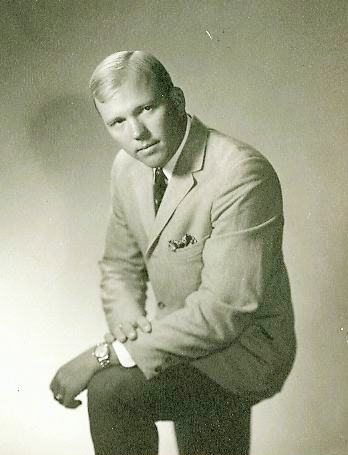
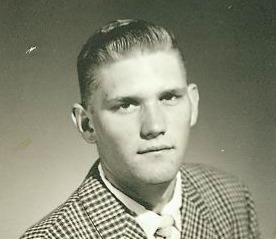
Henry “Butch” Leiber
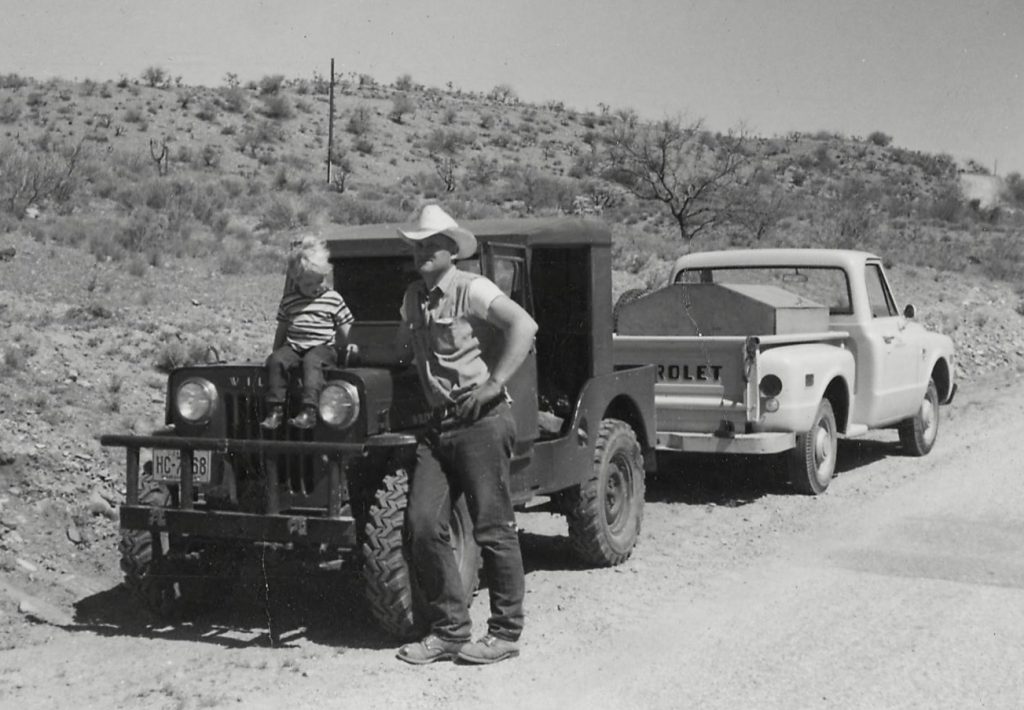
Butch Leiber and daughter, Leslie, relaxing on a Willys Jeep.
Henry “Butch” Leiber graduated from Amphitheater “Amphi” High School and also the University of Arizona. He married Kathryn “Oot” and lived on the property from 1977 – 1988. They had a daughter, Leslie.
Currently he lives in Montana with his second wife, Dorothy.