
A Living Piece of the American West
Discover one of Southern Arizona’s most iconic treasures. The Empire Ranch, cared for by the dedicated volunteers of the Empire Ranch Foundation (ERF), is a place where history, open skies, and western heritage come together in unforgettable ways.
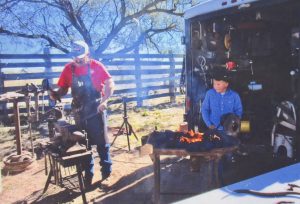
Blacksmith demonstration Empire Ranch Cowboy Festival, November 2018
Founded in 1997, the ERF works hand‑in‑hand with the Bureau of Land Management (BLM) to protect, preserve, and sustain the ranch’s historic buildings and sweeping landscape. Today, the ranch stands as an outstanding western heritage and education center—a place where the past feels close enough to touch.
Set in the heart of Arizona’s wine country, Empire Ranch invites you to slow down, wander, and experience the beauty of the high desert. Visitors can explore the original ranch house, outbuildings and the property, stroll through wide‑open grasslands, learn about the families and cowboys who shaped the region, and enjoy the peaceful charm that makes this place so special.
Whether you’re a history lover, a nature enthusiast, a photographer, or simply someone who enjoys discovering hidden gems, Empire Ranch offers a memorable escape that feels both timeless and uniquely Arizona.
Come see why generations have been captivated by this remarkable place—and why the Empire Ranch Foundation works tirelessly to keep its story alive.
Check out their calendar of events and don’t miss their annual Cowboy Festival in the fall!
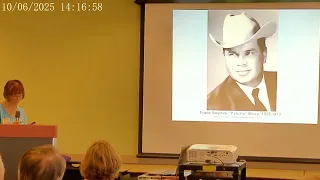
Marti Conroy Presents the History of Empire Ranch, October 2025
OVHS was honored to welcome Marti Conroy as our October 2025 Speaker Series presenter. With her deep knowledge and engaging storytelling, Marti brought the rich history of Empire Ranch to life—sharing the stories, people, and landscapes that shaped one of Southern Arizona’s most iconic historic sites. You can watch the full presentation on our YouTube channel or click the links below. And, and for easy reference, transcripts are also available below. It’s a wonderful opportunity to learn more about this remarkable ranch and the ongoing efforts to preserve its legacy.
The History of Empire Ranch, Part 1 (25 minutes)
The History of Empire Ranch, Part 2 (20 minutes)
Check out our entire OVHS Video Series collection or subscribe to the OVHS YouTube.

Empire Ranch
Devon:
My name is Devon and I am with the Oro Valley Historical Society, and we try to do these talks at least once a month, and I see some familiar faces from last month, so thanks for coming back. This month we’ve got somebody who came from a far distance. GPS said an hour and 15 minutes, so she’s here. Marti Conroy is on the board of the Empire Ranch Foundation and has been on that board for a long time, nine years, and knows a lot of stuff that she’s going to be talking about today—how the ranch was started, how it grew, how it’s a little bit smaller now, and just give us some good history about it. And we look forward to hearing from Marty. Thank you.
Marti:
Everybody hear me? Yes.
I’m delighted to have this opportunity to tell a few tales about the historic Empire Ranch located in the heart of a 45,000-acre Las Cienegas National Conservation Area just north of Sonoita.
My tales will introduce you to four families, two companies, one government agency, and one nonprofit organization, and they’ve all played a role in the Empire Ranch’s historic past and evolving history.
Our first family came to the scene in November of 1875.
Envision 23-year-old Walter Lennox Vail in Tucson’s Cosmopolitan Hotel, writing to his younger brother, Edward “Ned” Vail.
Walter, originally from New Jersey, traveled to Tucson from California to explore the possibility of making his fortune by ranching in southern Arizona.
“I reached this place three days ago pretty well tired out, but considering the trip, I think I was in pretty good condition when I reached Tucson. I have been trying ever since I came here to hire horses for a trip through the country, but have not been able to do anything until this morning, which was to buy a mule. I was very much disappointed after I got here to find that it is impossible to buy any land unless you find a man who has been on his ground for three years. His title is of no account, and as the country is all new on account of the Indian trouble, such places are very hard to find. I feel positive from all I hear that there is as fine grassland in this territory as there is in the world. I think myself that it is destined to be one of the richest states in the Union.”
It wasn’t until the following year that Walter was able to return to Arizona with sufficient funds and a partner, Englishman Herbert Hislop, to embark on his budding venture.
In August, they purchased a 160-acre homestead owned by Edward Fish and Simon Silverberg. Edward Fish was an entrepreneur that had a house here in Tucson, and I think part of that house belongs to the Museum of Art.
Included in the purchase price was a four-room, flat-topped adobe house. There were windows but no glass. Everything was open.
A central breezeway, or zaguan, bisected the rooms of the house and led to an adjoining adobe-walled corral.
In October of 1876, John Harvey, another Englishman born in Bermuda, joined the partnership, contributing much-needed capital for additional land and stock. Thus, the Vail, Hislop, and Harvey Company began, though it was most often referred to as the English Boys Outfit.
The homestead included a much-valued and critical component to ranching—dependable water from the Cienega Creek. Yet the partners knew that in order to succeed, they must expand their stock and land holdings.
The first purchase was a neighboring ranch which included a quarter section of land and a flock of sheep. It probably was land that they had to give up because they couldn’t pay the taxes or couldn’t add on anything, which is what was required from having a homestead.
In January of 1877, they purchased 733 cattle near Benson, Arizona, and disposed of the sheep. Later that year, Walter traveled to John Chisum’s ranch in New Mexico and purchased 40 Durham bulls.
The first of the English boys to depart in 1878 was Herbert Hislop. He never adjusted to the rigors of frontier life and was worried about financial matters at home. In a letter to his sister, he expressed concerns about the lack of peace with his neighbors. We thought at first that it was the Indians he was concerned about, but we think it was actually the neighbors that had other ranches nearby.
Walter purchased Hislop’s shares with money borrowed from his aunt Anna Vail, and the corporate name was changed to the Vail and Harvey Company.
In 1879, during a tour of the ranch’s northern pastures, prospector and Empire Ranch hand John Dillon pointed out some likely silver-bearing formations in the Empire Ranches.
This would be up on the top when you’re coming on I-10 and you turn to go south on 83. Up there is a big satellite dish that you can see on the left as you’re going towards Sonoita. That’s where the Total Wreck Mine is, so it wasn’t close.
Vail, Harvey, and Dillon registered a claim for the Total Wreck Mine, which proved very successful, developed in partnership with Walter’s uncle Nathan Vail. The Total Wreck Mine became fully operational in 1883 under the direction of Ned Vail.
At its peak, the Total Wreck Mining Company boasted over 50 residences and commercial establishments. Revenue from the mine, over $500,000 between 1881 and 1887, fueled the expansion of the Empire Ranch to over 100,000 acres. It went from the bottom of the Rincons all the way to the Mexican border.
John Harvey left the partnership in 1881, selling his shares to Walter, who continued to develop and expand the business in partnership with other Vail family members and the Empire Land and Cattle Company.
That same year, Walter returned to New Jersey to marry his longtime sweetheart, Margaret Newhall, and bring her to live on the Empire Ranch. Margaret chose to live at the ranch full-time instead of setting up a home in Tucson, as was often the custom.
The Empire was the first home of six of Walter and Margaret’s seven children.
As the Empire Ranch expanded, so did the buildings at the ranch headquarters. By 1882, the original four rooms of the ranch house had grown to 22. Rooms for offices and staff were added behind the original structure, and a gable-roofed Victorian addition became the family home, and outbuildings were constructed to support the ranching operations.
A little more than 10 years after starting the Empire, Walter began to look for pastures in Southern California to ease overgrazing concerns. To fund his expansion, he took on a new partner, Carroll Gates.
By the early 1890s, when drought greatly affected southern Arizona, the importance of the California land holdings was clear. The Empire Ranch became a breeder operation that supplied the ranches in California.
In 1896, the Vail family moved their home and business offices to Los Angeles. Management of the Empire Ranch was initially left under the direction of a foreman, Hadden McFaddin.
Harry Heffner managed the Empire Ranch from 1902 to 1905.
Ironically, after surviving the Apache Wars and the hardships of remote ranching life in southern Arizona, Walter’s life was cut short when he was killed by a streetcar in Los Angeles in 1906.
Walter’s 17-year-old son, William Banning Vail, was sent to Arizona to learn the business and eventually take over operation of the Empire.
Banning married a native Tucsonan named Laura Perry in 1913, and they raised three children on the Empire Ranch: Laura, who was called Dusty; William, known as Bill; and Tom.
Banning and his family lived on the ranch until 1928, when our second family, the Boises, came on the scene.
The Empire Ranch was purchased by the Chiricahua Ranches Company, successor to the well-known Chiricahua Cattle Company.
The three Boise brothers—Henry, Charles, and Frank Seymour—were respected ranchers known for their promotion of the Hereford breed of cattle in the Southwest.
Frank Boise and his wife Mary moved to the Empire Ranch in 1928, while the other brothers managed nearby operations that the family had purchased. Frank and Mary became sole owners of the Empire Ranch in 1951.
Frank managed the Empire for 28 years until his death in 1956. An engineer with degrees from Occidental College and MIT, he liked nothing better than building or repairing ranch equipment. He served as president of the Arizona Cattle Growers Association from 1935 to 1936 and was elected to the Cowboy Hall of Fame in Oklahoma in 1958.
Mary Boise was also an avid and talented gardener. She participated in all facets of ranch life, including roundup, sorting, and shipping.
The house was surrounded by a lush lawn bordered with flower beds of tulips, irises, and roses. Huge trees provided ample shade.
During the Boise period, rooms in the Victorian portion of the house were remodeled. Propane and eventually natural gas were piped into the house. A large electric walk-in refrigeration unit was installed. Plumbing was upgraded and cement stucco was applied to the exterior house walls. Up until that time, you saw nothing but adobe. A swimming pool was installed south of the house and became the focal point for family gatherings and parties.
During these years, the Boises hosted numerous film stars, including John Wayne, as Hollywood romanticized the West in films such as Red River. That’s one of 52 movies and TV series that were filmed in that area.
A week ago, we showed Monte Walsh, and it was a movie under the stars that The Loft brings out their screen and it’s a free movie that you get to sit out and watch.
Frank and Mary had two sons, Frank, known as Poncho, and Robert, known as Bob. As Poncho and Bob became adults and helped manage the ranch, additional accommodations were required.
A surplus house from the Army base at Fort Huachuca was purchased and installed west of the main house. Bob and his wife Miriam lived there, and he called it Bob’s Casita.
Two of Bob and Miriam’s four children were born during the time they lived on the Empire. In 1956, the family relocated to manage the Slash S ranch in Globe, Arizona.
Poncho and his wife Sherry initially made their home in the small grove house located northwest of the ranch house. In the early 1950s, they moved to a newly remodeled house constructed on the hill north of the original ranch house. Poncho and Sherry raised four children—Steve, Kitty, Sherry, and Carol—on the Empire.
In 1969, the Boises sold the Empire Ranch to Gulf American Corporation, which planned a large residential community development on the Empire. It was supposed to have about 150,000 houses.
Gulf American contracted with the Boise family to continue managing the Empire under lease agreements for the land.
Poncho’s son Steve took over responsibility for ranching on the Empire after an untimely death in 1973. That’s Faith, she is now the president of Empire Ranch – with her dad.
Thankfully, Gulf American’s development plans were not realized, and in 1975 they sold the Empire to Anamax Mining Company. Anamax discontinued the Boises’ grazing lease on the Empire.
Enter the third family, the Donaldsons.
Anamax leased the Empire to rancher John Donaldson. John’s son Mack and his wife Billie moved to the Empire to partner with John. Both Donaldson families, including Mack and Billie’s children, Alexa, Sam, and Renee, lived on the Empire until 1988.
In 1988, the U.S. Bureau of Land Management acquired the Empire Ranch headquarters and surrounding 42,000 acres through a series of land swaps, creating the then-named Empire-Cienega Resource Conservation Area.
Legislation signed in December of 2000 designated the lands as the Las Cienegas National Conservation Area, assuring their preservation and that nothing could be built on it. That was through Jim Colby when he was in government.
John and Mack Donaldson and Mack’s son Sam continued their grazing lease with the BLM until 2009, when our fourth family, the Tomlinsons, assumed the lease.
The Tomlinson family owns the Vera Earl Ranch Incorporated, which borders the Empire Ranch on the west and was established in 1968 by Burton and Betty Anne Beck. Ranching operations are managed by Ian Tomlinson, a grandson of the Becks. He and his wife Kristen and daughters Marin and Addison live in Sonoita.
The historic ranch buildings, unoccupied since 1988, had deteriorated and required help to save them.
In 1998, a group of private citizens working in partnership with the BLM formed the Empire Ranch Foundation as a volunteer 501(c)(3) charitable organization.
The Empire Ranch Foundation is dedicated to preserving and interpreting the Empire Ranch historic buildings and surrounding landscape for further generations. Within a year of its establishment, the foundation had become heavily involved in preservation work, as well as its partnership and assistance agreement with the BLM.
A Save America’s Treasures matching grant launched a major project to perform critical emergency repairs to deteriorated foundations, walls, and roof systems in the main ranch house. The federal grant funds were fully matched with private funding raised by the foundation, and the BLM provided another $100,000 of additional funding.
Emergency repairs to important outbuildings were undertaken. Work on the stone corral included anchoring the roof, installing new support posts, and repointing deteriorated mortar.
The historic adobe hay barn repairs straightened and sealed huge cracks in the two leaning walls in the gable, restored eroded foundations, repaired a falling corner, and secured the roof. That barn was created in 1880.
At the ranch house, deteriorated east wall foundations and brick were erected and foundations were strengthened. The south barn was replumbed and re-raced to correct leaning, and missing metal roofing was replaced. This is where the south corral and the south barn were used in Red River when John Wayne had his famous fight.
In 2007, attention returned to the ranch house, where foundations of the west wall of the master bedroom and bath of the Victorian addition were repaired, and the lintel and gable were reinforced and anchored. Subsequently, old carpet, asbestos tile, and linoleum in the living and dining room and kitchen were removed. The lintel at the south end of the zaguan was reinforced by the installation of a steel beam in 2010.
Between 2011 and 2013, the Fort Huachuca house was rehabilitated to serve as a visitor contact station and gift shop and to provide space for the foundation to hold meetings.
In 2015, a project to stabilize the adobe hay barn was completed. The sliding door on the south side of the hay barn was rehung in 2017.
In 2017, the Empire Ranch House Stabilization Project began to reinforce foundations in several areas, secure walls for structural strength, repair interior and exterior wall surfaces, replace the roof on the Victorian addition, and rehabilitate the children’s addition to make it safe for visitors. The project was completed in the summer of 2018. They put a big fence around that house and we could not even get near it.
A core of dedicated volunteers, with training and supervision from BLM staff, have devoted thousands of hours to smaller preservation projects. Volunteer days are held the first Saturday of most months. We are the largest group of volunteer house with the BLM every year. Last year it saved them almost $80,000 – the number of hours of work we did.
BLM and the foundation work together for cultural resource preservation, adaptive reuse, and interpretation. Through this partnership, we have researched the history of the ranch, developed plans for its preservation and interpretation.
Implementation of those plans through hands-on work, grant writing, and raising funds. All told, the foundation has contributed over $500,000, and the BLM’s deferred maintenance program has contributed nearly $2.5 million for preservation work to restore the ranch house and the other seven buildings in the headquarters.
The foundation’s education program was launched in 2004, where 45 students and four teachers from a Tucson middle school traveled to the ranch for an intensive day of learning. Since that time, the annual education day has hosted hundreds of middle school students.
The students have learned about ranching heritage through demonstrations from BLM staff and local ranchers and cowboys. Wild About the Grasslands, the foundation’s highly acclaimed ecology and ranching heritage youth education and outreach program, was offered from 2007 to 2014 with funding provided by the BLM from their Hands on the Land program.
In order to achieve our preservation and education mission, it is essential to build public awareness and a strong membership. That’s one reason I’m here today.
With the assistance of Empire Ranch Foundation volunteers and BLM staff, the foundation sponsors events to raise public awareness, funds, and friends.
Our annual cowboy festival draws more than 2,000 visitors who come to the ranch to enjoy western heritage demonstrations, arena and livestock exhibits, cowboy cooking, and western entertainment.
On the first Saturday in April, and we think it’s going to be March next year, we have our spring trail ride. You can rent a horse or you can bring your own. It’s a great way to experience the beauty of the Empire Ranch and the Las Cienegas National Conservation Area. Last year we made it a one-and-a-half-hour ride and we took two groups out of 45 to 50 riders.
On the first Saturday in July, we celebrate National Day of the Cowboy at the ranch. It is a free family event with demonstrations, preservation, ranch tours, and because of the heat, we’ve had several medical incidences that I’ve had to take care of. So we’re trying to change that to another cooler month. That is the actual day that Oklahoma— their association does have for the National Day of the Cowboy, though, so that’s why we kind of tried to do it that way. They just didn’t know about Arizona.
Each summer, classic western movies are celebrated and shown outdoors at the Empire Ranch. Includes knowledgeable presentations by guest speakers and audience participation is invited. We just finished having this one, Monte Walsh, and we had over 200 people sitting out in our big area eating and buying snacks and watching the movie.
On the second Saturday in December, we decorate the Empire Ranch House for Christmas. All 29 rooms get something and have a fun celebration to start off the holidays. We have music, we have vendors, we have cookies galore, make-and-take decorations, and best of all, Santa.
An active history archives and publications program is documenting and sharing the Empire Ranch history through interpretive exhibits in the ranch house and information on the ERF website.
Trained docents provide walking tours of the historic Empire Ranch on the second and fourth Saturday of each month at 11:00, and they take about an hour.
On our website, we have a video that takes you on a virtual tour of the Empire Ranch House that was done during COVID. It was a great way to visit the ranch from the comfort of your home or prepare for your visit.
Print and online publications, oral histories, and the preservation of the Empire Ranch historical materials also help to tell the story. And because we’re going to be celebrating 150 years next year, we’re going to have several new events. What we are having is there is a new book being published, and it is the biography of Walter Vail.
Membership in the Empire Ranch Foundation provides vital support for the continued historic preservation of the Empire Ranch. Annual membership begins at $35 and keeps you informed through online newsletters, which we call e-blasts, and invitations to events with the flyers. Most of our events that you come to, other than the trail ride, you actually don’t have to spend any money at all to come to them.
We ask for a donation for parking on some of them. The rest of them, it’s all free. If you don’t want to buy lunch, you don’t want to buy anything from a vendor, you don’t want to come in the gift shop, you can spend all day just listening to all the things that are going on.
For more information, please visit our website or give us a call. Thanks so much for this opportunity to tell you about the Empire Ranch and the foundation.
Any questions?
Yes.
Audience member 1:
Do you want to make some comment about the music program that the University of Arizona School of Music did down there?
Marti:
Yes. We had one called Symphony Soundscape. We had it in the adobe barn. They made an actual symphony of the sounds out there, and it was well received. We’d like to do it again, and I think they’ve done it one other place.
Audience member 1:
They did it in Patagonia at the opera house. They did it in a couple places up here in Tucson. I’ve seen it more than once. It’s fantastic.
Marti:
Yes, it is. It’s utterly fantastic.
Audience member 1:
If you guys could get them back.
Marti:
Well, it just happens that our board—we’ve got about six people that have either retired from the U of A or are still working there. So that always helps, doesn’t it? Any others?
Audience member 2:
Is it open every day?
Marti:
It is open 24/7. Although from dawn to dusk, you do not want to be out there at night unless you are an amateur photographer and are taking gorgeous pictures of the Milky Way because it is black out there.
We have site hosts through the BLM. They can spend six months, and they actually interview them. So we have a site host right now that will be leaving in October, and another site host will come and will stay until April. These two site hosts, they’re husband and wives, like it so much that they want to do it continuously.
The site host that’s going to leave us in October is going to San Pedro for six months. The other gentleman that’s coming in October with his wife has been dedicated because his career was photography. He is the official photographer for the BLM. So when he leaves our place, he goes to another one of the BLM places where he can take photographs, and he takes gorgeous photographs.
But it is open 24/7. We have self-guided tours, and each room has a description of the room, the preservation, the architecture, and what it was used for. Because when you started creating rooms and the other rooms you left weren’t bedrooms anymore, they were something else. One was a commissary for the cowboys to get extra food and stuff. So each one of them has changed.
Audience member 3:
When you say it’s open 24 hours, can you go in the house?
Marti:
Yes. The house is not locked. There are only two places that are locked, and one of them is the tack shed, which isn’t even the house, and the other one is the office. So coming for a docent tour, you get to see those two rooms too on top of everything else.
Audience member 3:
And the rooms have period pieces of furniture and stuff like that?
Marti:
Everything. When you do interpretation, you have to stay with the years. The first part of that house is Walter Vail’s era. Therefore, you can’t have anything really modern in it. The other half went as far as 1969, so you’ve got different things, although you’ve still got continuity because Walter is the one that built all those 29 rooms.
Cattle rustling was a big problem on the other side of the mountains around the time this ranch was being established. We didn’t hear much that there was any. I can tell you a little story that I like to tell when I do docent tours, and it’s only a rumor, but Walter Vail wanted to meet Geronimo after he was captured and he was at Fort Bowie.
So they told him he could. He went and introduced himself to Geronimo, and Geronimo said, “Well, we’ve already met.”
And Walter said, “I think I’d remember if I had met you.”
And Geronimo went on to say, “That night you were out looking for strays and you stopped here and spent the night. I was this far from your face, and had you woken up, I’d have had to kill you.”
Whether that’s true or not, we don’t know, but it’s a good story.
Audience member 4:
What’s the distance to the nearest Circle K?
Marti:
Sierra Vista.
Okay. I can make it there in 45 minutes.
Tucson. Vail might have one, I don’t know. But it would be Tucson, and that is an hour through most places.
Audience member 4:
That was just my way of asking how far it is from anything.
Marti:
I call it an hour. I have to drive that sometimes five days a week because of the marketing meetings that I go to, and I still work at the U of A for two days. So I go in on Monday and Tuesday, and I can leave my garage, which is right across from the Empire Ranch on the other side of 83, and arrive at the U of A in one hour, even including the construction that’s going on on I-10.
Audience member 5:
Is the Vail family the namesake of the town of Vail?
It is. The reason that happened was that the railroad needed a place to put their rails, and Vail and his brother owned the land. So, when they sold it to the railroad, they named it the Vail Station.
Along those lines, one of those books that was up there, Diary of a Desert Trail, that is Ned’s journal. When the drought happened, the railroad raised their prices because they knew cattle had to be sent elsewhere in order to have water.
And Ned said, “Nope, not going to happen.” Now, this guy’s from New Jersey, but he dressed. Walter went around in suits, but Ned didn’t. He said, “No, I’m just going to do a cattle drive, take them to California where Walter’s at.” And he did. That book is a little tiny book, but it’s his journal because I think it took nine months.
He made more money and lost less cattle. There are all kinds of pictures inside the book that are phenomenal when they had all the cattle crossing the Colorado River at Yuma.
With that, the railroad renegotiated and lowered their prices because the stockyard from the Empire was at Pantano, the little town.
That’s where the stockyard was and where the train could go through and they could take the cattle and sell them.
He did that, and he was rather proud of himself.
The land in California that Walter bought—some of the land that he leased for a while was on Catalina Island, and there is a pier there that’s called the Vail Pier.
Then their house was built on an island called Santa Rosas, and that is now a state park. They actually had to take that away from the Vails when they made it a state park.
That’s why his biography is so interesting because of the two states that he moved to. And if you’re ever in Temecula, California, the museum there has a lot of Walter Vail material.
Well, thank you again for coming. I enjoyed it.
Devon:
Thank you, Marty, so much.