
Ancient Hohokam Presence in Oro Valley
Written by Devon Sloan, November 2023
In 1990, President H.W. Bush dedicated November as “National American Indian Heritage Month.” Continuing each year under subsequent presidents, President Barack Obama in 2009, changed the title to “National Native American Heritage Month”.

The nearest Indian nation to Oro Valley, covering 2.8 million acres with 28,000 members, is the Tohono O’odham which descended from the prehistoric Hohokam, and shared linguistic and cultural roots with the Pima Indian community of Northern Arizona.
The English translation for the Pima word Hohokam is “those who vanished” as it is uncertain what happened to the Hohokam people. Changes in the environment, introduction of newcomers’ diseases, and internal political changes may be reasons for the disappearance. Up until 1986, the Tohono O’odham were called the Papago, a Spanish translation for the Pima word that meant “tepary bean eaters.” Tohono O’odham means “People of the Desert.”
Their existence in Oro Valley became evident with discoveries from around 450 A.D. of communities which included ceremonial mounds, ball courts, cremations, petroglyphs, figurines, decorated pottery, and jewelry of stone, shell and clay. Honey Bee Village, Romero Ruin, and  Sleeping Snake Village were sites where many of these artifacts were discovered.
The Hohokam were farmers, making the desert work for them, by creating sophisticated canal systems, using ditch irrigation, dry farming, and storm water runoff to irrigate their crops of cotton, tobacco, corn, beans, melon, sugar cane, and squash. They were also gatherers of saguaro fruit, cholla buds, and mesquite bean pods. Hunting included deer, rabbit, and javelina, but only as much as they needed.
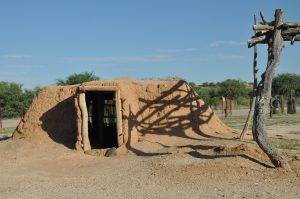
Pit House Replica at Steam Pump Ranch in the Heritage Garden.

School Field Trip with Paul Canez and Kids in Pit House, October 2025
Pit houses were their traditional dwellings built by digging a round flat hole in the ground about a foot deep which kept the house cooler in the summer and warmer in the winter. Posts were placed in the hole, and wood beams made from mesquite trees and branches were used to connect them. The houses were covered with mud and grass to provide insulation.
The name Tucson comes from the Tohono O’odham word Chuk Shon which means “at the foot of the black mountain.” Eventually the Spanish controlled the area and the term Chuk Shon changed to Tucson.
Use these helpful tips to find the Honey Bee Canyon Petroglyphs and Discover the Hohokam – Three Sites You Shouldn’t Miss
Learn more about pit houses, native crops, the Honey Bee Village excavation and more at the Heritage Garden at Steam Pump Ranch, operated by the Oro Valley Historical Society.
Another must read – The Hohokam and Huhugam: An Enduring Presence in Oro Valley and the Greater Tucson Basin, by Brittnie Smith, January 2026.
Watch videos on the OVHS YouTube Channel:
OVHS Video Series: Introduction to the Hohokam and Their Craft Traditions with Mary Jo McMullen