
Ina Road was named for Miss Gittings - but it's pronounced "EE-nah"!
Explore three authors’ perspectives to gain a fuller understanding of Ina’s life, work, and legacy.

Ina Gittings (left) and an unidentified woman compete in an annual women’s track meet, c. 1906
If you’ve ever wondered how Ina Road got its name, the story leads back to an inspiring woman—Ina (EE-nah) Gittings, a pioneer in education, athletics, and homesteading.
Born in 1885 in Wilbur, Nebraska, Ina was ahead of her time. She earned a degree from the University of Nebraska in 1906 and led a successful, independent life, never marrying. Her early career included teaching public school and serving as Director of Women’s Physical Education at the University of Montana.
During World War I, she volunteered as a physiotherapist in France and later took part in relief efforts in Turkey. In 1920, she began a long and influential career at the University of Arizona, where she earned her master’s degree in 1925 and served as Director of Women’s Physical Education until 1951. She introduced female students to sports like archery, track and field, and horseback riding—groundbreaking for the time.
With little funding for women’s athletics, Gittings fought for every resource. When a new field was needed, she secured an onion field from the Department of Agriculture—on the condition that her students harvest the onions themselves.
Beyond campus, Ina was active in Tucson’s civic life. She served on the YWCA board, was a charter member of Alpha Phi, and led the National Women’s Overseas Service League. She often gave talks on health and physical education.
Gittings also homesteaded 480 acres in Oro Valley in 1932. One 160-acre parcel is now part of Rancho Vistoso. The other, a 320-acre parcel near present-day Ina Road and La Cholla Boulevard, became her homestead. Though she lived near the university, she likely visited the land on weekends, as many Tucsonans did.
Ina Road, which ran along the edge of her property, was named in her honor. Though she pronounced her name “EE-nah,” the local pronunciation “EYE-nah” stuck—much to her dismay. She even wrote letters to newspapers trying to correct it.
Ina Gittings retired fully in 1955 and passed away in 1966. Her legacy lives on through the Gittings Memorial Fund, Gittings Hall at the University of Arizona (built in 1964), and her name on the Women’s Plaza of Honor.
So, the next time you drive down Ina Road, remember the remarkable woman behind the name—a trailblazer in education, athletics, and the history of Oro Valley.
Written by Devon Sloan as featured in OV Style Magazine, January 2024, page 13

Ina Gittings
“You say potato, I say potahto.” What does that have to do with JANUARY, you ask?
January 1885 was a fortuitous month for Oro Valley, but we wouldn’t know it for another 45 years until Ina
Gittings homesteaded here east of La Cholla, between Ina and Magee, and along what is now Rancho Vistoso
Boulevard. It was unusual at the time for women to own property, but Ina Gittings traveled to a different beat.
She was hired in the “Department of Physical Culture” at the University of Arizona in 1920 and brought
women’s athletics to the forefront of education. This was after she served as a ‘reconstruction aid’ trainer
during World War One, basically teaching the first generation of physical therapists. She then went to Turkey to
work with refugees after the Turkish/Armenian wars. Even then, while working with the refugees, she would
do some physical education with them to warm them up for their tasks ahead.
After World War One, the nation noted that with the men gone to war, we needed stronger women in case a war was to occur again. At the University of Arizona, Ina was able to create her own program and in addition to sports, she focused on teaching emotional control, motor coordination, social cooperation, confidence building, health guidance, along with a change in women’s athletic clothing – bloomers, not corsets!
Her classes were held on the second floor of what is now Old Main, sharing with male students until the men got their own building. Legend has it that JF “Pops” McKale became so angry hearing there was going to be a women’s basketball game in the new Herring Hall that he ordered a football player to flood it with fire hoses the night before the game. Ina Gittings let him know she was not pleased – she traveled to a different beat!
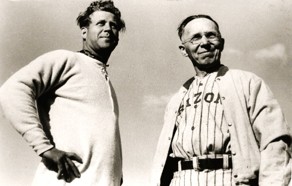
Hank Leiber and JF Pops McKale, 1941
But there’s more to Ina than just her interest in women’s sports and physical education. She also belonged to the Tucson Writers Club. Some of Ina’s poetry written in Turkey after World War One, much of it concerning close relationships, was discovered, but destroyed in 1966. She traveled to a different beat.
There’s a building at the University of Arizona named after her, (the first building on campus to be named after a female faculty member) and Ina Road is named after her. And the “potato potahto”? The road is pronounced EENA, not INA. She wrote many letters, made many speeches, had many discussions about that mispronunciation, and even though she made a lot of gains for herself and for women in sports, she wasn’t able to make us travel to a different beat along Ina Road.

Jim Williams, Author of Oro Valley, The First Fifty Years and 2025 winner of a national award from the American Association of State and Local History.
By Jim Williams. Originally published in OV Voice, May 2014.
She was an early women’s educator, a community activist and a homesteader in Oro Valley. A major, local roadway is named after her. But how do you pronounce her name? Ina Gittings. You say EE-nah and I say EYE-nah? More on that later.
İna Gittings was born in 1885 in Wilbur, Nebraska. Ina was a professional woman ahead of her time. She earned a university degree and led a successful, independent life. She never married.
Gittings graduated from the University of Nebraska in 1906. Her first job was as a public-school teacher in Lead, South Dakota. Ina served as a physical education instructor at the University of Nebraska from 1906-1909 and then spent six years as the Director of Women’s Physical Education at the University of Montana. She was a trailblazer in women’s athletics!
When America entered World War I in 1917, Ina Gittings left education and volunteered to go to France and serve as a physiotherapist, she helped the wounded young men to recover. After the war, she also served in relief efforts in Turkey.
Miss Gittings came to teach and serve as Director of Women’s Physical Education at the University of Arizona in 1920. She completed a master’s degree there in 1925 and continued to work at the University until 1955. She introduced female students to archery, track and field, horseback riding and other sports. Women’s involvement in athletics was a new idea in the early twentieth century. Prior to that time, girls were thought to be too frail for sports.
Before the 1970s, universities provided very little in funds or facilities for women’s athletics. Men’s sports received the vast majority of athletic funds. “We struggled to get everything they [the girls], wanted to keep them interested. It was quite a battle sometimes, but we succeeded,” she later remembered. At one point, the women needed an extra athletic field for newly introduced sports. Only the Department of Agriculture’s onion fields were available. Ina won the battle and obtained the onion fields, but she and the female athletes first had to harvest the onions themselves!
Miss Gittings was very active in the Tucson community and in professional organizations. She served as the president of the National Women’s Overseas Service League of World War I. Ina was a member of the Tucson YWCA board and a charter member of the Alpha Phi sorority. She often delivered talks on physical education and health to local organizations.
Ina Gittings was also one of Oro Valley’s early pioneers. She claimed two sections of federal land under the Homestead Acts in October 1932. The sections totaled 480 acres. One parcel of 160 acres was located in what is now Rancho Vistoso, along Rancho Vistoso Boulevard and includes most of the Vistoso Vista subdivision. The other parcel, along what is now Ina Road, totaled 320 acres. This was located east of La Cholla Boulevard, between Magee Road and Ina Road. Homesteaders were required to build a residence to keep title to the land but did not have to live there full time. Ina had a home near the university and probably visited the homestead on weekends, as many Tucsonans did.
Ina Road was named for her. Miss Gittings pronounced her name “EE-nah.” But our local Ina Road has come to be pronounced “EYE-nah.” She wrote letters to local newspapers complaining about people mispronouncing “her” road. Ina Road was unpaved when she homesteaded in Oro Valley in the early 1930s.
Professor Gittings stepped down from the position of Director of Women’s Physical Education in 1951. She kept her professorship and some teaching duties until fully retiring in 1955. Richard Harvill, president of the University in the 1960s, said, “Miss Gittings served the University with complete dedication and competence for 35 years” and her influence on young women “was well known and widely recognized.” She continued to deliver talks to community groups into the 1960s.
Ina Gittings died in 1966. The Gittings Memorial Fund was established in her honor. She is listed on the Women’s Plaza of Honor on the University of Arizona campus and Gittings Hall was built in 1964 and named for her. When you drive on Ina Road, remember women’s educational pioneer and Oro Valley homesteader Ina (EE-nah) Gittings.

Claiming the Desert: Settlers, Homesteaders and Ranchers in Oro Valley, Arizona, 1865-1965, by James A. Williams
Fun Fact: The Rattlesnake Queen of Arizona, Catherine Chapman-Reidy lived with Ina Gittings near the University when she came to Tucson.
A great resource to learn more about Ina Gittings and Other Notable Locals, is Claiming the Desert – Settlers, Homesteaders and Ranchers in Oro Valley, Arizona 1865-1965 by James A. Williams. Jim is a local historian and retired teacher. A former president and Honorary Member of the Oro Valley Historical Society (OVHS), he donates his book profits to OVHS. Purchase his book on Amazon or at the Pusch House Museum at Steam Pump Ranch.
Jim is also the recipient of an Award of Excellence for his book Oro Valley the First Fifty Years, a prestigious award presented by The American Association for State and Local History (AASLH). This book can be purchased at Amazon, the Western National Parks Store on North Vistoso Village Drive, or also in the Pusch House Museum.
Read more about the Town Storyteller, Jim Williams from ILOVEOV.com, Featured Citizen — Jim Williams, January 2024