
Jim Kriegh: A Legacy of Discovery
A man whose vision, curiosity, and leadership helped shape the community we know today. As a founder and former President of the Oro Valley Historical Society, Jim played a vital role in preserving and promoting our town’s heritage.
Marjorie Kriegh, along with her children Kevin and Kathy, strongly supported Jim’s vision for incorporation. While working for an attorney, she confirmed it was indeed possible. Marjorie then began saving newspaper articles throughout the process, ultimately filling three large scrapbooks. She later became the Town Historian and continued documenting the journey to successful incorporation.
Jim was also instrumental in the Town of Oro Valley’s acquisition of Steam Pump Ranch, ensuring that this historic site would be protected and shared with future generations.

Henry “Hank” G. Zipf and Jim Kriegh at the Society’s first fund raising event held at White Stallion Ranch
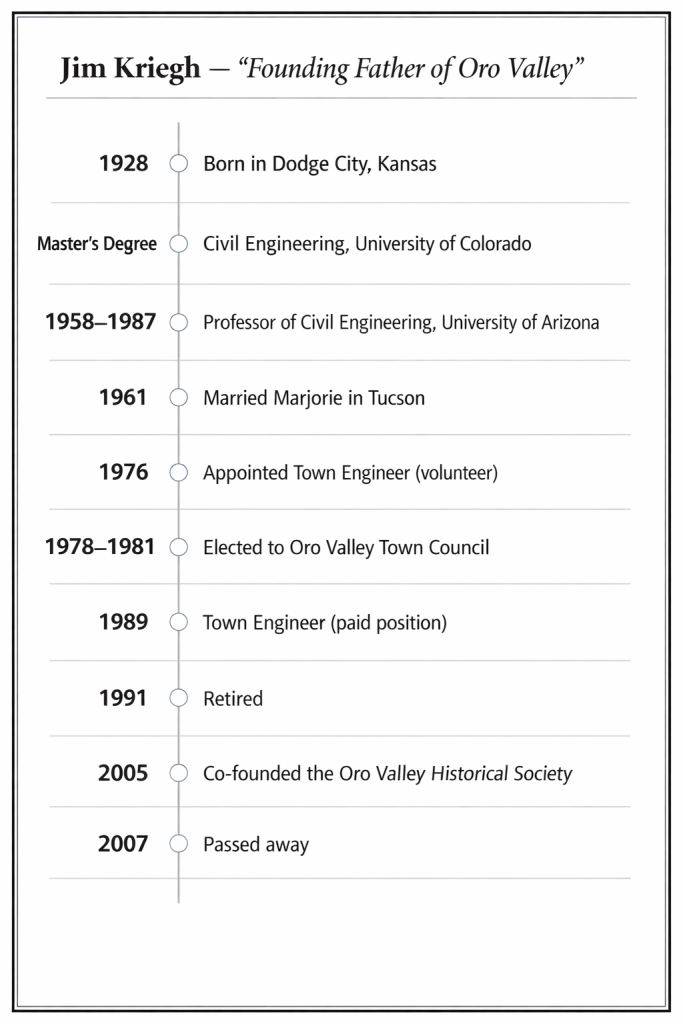
Jim Kriegh Timeline
The Sheraton Resort / El Conquistador Tucson, A Hilton Resort

Opened in 1982 as Tucson’s first major resort, the Sheraton Resort—now El Conquistador Tucson, A Hilton Resort—sits along Oracle Road at the base of the Santa Catalina Mountains.
Fast-tracked through Oro Valley’s early permitting process, the project was overseen by Jim Kriegh, whose engineering expertise ensured its successful completion. The resort quickly became a vital source of tax revenue for the newly incorporated town, helping fund essential services and facilities.
In 2003, Hilton Hotels acquired the property. The 1980s marked a period of rapid growth for Oro Valley, including the 1986–87 annexation of more than 8,600 acres—over 7,000 of which became Rancho Vistoso.

Mural at James D. Kriegh Park.

Jim’s Advice to YOU: Dream it, then do it!
Dedicated on April 18, 2001—Oro Valley’s birthday—James D. Kriegh Park honored our town founder. A nature lover, Jim often walked the park’s trails with his dog and was deeply surprised, humbled, and moved by the recognition. The park is located at 23 W. Calle Concordia, near his former home.

Freedom’s Steadfast Angel of Love sculpture created by Lei Hennessy-Owen

Memorial Rock Plaque at James D. Kriegh Park.
The park features a 9/11 Memorial honoring both the national tragedy and Christina-Taylor Green, a CDO softball player and victim of the 2011 Safeway shooting. Born on September 11, 2001, Christina is remembered with an angel statue overlooking the softball field, which includes an I-beam from the Twin Towers, metal from the Pentagon, and a boulder from the Pennsylvania crash site. Explore Freedom’s Steadfast Angel of Love and other public art in Oro Valley.

Visit the Pusch House Museum to View Jim’s Meteorite Collection from Around the World.
A civil engineer and retired University of Arizona professor, Jim combined a deep respect for the past with an insatiable passion for discovery. That same spirit led him to an extraordinary find:
In 1995, while metal detecting for gold, Jim Kriegh discovered one of the world’s largest meteorite fields in Gold Basin, Arizona. Analysis by the University of Arizona’s Lunar and Planetary Laboratory identified the fragments as L4–5–6 chondritic meteorites, about 4.5 billion years old.
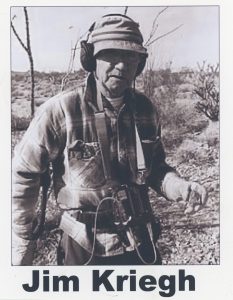
Jim Kriegh
Jim, along with John Blennert and Twink Monrad, recovered over 2,000 meteorites, believed to have fallen up to 15,000 years ago.
Announced at the 1998 Tucson Gem and Mineral Show, the discovery made Jim a local celebrity. He traded and collected meteorites from around the world, later donating part of his collection to the Oro Valley Historical Society. Learn more on our Meteorite Page, where you’ll find interviews, videos, and details about Jim’s historic Gold Basin meteorite discovery.
Oro Valley owes much to Jim’s dedication to both science and history. His work reminds us that exploration doesn’t just happen in faraway places — sometimes, it begins in our own backyard.
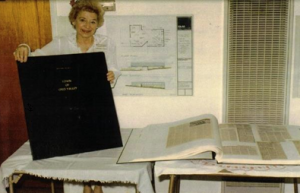
Marjorie Kriegh, Oro Valley Town Historian
When I first came to Tucson, I rented an apartment on little casita on Campbell Avenue, north of River Road. In that area, I lived for a while and met a lady there whom I later married. We married in late 1960 and moved up north to Alvernon. We started looking and renting, trying to find a house to buy. We went out east of Tucson, where most of the places were, but we hated the traffic and couldn’t find anything we really liked. My wife wanted something particular that wasn’t common in homes at that time. They were putting in things like the built-in machine stuff as almost part of the kitchen. She didn’t like that—she wanted a separate laundry room. We spread the word, and a realtor we ran into said, “Oh, I have a home out on the other side of town. Let’s go take a look—it has a separate laundry room.” We went out and took a look at it; it was a model home, one of three in the Shadow Mountain Estates. They were trying to sell it, and we liked it, so we told them we’d buy it.
The idea came about in 1968 when the mayor of Tucson, Jim Corbett, announced that he was going to annex mountain to mountain. There was actually a picture in the paper showing a map completely surrounding Tucson, with all the areas he wanted to annex. This included the Catalina Foothills, the Catalina Mountains, Tucson Mountains, and the areas around the south. Part of the concern was, most people, of course, did not want to be part of Tucson. But the laws back then were different than today. All he had to do was pick up 51% of the assessed valuation in the map to annex everything. Many people in the Foothills were afraid that businesses around—particularly on the south side—would offset the assessed valuation in the Foothills.
The group of homeowners covering the Foothills and Tucson Mountains got together to see what they could do to stop it. At the time, they even prepared bumper stickers saying, “Kicking, stomping, screaming, yes! Annexation, no!” because Jim Corbett had said he’d take them in kicking, stomping, and screaming.
 At that time, I happened to be part of the Shadow Mountain Homeowners Association. My wife worked for an attorney who lived in Flecha Caida of Catalina Foothills, attorney Ellsworth Triplet. He started studying the laws about incorporation and asked my wife, Margie, if he could get in touch with me. I did, and he said that after studying the laws around Tucson, he thought we were probably the only area that could even consider incorporating.
We had to be further than six miles from the City of Tucson, and we had to have common interests and goals. It wasn’t essential to have a shopping center or anything because we were modeling ourselves after Paradise Valley, which went all the way to the state Supreme Court to get incorporated, and they didn’t have businesses that some people thought were necessary. I talked to our homeowner’s association board members about it, and they said, “Let’s go for it.” I got together with Professor Nuland at the University, who taught surveying. I had taught surveying at the University of Colorado before coming down here to teach in the Civil Engineering Department. We decided to see what that six-mile limit would look like.
We established the six-mile limit and had to swing an arc of a circle. We missed that limit by two feet—so we went six miles plus two feet at one point. I drew up a metes-and-bounds description covering Shadow Mountain Estates, Shadow Mountain Estates East, Linda Vista, Citrus Tracks, half of Campo Bello Estates, and the Oro Valley Country Club. At first, I included Highlands Trailer Park. Then we counted the people—we needed at least 500 “bodies.” It didn’t have to be adults—any men, women, and children living in the area counted. I counted and came up with 791, so we had enough people, common goals, and were further than six miles from Tucson. That meant we had something we could work with.
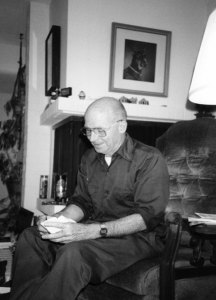
Jim Kriegh Planning for the Future in his Living Room
I contacted Oro Valley Country Club Estates at the time, and the president of the Oro Valley Country Club Estates, Bob—I believe it was Bob Daly at the time—was working with Pima County to get their roads paved. Pima County was working on that, so he did not want to jeopardize the situation with having their streets paved and so forth down there. We just had to sit quietly for some time.
Two years later, when Steve Engle became president of the Oro Valley Homeowners Association, I talked to Steve about it, and he was all for the idea. So we continued looking into it, talking to more people. Of course, in those two years, the area grew a little bit; there was a slightly larger population. I talked to Highlands. They could not get 51% of the people to go for the idea, so we took them off the map. Our first map decided that we’d call it the town of Palo Verde. We had a list of about ten names and decided to call it the town of Palo Verde. Considering the town of Palo Verde, it later showed that there was a Palo Verde Nuclear Plant west of Phoenix, so we would have had to change it. [Read, How Did Oro Valley Get Its Name?]
I happened to run into a gentleman called Jack Spalding at a filling station. In fact, the people at the filling station suggested him to me. I asked if they knew him, and they said, “Oh yes, he’s up here at the corner of Ina and Oracle at the Mobile Station, Ike’s Mobile Station.” They warned me he might be a little rough and to be careful, but he was sitting right out there in the car. I went out, talked to him, and got along with him great. He liked the idea of incorporating, and a few weeks later, he suggested that if we really wanted to get the people in Oro Valley Country Club along behind it, we should call it the town of Oro Valley. I said, “Okay, that’s fine.” All of our people were fine with it, and I’m glad we decided that. It’s been a name that I think we can all be proud of. Part of our hesitation at first was that we couldn’t call it the town of Oro Valley as we didn’t really have their [the country club] permission. But after it became apparent that they liked the idea, it was well received.
What really drove us to continue with incorporation after we talked over the idea was that we wanted to control our own destiny. Our police protection was not too good—not because of the Pima County Sheriff’s Department necessarily, but they were spread too thin and could not cover the areas properly. We thought that if we could gain control of our area, then the things we decided would be decided by the people living there. Often, we would go down to Planning and Zoning or the Board of Supervisors to have something to say about things affecting us, and they seemed to care less whether we were there. There was rarely any response to anything we had to say.
Those were the things that really got us going. After we decided we could incorporate, we decided to make the move. We knew that the City of Tucson and Pima County were both against us, and the newspapers, including the Tucson Citizen, the Tucson Daily Star, spoke against the idea of another incorporated town. At that time, there were only two incorporated towns in Pima County: the City of Tucson and South Tucson. The City of Tucson had South Tucson surrounded, so we knew they didn’t want us to exist. When we decided to follow through with incorporation, we circulated petitions. We circulated them Friday, Saturday, and Sunday, and turned them in on Monday so the City of Tucson wouldn’t have time to annex anything and put us within the six-mile limit.
I think that the City of Tucson felt that they would start losing money. They wanted to control the whole valley, have it under one government, and I think those were some of the driving forces. They did not want it, and it was often said they did not want us to become like Phoenix with a lot of satellite cities around it. In fact, after we did become incorporated, there was still a lot of resistance from the City of Tucson and Pima County. When we filed the petitions, of course, the Board of Supervisors, even though the law says if we meet the criteria they shall incorporate you, they did not. They said no and gave excuses like, “Well, you can’t buy a loaf of bread or a cup of coffee in Oro Valley.” We ended up having to go to court, and this took a four-year court battle. We had to file suit against Pima County because they did not incorporate us.
That was first going to be heard in the City of Tucson, but an attorney advised us that if it was heard in the City of Tucson in Pima County, we wouldn’t stand a chance. It was better to get a change of venue, and we did. We got a change of venue to Pinal County. Our court case was then going to be heard and was heard up in Pinal County. The court case was, I think, fairly simple, inasmuch as we went through all the criteria necessary for incorporation according to the laws. They did challenge the six-mile limit and really wanted to know how we came up with the fact that we were six miles further. Pima County was challenging it, and we explained to them that we used the coordinate system that Pima County had established, which Professor Nuland developed for them. We used that coordinate system and established the six-mile limit from that, and Professor Nuland is the one that did it. That dropped all challenges to the six-mile limit right then and there.
It turned out that the judge in Pinal County, after he ruled in our favor, became ill and couldn’t finalize the papers. During that time, the City of Tucson annexed an area and put us within six miles. Then it went to the Court of Appeals—or the local court in the Tucson area—and they ruled against us, saying we weren’t incorporated because we were within six miles of the City of Tucson. The only other place we could go was the state Supreme Court. When it got to the state Supreme Court, they ordered that Pima County incorporate us. Pima County stalled for a while until they finally— I think it was Bud Walker, who was on the Board of Supervisors—said, “If they want to be incorporated, let’s incorporate them,” and they voted to incorporate us at that time.

Kriegh’s Fight for Oro Valley from the Beginning – – Daily Star April 26, 1984
There was some very strong opposition to start developing in the town. The biggest opposition actually came from two people who lived in the same area I lived in, the Shadow Mountain Estates. They would have meetings and had Pima County officials out to tell people how much it would cost us in taxes if we became a town—that we would have to take care of our own sewers and many other things—and they had a lot of people scared. They were building quite a bit of opposition to the idea. I think these people against it had it figured out—they knew how they were going to stop the town. Pima County agreed to appoint the first council from two people who were for the town, which was Steve Engle and myself, and two people who were definitely against the town, which was Virgil Brandon and Dorothy Montgomery, and somebody supposedly neutral, Kenneth Holford. After we were appointed to the council and getting started, there was every effort by, of course, two to make things not work. There was effort from two of us trying to make things work, and I think Kenneth Holford, in my personal opinion, was against the town from the very beginning. In fact, I went up and tried to get a restraining order to keep him from being appointed.
The first official election actually had four people who were against the town elected to the council. Lauren Rhude, who was for the town, was the only person who made it on the council, and he made it by a recount and one vote. I have always said Lauren Rhude was clever enough, smart enough, that he almost completely controlled the other four on the council. They could not do the things they wanted. He knew how to handle the situation.
They did make a motion to disincorporate the town, and it passed 4 to 1, but the town attorney said, “You can’t do that. You don’t disincorporate a town that way.” When they found out they couldn’t do it, they wanted to start circulating petitions to disincorporate the town the way they found out they had to do it, and that was tried. One of the big leaders in circulating the petitions was Orval Shields, who had helped us get the signatures for the town. He got 100% of all the signatures in the area he lived in for the town, but for some reason, he decided to try to fight it. He tried to collect signatures with a beacon light out at night and would get anybody’s signature, whether they lived in the town or not. They had a lot of signatures, but they didn’t have enough to successfully disincorporate the town.
At first, what made the town successful was the fact that we had volunteers. Everybody was a volunteer. Our building inspectors were qualified electricians or mechanical engineers who could really do plan checks and inspections. We had Planning and Zoning. We had the clerk. We were all volunteers at first until we started getting some revenue. The majority, after they elected, would not appoint me as town engineer, but eventually they did. One of the people elected made a motion—another person who came on the council later, still against the idea—said that he knew I would be the volunteer engineer and made the motion to appoint me. I was then appointed.
The first mayor was Kenneth Holford, followed by Dick Colt, who lived in Oro Valley Country Club. Dick Colt was not necessarily for the idea of the town, but as mayor he turned the town around. He said he would do what was necessary even though he was not for the idea of running the town, and he actually turned it around and got things going. After him was Lois Lamberson, who lived in Shadow Mountain Estates. Then after Lois Lamberson was Steve Engle, who served as mayor for a long time and was well liked and respected by everybody living in the town of Oro Valley.
When the town first got started, we had a lot of volunteers, which kept us going until revenue started coming in. As we started getting bigger, we had to hire a town clerk, hire a Planning and Zoning director, pay building officials, and pay building inspectors. The revenue started drying up. In other words, it was going backward, and it was just about the time we were going to go from maybe a $200,000 surplus down into the red when Mr. George Johnson came along and suggested he wanted to build a hotel. He asked that the area be annexed before the hotel was ever built, and the town did annex the area. I know I was with George on the site when he said he would like to build a resort hotel there. His dream of building this big hotel—it was the first resort hotel in the metropolitan Tucson area—became very successful.
It also turned the financial picture of the town around because of the building permit fees and all the casitas and other developments that followed. Building in the town really started to move, more and more homes and developments were being done, and the town started becoming well-heeled and financially sound. Today, that resort’s name is the Hilton El Conquistador. It was all done in a way that our engineers and the firms we hired stayed on top of it. We paid them extra, charging the developer an extra plan check fee percentage to cover those costs, which he fully agreed to, so we could build it fast. We actually opened that hotel 11 months from the day we broke ground.
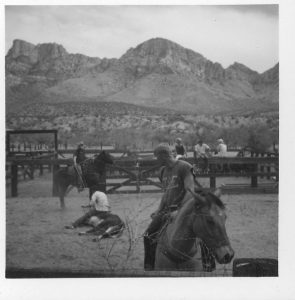
Pusch Peak: Branding Cattle at Steam Pump Ranch
One of our councilmen, Steve Renneckar, who was a former councilman and an attorney, used to do some development in the town. He later was on the council, and he and I became good friends. He lived in the foothills, had a telescope, and used to watch the big horn sheep. He called me over one time to his house so I could see all the big horn sheep up there at the end of Pusch Peak grazing.
The park was built by Pima County, just within a year or so before we became a town. It was named Dennis Weaver Park, after one of the Pima County Board of Supervisors who said no to our incorporation. That cost us a four-year court battle. Many newer citizens thought it was named after Dennis Weaver, the actor, and they were surprised when they asked me. I’d say no, it was a board of supervisor.
Mural at James D. Kriegh Park. Photo taken October 2025.
I always said—and we always said—that if the county had tried to get us to take over the park when we couldn’t afford it, and when only a very small percentage of people living in Oro Valley were using the park. Later, as Oro Valley grew and more people were using the park, the town agreed—and I think rightfully so—to take it over. I’ve probably always said it should be called Oro Valley Park, not Dennis Weaver Park, because Dennis Weaver was not a name, we really enjoyed considering the battle he caused us. It was the council’s decision to name it after me, and it’s an honor, but I didn’t ask them to do it. Oro Valley has certainly gotten a lot larger. It used to be that driving out this way, there was hardly any traffic, and I was always glad to have that little traffic when I came back from the University. Now, the traffic is quite heavy at times, but I really expected it. I think the town’s doing a lot to handle it. I like the way the town’s growing.
To me, the Hilton El Conquistador was one big asset for the town. I think Northwest Hospital is another big asset. I think these things will keep the town growing, developing, and bringing in more business to make it and try to keep it the town that the people like.

Memorial Rock at James D. Kriegh Park.
I think the one thing about Oro Valley that I’ve always liked is the people who live in it—they seem to really like it. At one time, we were rated the safest town in the country. We have good police protection, controllable planning and zoning and development. It is a town that people can come to and hopefully eventually enjoy all the various things they might like in the form of arts, recreation, and other facilities. The other thing I’d say is if you have a dream of something that needs to be done and feels it should be done, do it.