
William “Curly” Neal (1849-1936) and Annie Box Neal (1870-1950)
 Oracle Road — today recognized as Historic Route 80 — was once one of Southern Arizona’s busiest corridors. In the late 19th and early 20th centuries, it linked Tucson with the communities of Oracle and Mammoth, carrying miners, ranchers, travelers, and freight northward. Among the people who helped make this route essential was businessman, rancher, and entrepreneur William “Curly” (due to his long, wavy hair) Neal, whose work connected Tucson to the mining districts and settlements beyond the Catalina Mountains.
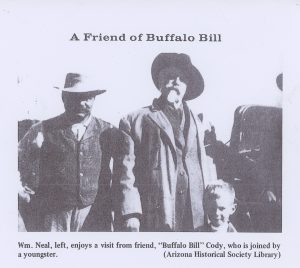
Curly Neal and Buffalo Bill Cody
Born in the Cherokee Nation in Oklahoma, William’s (Curly) heritage reflected the complexity of American history: his mother survived the Trail of Tears, and his father was of African American descent. Curly learned self‑reliance early, taking on odd jobs until, at nineteen, he met Buffalo Bill Cody, who enlisted him as a military scout around 1868. William left the Army in 1878, but he and Cody remained lifelong friends.
After settling in Tucson, Curly worked as a cook at the Maison d’Arcy restaurant before saving enough to launch his own stage and freight business. Opening in 1876, his Coral Stables — also known as the Opera House Livery and Stables — operated on Pennington Street and quickly became a hub of activity. Curly likely crossed paths with George Pusch, whose Steam Pump Ranch was already a vital stop for travelers heading north. By 1874, the ranch offered water, rest, and blacksmith services for stage lines. calvary, and ranchers. A fare from Tucson to Steam Pump Ranch cost just $1.00.
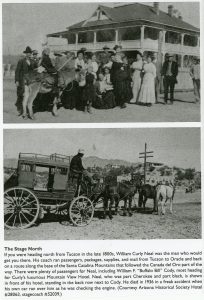
With the arrival of the Southern Pacific Railroad in Tucson, Curly secured the mail contract for the Tucson–Oracle–American Flag route, making Oracle Road a daily path for his carriers. His freight line supplied Fort Lowell and hauled ore, wood, and water to the mines in Mammoth and Oracle. By the height of his career, Curly was considered one of the wealthiest African Americans in Tucson. A contemporary account from the Mohave County Miner praised his operation:
“One of the largest freighting outfits in the world is used in connection with the mill at the Mammoth property. The distance from the mine to the mill is three miles, all but half a mile downgrade. Three teams move 145 tons of ore a day. Each team consist of 20 animals, and they draw four wagons. The wagons are immense affairs, almost as big as box cars. Wm. Neal is one of the best businessmen in southern Arizona.”

Curly and Annie Neal. Photo courtesy of Arizona Historical Society.
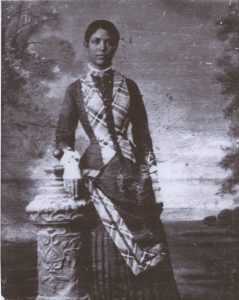
Annie Box Neal
Curly’s wife, Annie Magdelena Box, led a life every bit as remarkable as his. Born in Tahlequah, Oklahoma, Annie was the daughter of sixteen‑year‑old Hannah Box — herself a survivor of the Trail of Tears — and Wiley Box, who was of English and African descent. The family moved to Tucson in 1879 seeking a healthier climate for Wiley, who had contracted yellow fever.
Annie attended St. Joseph’s Academy, where she studied music and learned the social refinements expected of young women of the era. She became an accomplished pianist and reportedly composed several pieces. Yet she preferred outdoor work and later joined her parents as they prospected for gold across the Arizona desert. During these years she developed a reputation as a skilled sharpshooter.
Annie’s early adulthood included two marriages — first to soldier James Lewis, then to William Easton — both of which ended in divorce. She met Curly Neal through her mother’s Tucson boarding house, where Curly lived, and the two married in 1892, combining their mining claims, inherited land (some inherited from Hannah), and business ventures.
Together Curly and Annie established the Mountain View Hotel in Oracle, Arizona in 1895. Annie primarily ran this 12-room hotel and health resort, while Curly attended to their 3N Ranch and additional enterprises, including a ranch in New Mexico. Annie was known as a gracias hostess and ran the hotel with warmth and flair. In 1896, the Tucson Citizen wrote: “Mrs. Neal is the queen of hostesses and that to find such a hotel and such service so far away from the railroad is like a pleasant dream.”
By the early 1920s, new luxury hotels in Phoenix and Tucson began attracting wealthy Eastern visitors, bringing with them social expectations and racial attitudes that Curly and Annie had not previously encountered. The Mountain View’s popularity declined, and its era of grandeur faded.
Curly died in 1936 at age 87 after a tragic accident at the hotel. Annie sold the 3N Ranch two years earlier but remained at the Mountain View until her death in 1950 at age 80.
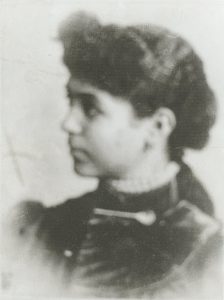
Annie Box Neal