
Sara Plummer-Lemmon (1836 - 1923)

Sara Plummer 1865 (Wikipedia)
Sara Allen Plummer Lemmon—namesake of Mount Lemmon in Arizona’s Santa Catalina Mountains—was a remarkable 19th‑century botanist, illustrator, and educator whose life bridged science, art, and adventure.
Born in Maine and educated in Massachusetts and New York, Sara worked as a teacher and volunteered as a Civil War nurse. At 33, seeking a healthier climate, she traveled alone via ship from New York to California, eventually settling in Santa Barbara. There she quickly became known as one of the town’s leading intellectuals, drawing on her background in chemistry and physics and her talent as an artist.
Sara founded Santa Barbara’s first library, helped establish the Natural History Society, and taught herself botany by sketching local plants. Her work led her to fellow botanist and Civil War veteran, John Gill “JG” Lemmon, a Civil War veteran and respected plant collector. The two married in November 1880 and formed a scientific partnership that would define both of their careers.
Their honeymoon became a legendary expedition: after several attempts—and with the help of rancher Emerson Oliver Stratton—they reached the summit of the Santa Catalina Mountains. Sara became the first white woman to stand on the peak, which was named Mount Lemmon in her honor. The name became official in the 1904 Pima County survey. The Tohono O’odham name for the peak is Babad Do’ag (Frog Mountain).
During their 1880–1882 expeditions, they endured life‑threatening illnesses, financial hardship, and even Apache raids while exploring southern Arizona and the summit that now bears their name. Despite these dangers, the couple documented an extraordinary number of previously unknown plants.
Their discoveries account for about 3% of all vascular plant species in Arizona, a remarkable contribution from just two years of fieldwork. Species they identified are still recognizable today by their botanical epithets: “lemmonii” honoring J.G. Lemmon (e.g., Asclepias lemmonii) and “plummerae” honoring Sara Plummer Lemmon (e.g., Allium plummerae).
By the 1880s, Sara Plummer Lemmon was celebrated as one of California’s most accomplished botanical illustrators and a sought‑after lecturer. As a member of the California Academy of Sciences, she contributed an extraordinary number of paintings and plant specimens. Sadly, many of her works were lost in the 1906 San Francisco earthquake and fires, erasing a portion of her remarkable legacy.
Sara was also a passionate advocate for California’s natural heritage. After 12 years of persistent campaigning, she succeeded in having the golden poppy designated as the official state flower. When she passed away in 1923, the symbol she championed was engraved on her headstone—a final tribute to her lifelong devotion to the landscapes she loved.
Together, Sara and John discovered, described, and illustrated hundreds of plant species. Her meticulous artwork helped bring Western botany to national audiences, cementing her legacy as one of the most influential naturalists of her era.
Life stories: Mt. Lemmon’s namesake was female explorer, by Kimberly Matas Arizona Daily Star, Updated
Sara Plummer Lemmon: Pioneering Botanist, by Erin Blakemore, JSTOR Daily, March 11, 2015
Look to the Mountains, by Suzanne Hensel, 2003

Gertrude Pusch-Zipf (right) on horseback in front of Lemmon Rock Lookout Tower by Hank Soldier’s Camp.
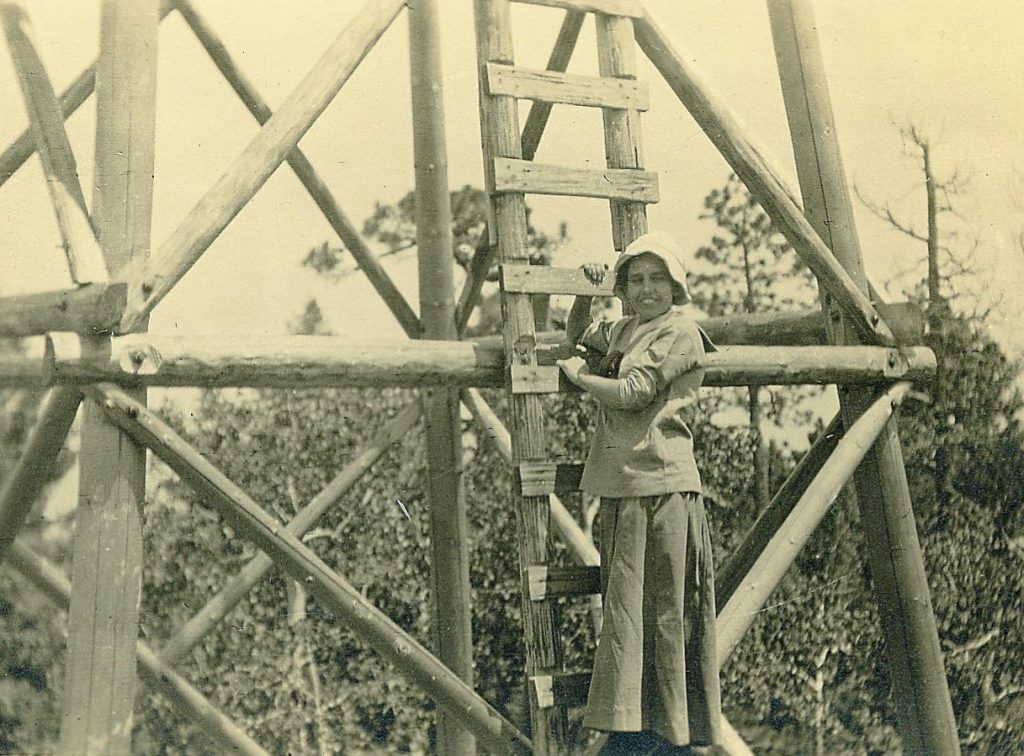
Gertrude Pusch in Bonnet on Ladder on Lemmon Rock Lookout Tower