
Sara Plummer-Lemmon (1836 - 1923)

Sara Plummer 1865 (Wikipedia)
Few people who visit Mount Lemmon realize that the mountain is named for an extraordinary woman whose life combined science, art, education, and adventure. Sara Plummer Lemmon (1836-1923) was a pioneering botanist, botanical illustrator, educator, librarian, and advocate for the natural world. Her contributions to science helped shape our understanding of Arizona’s flora, while her determination and intellect made her one of the most remarkable women of the American West.
Born in Maine in 1836, Sara received an impressive education for a woman of her era, studying chemistry and physics and developing considerable artistic talent. She taught school in both Maine and New York and later volunteered as a nurse during the Civil War, caring for wounded soldiers. Unfortunately, recurring health problems made the harsh northeastern climate difficult for her, prompting a life-changing decision. In 1869, at age 33, she traveled alone to California in search of a healthier environment.
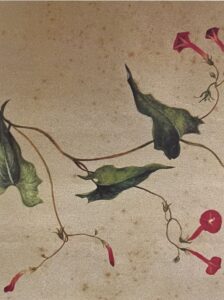
Sara Plummer Lemmon Watercolor, “Red Morning Glory”
Settling in Santa Barbara, Sara quickly became part of the city’s intellectual community. She established Santa Barbara’s first lending library and helped foster cultural and educational opportunities in the growing town. Her artistic skills led her to sketch local plants, and what began as an artistic interest soon evolved into a passion for botany. Through careful observation and illustration, she taught herself the science of plant identification and classification.
In 1876, Sara met John Gill “J.G.” Lemmon, a respected botanist and fellow Civil War veteran whose lecture she attended in Santa Barbara. Their shared fascination with plants blossomed into both a scientific partnership and a romance. The pair married on Thanksgiving Day in 1880, and rather than embark on a traditional honeymoon, they chose an ambitious botanical expedition to southern Arizona.
Traveling by train from California to Tucson, the newlyweds assembled wagons, horses, and burros and set out to explore the rugged Santa Catalina Mountains. Guided by rancher and miner Emerson Oliver Stratton, they reached the highest peak in the range. Sara became the first known Euro-American woman to stand on the summit, and the mountain was later named Mount Lemmon in her honor. The name was officially recognized in the 1904 Pima County survey. Long before that, however, the mountain was known by its Tohono O’odham name, Babad Do’ag, meaning “Frog Mountain.
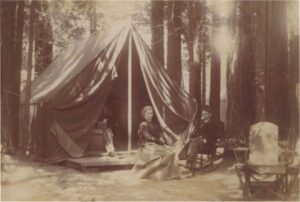
Sara Plummer Lemmon and Husband, John
The Lemmons’ Arizona explorations extended far beyond the Catalina Mountains. They conducted extensive fieldwork in the Chiricahua and Huachuca Mountains, often under extremely difficult conditions. Their expeditions were challenged by illness, financial hardship, rough terrain, and the dangers associated with travel in the Arizona Territory during the early 1880s. Despite these obstacles, they documented and collected a remarkable number of plants previously unknown to science. Their discoveries accounted for approximately three percent of Arizona’s vascular plant species, an extraordinary achievement resulting from only a few years of fieldwork. Species they identified are still recognizable today by their botanical epithets: “lemmonii” honoring J.G. Lemmon (e.g., Asclepias lemmonii) and “plummerae” honoring Sara Plummer Lemmon (e.g., Allium plummerae).
Back in California, the couple continued their scientific work through the development of the Lemmon Herbarium, preserving specimens and expanding botanical knowledge. Although many publications initially credited discoveries to “J.G. Lemmon and Wife,” John consistently advocated for Sara to receive recognition for her contributions. Sara also gained recognition as one of California’s leading botanical illustrators, combining scientific accuracy with artistic excellence. As a member of the California Academy of Sciences, she contributed numerous plant specimens and illustrations, although many of her works were tragically lost in the 1906 San Francisco earthquake and fires.
After John’s death in 1908, Sara continued her work independently. She remained active in civic and women’s organizations and served as California’s Commissioner of the Department of Women. One of her most enduring accomplishments was a twelve-year campaign to have the California golden poppy designated as the state’s official flower. Her efforts succeeded, and the golden poppy was officially adopted as California’s state flower. Fittingly, a poppy was engraved on her headstone when she died in 1923.
Today, Mount Lemmon stands as a lasting tribute to a woman whose curiosity, determination, and scientific contributions helped illuminate the natural history of the Southwest. While the mountain bears her name, Sara Plummer Lemmon’s true legacy lies in the hundreds of plant specimens she documented, the scientific knowledge she advanced, and the barriers she broke for women in science. More than a namesake, she was a trailblazer whose influence continues to be felt across Arizona and beyond.
Life stories: Mt. Lemmon’s namesake was female explorer, by Kimberly Matas Arizona Daily Star, Updated
Sara Plummer Lemmon: Pioneering Botanist, by Erin Blakemore, JSTOR Daily, March 11, 2015
Look to the Mountains, by Suzanne Hensel, 2003

Gertrude Pusch-Zipf (right) on horseback in front of Lemmon Rock Lookout Tower by Hank Soldier’s Camp.
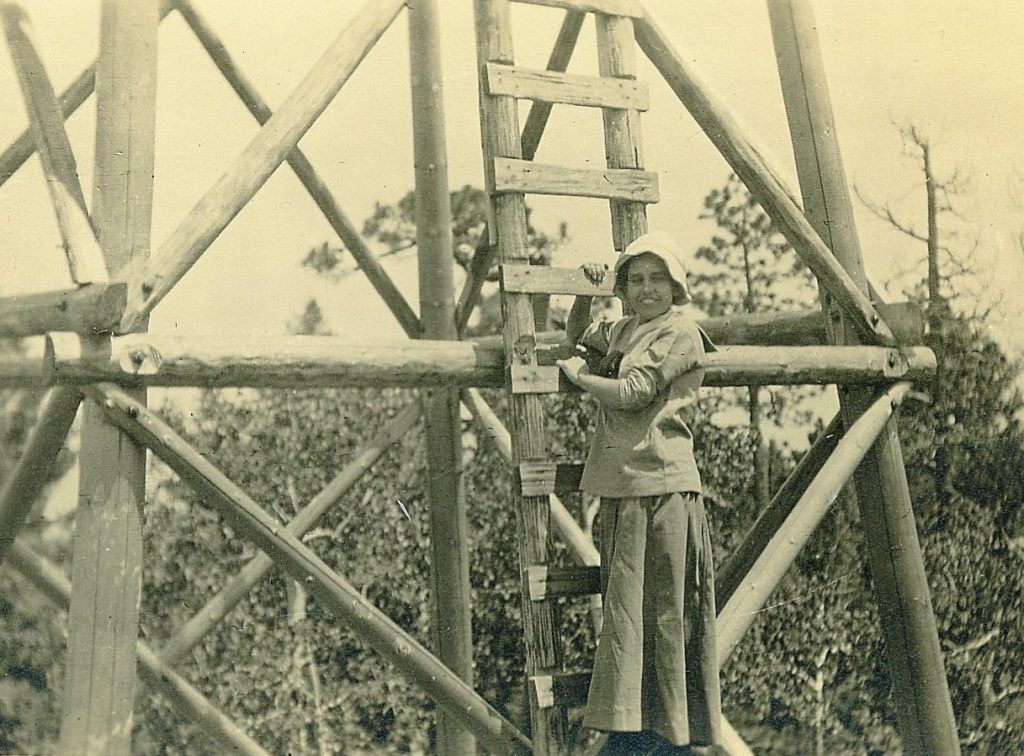
Gertrude Pusch in Bonnet on Ladder on Lemmon Rock Lookout Tower