
African American Education and History in Tucson
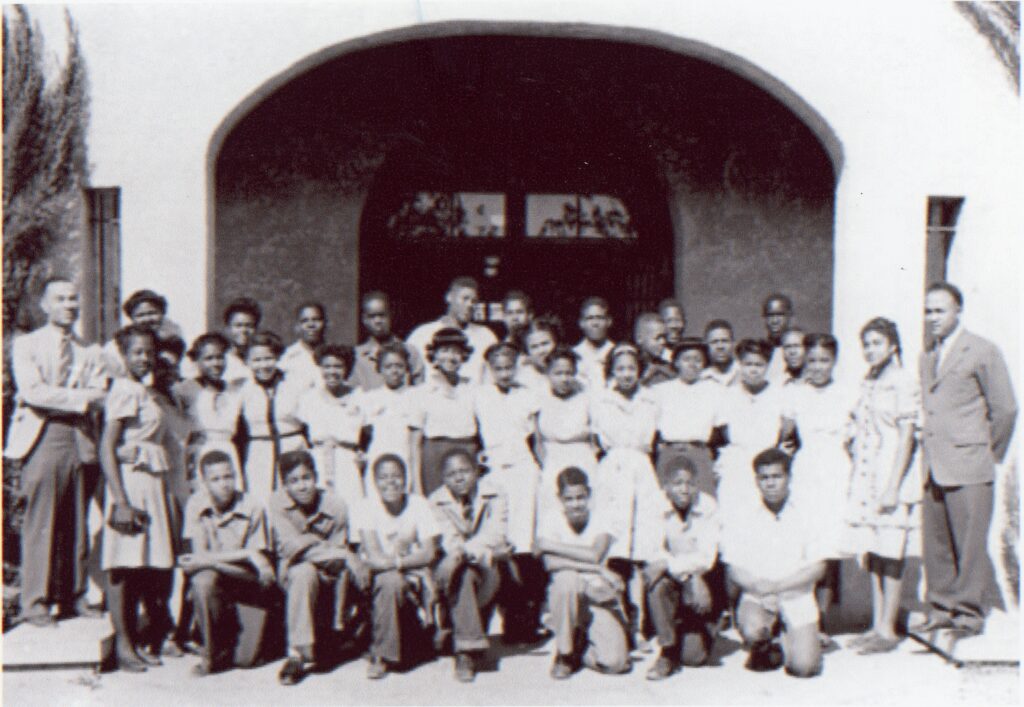
Students at Dunbar School
Located at the corner of 2nd Street and Main Avenue, the Dunbar School was constructed in 1918 as Tucson’s only school for Black students. As the school grew, families also gathered at Dunbar for cultural events and community activities, making the school an important center of African American community life in Tucson. With a winding history, The Dunbar Pavilion now stands as a growing community center, and a site of historical significance.
In 1909, Arizona legislated mandatory segregation in public schools for children in grades kindergarten through eight. When Arizona achieved statehood in 1912, the wording of the law was changed from ‘mandatory’ segregation to ‘permissive’ segregation. However, the practical effect remained much the same, as Tucson schools were segregated until 1951.
Before the construction of the Dunbar School, an earlier version of Tucson’s first school for Black children was located at 216 East Sixth Street, where Professor Cicero Simmons taught. This little school was known as the “Colored School” until Dunbar School was constructed and then that original site was taken over by George A. Stonecypher to be used as a bakery shop.
The Paul Laurence Dunbar School was originally constructed with just two rooms, and Simmons was the first teacher and later principal. Miss Mable Bland was soon hired to assist Simmons in teaching. The school accommodated students from grades one through nine and, for many years, it was the only school in Tucson that Black children were permitted to attend.
Miss Mable Bland and Professor Cicero Simmons taught an enrollment of 66 pupils in two classrooms until the first addition to the school was completed in 1921. The presence of Dunbar School may have drawn black settlement to the area, much as the presence of Davis School south of Mountain View had apparently drawn Hispanic settlement a decade before. Whatever the cause, Tucson’s Black population was growing, by 1910 Tucson’s Black population was 222, by 1920, it was 346, and by 1930, it was 1003.
Despite the growth of the school, teachers and students faced inadequate funding and a lack of facilities, including a cafeteria and auditorium, as well as an absence of new textbooks. Still, the students and faculty tried to live by the school motto: “Be the best.” Black educators played an especially important role in the lives of their students, serving as teachers, mentors, advocates, and role models during a period when racial segregation denied Black children equal educational opportunities and resources.
In an interview by Adiba Nelson, published in the Spring 2023 edition of Tucson Lifestyle, former student Barbara Lewis recalled the conditions at the school: “There were things we didn’t have … a lot of things we didn’t have. But our teachers, our principal, and our families, they made up for it. You know? We never got new books … We got used books after other schools were through … But that didn’t matter because our teachers brought … things. They had other things for us to use….”
She also reflected on the importance of the education and encouragement she received: “That kind of love and knowledge [would allow us] to talk beyond those used books. So, I always try to say, ‘Feel bad about what was done to us, but don’t feel sorry for us.’”
Barbara Lewis attended Dunbar School from 1942 to 1950, completing her education through the eighth grade. Now, she remains committed to preserving the school’s history and sharing the experiences of those who attended it.
Teachers regularly brought newspapers and magazines into the classroom for students to read and discuss, broadening their knowledge of the world beyond Tucson. The faculty also made a point of introducing their students to prominent African Americans who were travelling through the city, ensuring that they had opportunities to meet and learn from influential figures.
As Barbara Lewis recalled: “Our faculty was certain to see they came to talk to us kids, and they did. So, we knew beyond Tucson because I think even though a lot of Black kids couldn’t go to places and see these people, a lot of white kids couldn’t either. But we did.”
One particularly memorable visitor was the poet Langston Hughes. After learning that students were fainting in classrooms and during assemblies because of the summer heat and the absence of a cooling system, Hughes reportedly went to the school district office and, as Barbara Lewis recalled, “raised hell” until a swamp cooler was installed.
The school’s inadequate facilities and limited resources remained a significant challenge throughout its early history. It was not until 1948 that the school finally consisted of an auditorium, a cafeteria, and 23 classrooms, representing an important improvement in the educational environment available to its students.
In 1951, three years before the landmark Brown v. Board of Education ruling, the Arizona State Legislature repealed laws mandating the segregation of elementary and middle-school students, giving individual school districts the authority to desegregate. Following this legislative change, the superintendent Robert Morrow recommended renaming the school in an effort to remove the visible associations with segregation. Consequently, in 1951, the Paul Laurence Dunbar School became John Spring Junior High School, after early Tucson educator John Spring. The school continued under this name until its eventual closure in 1978.
In 1993, the Dunbar Coalition purchased the former school building with the intention of transforming it into an African American museum and cultural center. Since then, the building has continued to serve the community in a variety of ways. Its auditorium has been available as a rental venue, while the wider premises have housed a barber school, commercial kitchen, dance studio, and cosmetology school. The former Dunbar School is included within the John Spring Neighborhood Historic District, which forms part of the John Spring Multiple Resource Area, listed in the National Register of Historic Places.
The original 1918 Dunbar School was designed by prominent Tucson architect Henry O. Jaastad, who also oversaw the school’s subsequent additions through 1948. Shortly after completing his initial work on Dunbar, Jaastad went on to design the 1924 Main Building of Tucson High School. Together, these projects highlight not only his immense contribution to Tucson’s built heritage, but also his impact on Tucson’s schools.
A number of his works are now listed in the U.S. National Register of Historic Places. However, Jaastad’s path to becoming one of Tucson’s most influential architects was somewhat unconventional. After emigrating from Norway to the United States in 1886, he arrived in Tucson and began working as a skilled carpenter in 1902, contributing early to landmarks like the Willard Hotel, the Owl’s Club, and the Desert Botanical Laboratory. He later enrolled at the University of Arizona in 1908 and became an officially registered architect in 1922. Beyond his architectural legacy, Jaastad was a central figure in local politics, serving as Tucson’s Democratic mayor from 1933 to 1947.
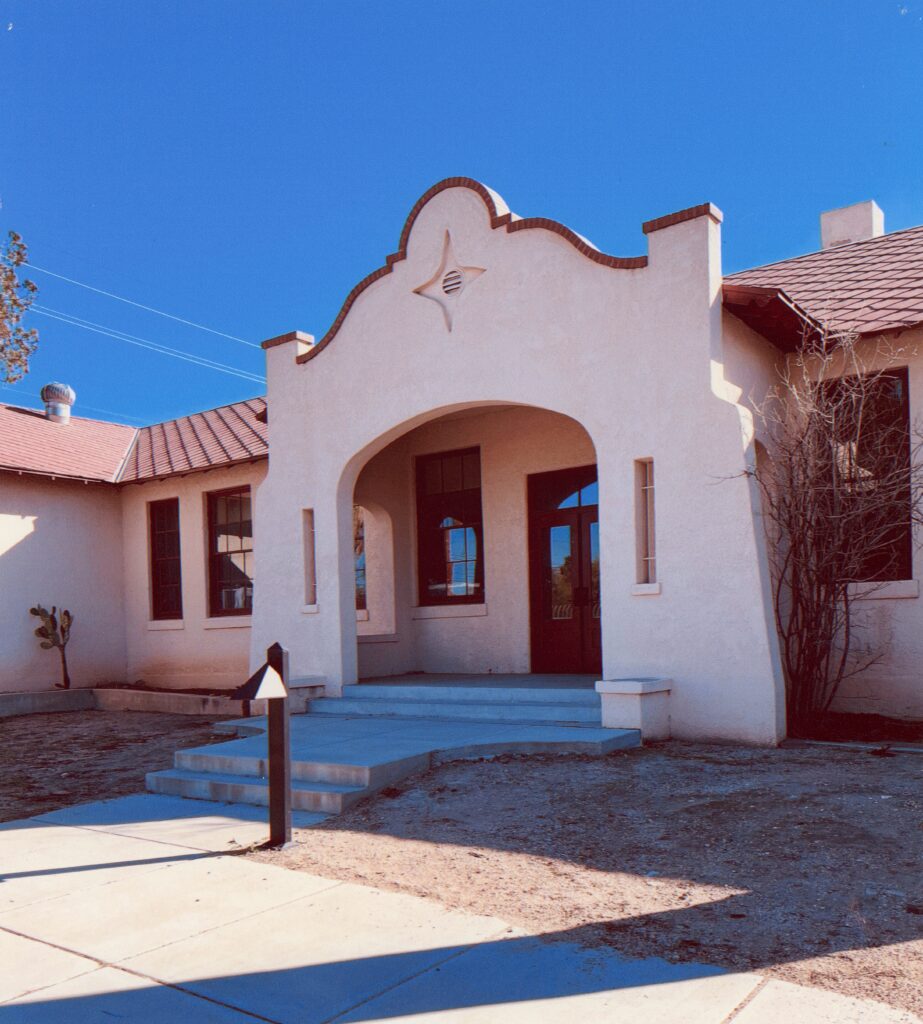
The Paul Laurence Dunbar School
The school was named in honor of Paul Laurence Dunbar, a nationally recognized African American poet, novelist and short-story writer whose literary career spanned the late nineteenth and early twentieth centuries. One of his best-known poems, We Wear the Mask, published in 1895, explores the experience of concealing pain and suffering behind a public appearance of happiness. The poem has often been interpreted as a powerful reflection on the psychological and emotional consequences of racial oppression. Dunbar was born in Dayton, Ohio, to parents who had been enslaved in Kentucky before the American Civil War. He began writing stories and poetry as a child and he was the only African American pupil at his high school. There, he distinguished himself academically and became both Class President and Class Poet. Even before graduating, Dunbar had published poems in the Dayton Herald and worked as editor of a local newspaper, the Dayton Tattler.
Despite his early literary success, financial circumstances prevented him from attending university. He also struggled to find employment in the newspaper industry because of racial discrimination. Instead, he worked as an elevator operator, a position that allowed him time to continue writing. During this period, he produced articles, short stories and poetry, including several works written in African American dialect, a style that would later bring him considerable recognition.
With support from Orville Wright and a local publisher, Dunbar published his first collection of poetry, Oak and Ivy, in 1893. In 1897, he secured a position as a clerk at the Library of Congress in Washington, D.C. Through his writing, Dunbar explored African American life and experiences in the United States, contributing to the growing literary and cultural consciousness of Black Americans. He achieved international recognition for his poetry, particularly his use of dialect, in collections such as Majors and Minors (1895) and Lyrics of Lowly Life (1896).
Dunbar’s literary influence extended well beyond his own generation. Maya Angelou drew the title of her 1969 autobiography, I Know Why the Caged Bird Sings, from a line in Dunbar’s poem Sympathy. Angelou also acknowledged that his writing had inspired her own literary ambitions. The image of the caged bird, representing confinement, oppression and the longing for freedom, became a recurring and powerful theme in her work.
Paul Laurence Dunbar’s name has been commemorated by numerous schools and institutions throughout the United States. These include Paul Laurence Dunbar High Schools in Lexington, Kentucky; Dayton, Ohio; and Baltimore, Maryland, as well as Paul Laurence Dunbar Vocational High School in Chicago, Illinois. The main library at Wright State University in Dayton and a branch library in Dallas, Texas, also bear his name. In Harlem, New York, the Dunbar Apartments were developed by John D. Rockefeller Jr. to provide housing for African Americans. In Chicago, Dunbar Park features a statue of the poet, created by sculptor Debra Hand and installed in 2014. Phoenix, Arizona, also has a Paul Laurence Dunbar School. Unlike the former Tucson school, this school remains in operation. That school was listed in the National Register of Historic Places in 1993 and added to the City of Phoenix’s Historic Property Register in 2005.
Today, the Dunbar Pavilion remains an important landmark in Tucson’s African American history. What began as a school established for Black children during an era of racial segregation is evolving into a place of culture and community. The building preserves the memories of generations of students, the dedication of Black teachers and educators, and the determination of families who valued education. More than a century after its original construction, the Dunbar campus today is working to honor that legacy in providing a place where African American history is preserved and community is continued.