
Connie Bacon traces the pump house’s frontier engineering, Apache‑era defenses, and ongoing preservation needs.
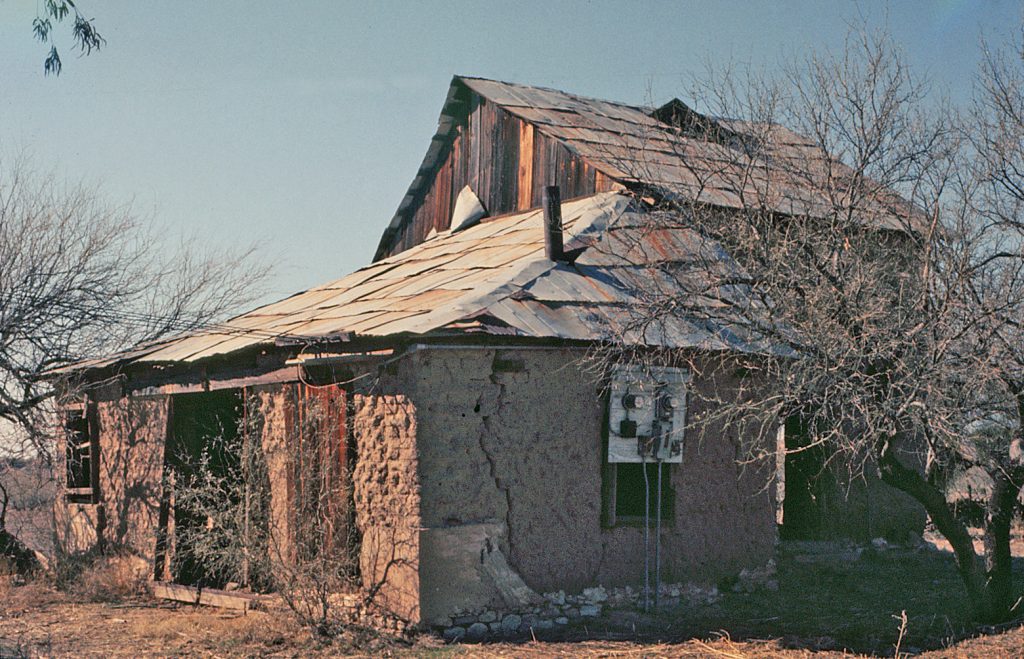
Pump House at Steam Pump Ranch 1971
Watch OVHS Video Series: The Steam Pump Building at the Steam Pump Ranch in Oro Valley, Arizona as archeologist Connie Bacon as she reflects on the enduring legacy of Steam Pump Ranch, a vital watering hole that once fueled the region’s bustling cattle industry. Built in 1875, Bacon explores the pump house’s rugged history, pointing out its original rifle slits designed for defense against Apache raids to the sophisticated steam engine that drew water for thirsty travelers and livestock alike. While she notes with concern that the weathered adobe may not survive much longer without preservation, the site remains a resilient landmark of Arizona’s frontier history. Decades after this 1980s account, the pump house continues to stand as a testament to the enduring legacy of the Steam Pump Ranch.
Check out our entire OVHS Video Series collection or subscribe to the OVHS YouTube channel.
Connie Bacon:
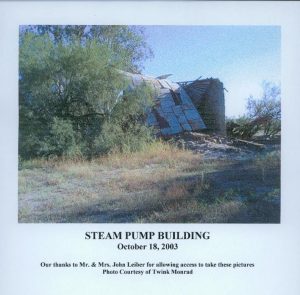
Pump House Building at Steam Pump Ranch October 18,2003
This is an adobe pump house. This was built, by all records, in about 1875 by two men named Pusch and Zellweger. They built this pump house right on the main road out of Tucson. You’re going to hear traffic – it is still the main road out of Tucson. They built it on this road – this pump house – and I’ll tell you what for in a minute.
They built it on that road so that travelers leaving Tucson on stagecoach could stop here – this was a watering hole. This pump house held a steam pump that brought water from about 70-75 feet in the ground. The closest water reserve is the CDO [Cañada del Oro], over here about 1/8 of a mile behind the barn. It brought the water up through the sand and then put it in a big reservoir that’s over there about 100 feet. A big stone reservoir that I understand stood about 10 feet high and about 20 feet in diameter, made of stone. That reservoir was for the travelers coming on the stagecoach, but the main reason it was built was for the cattle.
In 1875, there were about half a million cattle in this part of Arizona. They would bring the cattle from the north, east, and west, to this particular ranch to feed them and fatten then and water them before they took them into Tucson and put them on the railroad train. The railroad was built and started moving out of Tucson in 1880. In 1885, this was a bustling cattle community.
The steam pump building is particularly interesting – it’s original adobe, original rifle slits that were built for people to put their rifles through from the inside of the structure to shoot the Apache.
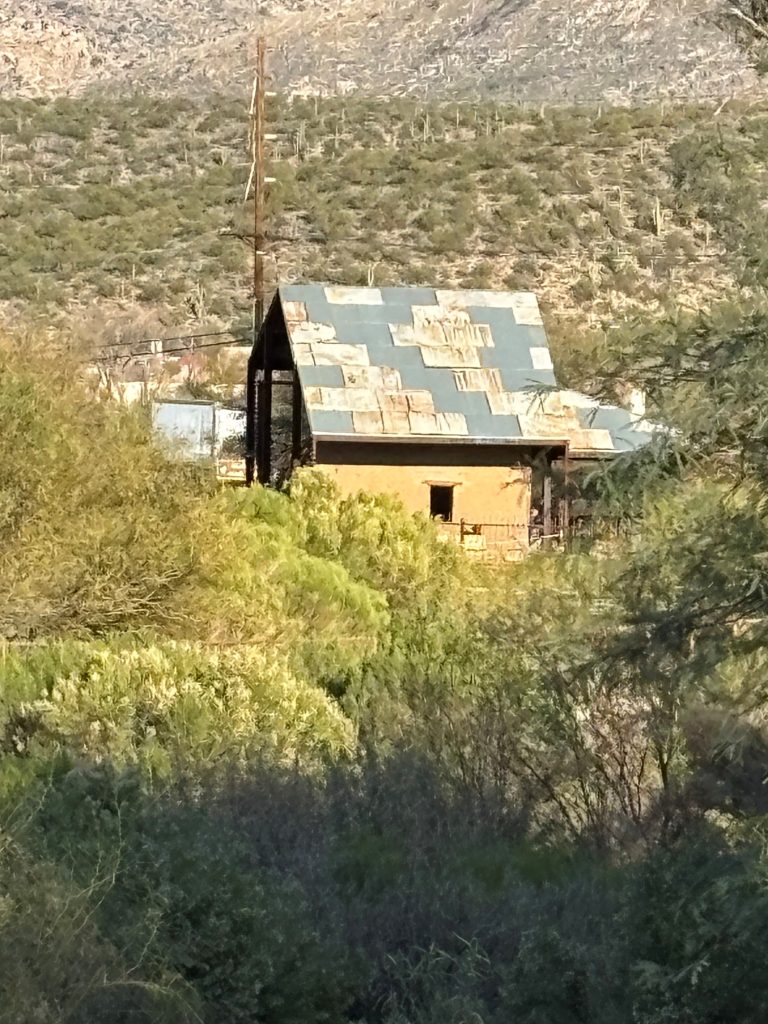
Steam Pump House – February 2026. Photo by Bob Kellar
Because of course this was big Apache raiding country, they had an established raiding route right from the Catalinas south. Along the CDO to the Santa Cruz River, then to Tucson, and then to Papago Pueblos and beyond.
This building is really interesting because there was another structure that came out – four more walls ran along here. The materials used for the roof of the blacksmith shop is ¼ inch steel, taken from the Tucson Ice & Storage Co. in the early 1900s – another property of George Pusch and John Zellweger.
That was to protect the building from heat and make it more pleasant to work inside in this extra little room. Here are some interesting ladders on the other side, maybe we can get the chance to see the ladder going up to the roof and you can see the worn places where people put their feet from years and years of use.
This is the main clubhouse of the steam pump ranch. Let’s take a look inside. We’re inside this wonderful structure and I’m going to describe to you what I see. There’s this grand hole in the ceiling that lets in the sky light, over this way right above my right hand is where those gun slits were for shooting rifles at the Apache. There’s a floor where people stand on in the attic here, this is the door that goes out to the blacksmith shop and out to the ranch we were talking about. This wall back here is a very important part of the pump house because through this window is where the engine stood that ran the pump. The engine then had a belt which moved through this window, there were big wheels that the belt went over, and the pump is sitting a little off-center in the middle of the cement floor. They did have cement in 1875.
John Leiber, present owner of the ranch, informed me that after the steam pump built up full pressure, it could pump up to 50 gallons of water an hour; in the late 1800s, maybe up to 300 – 400 gallons a day! [Learn more about the Procter-Leiber Family starting with John “Jack” M. and Elizabeth “Libba” Simmons-Procter and how their family grew.]
There are some very interesting cracks in these walls that you can see daylight through, and most anthropologists and archeologists just love to look at cracks. There’s one in this room; there’s one here that you can see the light through.
Going out from the attic – where the people stood for protection – are the shutters. Probably the very original wood shutters. Two beams that come down, about a foot and a half wide, and then the huge planks that are made into shutters. Nothing like the flimsy pieces of wood we call shutters now, but it looks like they’re 2×6, these wood shutters. You can see the adobe really good up in the rafters. They’ve plastered on top of the adobe down here in the pump room, probably to help preserve the adobe from the moisture, I would think.
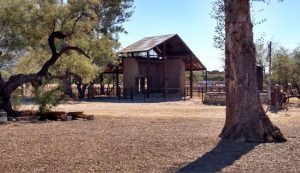
Protective cover over the pump house to help preserve it.
This building is – I’m afraid is going to come down within the next 10-15 years. It would be nice if we had some way to preserve it, but right now I don’t know that we have any way to. It’s a shame because it’s a very important building to this whole area, everybody here knows about the steam pump ranch.
Narrated by Connie Allen Bacon, Archaeologist, and Former Tour Director for the Center of Desert Archaeology (now Archaeology Southwest)
Film Produced, Directed and Edited by Frank Humphries