
Oro Valley historian, Jim Williams, interviews Paul Loomis about his experience before, during, and after his time as mayor.
Former Mayor Paul Loomis played a defining role in guiding Oro Valley through some of its most formative years. As the town’s first elected mayor, he stepped into leadership with a deep sense of responsibility and a desire to help the community grow with intention, stability, and heart. His years in office coincided with major turning points—complex water negotiations, rapid development pressures, and the preservation of treasured natural spaces like Honey Bee Canyon. Through it all, he worked to ensure that Oro Valley’s future remained firmly in the hands of its residents.

Paul Loomis
This video captures Paul’s reflections on those pivotal years. He speaks candidly about the challenges of maintaining strong town finances, the importance of open and inclusive public dialogue, and the delicate balance between growth and quality of life. He also shares insights into the evolution of town leadership, the role of HOAs in shaping neighborhoods, and the long‑term vision behind decisions that continue to influence Oro Valley today.
Across these conversations, a clear picture emerges: a leader committed to thoughtful stewardship, community connection, and safeguarding the resources—especially water—that define life in the desert. Paul’s stories offer not only a look back at Oro Valley’s journey from its “infancy” to a confident, maturing town, but also a reminder of the people whose dedication helped shape the community we know today.
Paul currently serves as Treasurer for the Oro Valley Historical Society.
Click here to watch this informative video but also see Paul Loomis in Oro Valley Panel Discussion with Three Mayors. Check out our entire OVHS Video Series collection or subscribe to the OVHS YouTube channel.
Paul Loomis: Okay, we’re on.
Jim Williams: All right, so we’re doing an interview for the Oro Valley Historical Society with former mayor Paul Loomis. The date of this is August 3, 2021. I gave Paul a list of some questions to think about beforehand, and we’re going to cover most of those. The first question, before you even got into this, is: why did you decide to run for a local government election?
Paul: I decided to run for election because I thought I could help the town grow in a controlled growth type manner. I’d gotten involved with the town right after my property was annexed in 1995, and the property next door to me was planned to be apartments. And so I learned how to work with the town, and I tried to refer the zoning on that property to the voters and ended up suing the town and losing the lawsuit for a mandamus action to change the zoning. Basically, because I was annexed into the town at that time, during that same annexation, I was not notified of any of the information that was going out or any of the agreements that the town made with the various landowners in order to get their signatures on the annexation agreement. So that was part of the challenge that I had, and that I didn’t have standing in the town for them to recognize my protests.
Jim: So, you were elected in 1998 and served through 2010, correct?
Paul: That’s correct.
Jim: Okay, three terms. You were the first elected mayor. What do you see as the advantages of an elected mayor over the previous system of electing the mayor from the council?
Paul: Well, what it did was provide some continuation of the leadership over time. Previously, the mayor was elected annually by the council, so every year you could have a different mayor and different leadership for the town. But having the mayor directly elected by the people provided at least a single term of leadership rather than going from one to another.
Jim: Okay, all right. Some of the issues I’m going to ask you about are kind of repeatable—we talked last month—but I think we should get it on tape so you can express your opinion. One of the big controversies, and it started right around the time you became mayor, was the whole issue of Tortolita creating an incorporated town—a small area west of the town, very sparsely settled. They, for a period of time, existed as a town, and then eventually the courts overturned them. Why did you oppose that? Why do you think most of the council opposed the incorporation?
Paul: Well, they never really existed as a town. The county never recognized their incorporation. Tortolita was, as you said, a very sparsely populated piece of property. They had some special legislation at the state level that allowed them—that was only applicable to Pima County—and it was really only applicable to the area of Casas Adobes and Tortolita in order for them to become towns. The main challenge that Tortolita had was that they felt they could survive on state-shared revenue. They didn’t have any sales tax base, and they were not going to have a property tax. So the concern that Oro Valley had, that we as a council had, and that the region had, was how they would be able to provide city services to their residents.
That was the main reason that we opposed them. Oro Valley was not unique in opposing Tortolita. Marana was opposed to it, the city of Tucson was opposed to it, and the county was neutral, which I think they had to be. So, we were opposed to Tortolita because we didn’t feel that they would ever survive. At the time, small, incorporated towns that were surviving on state-shared revenue were going bankrupt. The League of Cities and Towns ended up sponsoring legislation to provide a minimum payment to those towns of less than a certain population, where they got a fixed amount rather than an amount shared based on population. So, it ended up that the cities and towns agreed with the incorporation of Casas Adobes but disagreed with the incorporation of Tortolita. I believe it was Tucson that provided the leadership in the lawsuit challenging the legislation, which was ultimately decided by the Supreme Court as unconstitutional.
Jim: Okay. Another big political issue during that same time period—my research shows it went on for about 10 or 12 years—was the Honey Bee Canyon question. In a way, it was really two different disputes. The original dispute was about land just east of the intersection of Honey Bee and Rancho Vistoso. Then the second controversy was about Stone Canyon and the development of the golf course, the resort, and the houses further up. Why do you think people were so agitated about that?
Paul: Well, Honey Bee Canyon was definitely two specific cases. The first part was Honey Bee Canyon Estates, which are just west of Honey Bee Canyon, and their property extended all the way to the edge of the canyon. Conservationists were very concerned about access to the canyon and a buffer area between the canyon and the residents. That discussion was going on from about 1992 through 1997.
Jim: Just before you were on the council.
Paul: Part of that concern was that when the original PAD was approved by Pima County, there was a promise to protect Honey Bee Canyon. The question was: what is protection? What is a buffer zone? That was ultimately agreed to, and Honey Bee Estates were developed with something like a 50-foot buffer.
Jim: About 1,000 feet from the middle of the canyon on either side, so about 500 feet in each direction. The second one is more in your time period.
Paul: Right. The second issue was related to the rezoning of Stone Canyon—basically amending the PAD for Rancho Vistoso—allowing them to put in the golf course and make changes to the golf course area. As a result, we negotiated with the property owners, Vistoso Partners, to allow them to build and adjust their buffers for the golf course. We formalized the agreement for the buffers in Honey Bee Canyon and an area called Neighborhood 12. Those areas were ultimately dedicated to the town as a result of the rezoning.
Jim: Okay. Toward the end of that process, the county stepped in and took over the issue, and then later allowed you to annex it. Is that correct?
Paul: Not that I’m aware of. Basically, Neighborhood 12 was in the county. It was owned by Vistoso Partners, but as part of the agreement, they had to annex that neighborhood into the town.
Jim: Water was always an issue, starting in the early 1990s. There were two separate issues: access to CAP water for potable drinking water, and the use of effluent water. What had to happen to resolve those?
Paul: Well, acquiring the water companies themselves in Oro Valley was a significant event. The CAP water and effluent were two separate issues—effluent was managed by Pima County, and CAP water was managed by the city of Tucson. We needed to conserve groundwater due to state requirements for assured water supplies. The 25-year plan required that we could not draw more water out of the ground than was being recharged. So, we needed to bring the CAP water allotted to Oro Valley from I-10 into the town and bring effluent into the town to use on lawns, grassy areas, and golf courses.
Jim: Right. And around 2005, a pipeline system was built from near Ina Road up to Sun City. Who paid for that? It mentioned to cost around $23 million.
Paul: The town paid for it. The golf courses paid for the bond debt service as part of their water rates, but the initial development of the pipeline—from Arthur Pack Park along Thornydale to Tangerine Road, then to La Cañada, down to El Conquistador, and up to Stone Canyon golf courses, including a reservoir and pumping station to Sun City—was funded by the town.
Jim: So, in essence, the golf courses have been paying ever since through their water rates.
Paul: Also, there is an alternate water surcharge on everyone’s water bill, so part of that pays for it as well.
Jim: Okay. There’s always been a big emphasis, especially since the Sheraton came in during the 1980s, on developing resorts and golf courses in the community. Why was that, and what was the impact?
Paul: The challenge of being a town is your sources of income. You have state-shared revenue based on population, sales tax based on commercial development, construction sales tax based on growth, and bed taxes for hotels and resorts. What you’re looking at with resorts is both sales tax benefit and bed tax benefit. That is the value of having resorts that doesn’t require a lot of towns.
Paul: And most of those services are provided by the resort itself. So, the town gets significant income from a resort with low expenses associated with it.
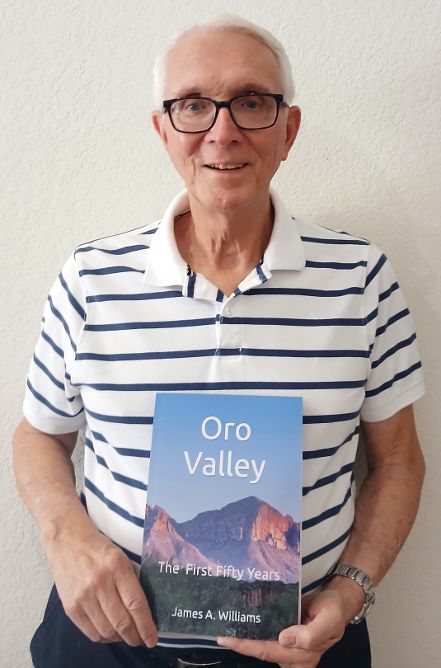
Jim Williams, Author of Oro Valley, The First Fifty Years and 2025 winner of a national award from the American Association of State and Local History.
Jim: There were a lot of articles starting to appear in local newspapers around 2000 that golf courses were in trouble, that fewer people were playing golf. Golf courses started to have bankruptcies around 2006, and it went on—almost every course here had some problem with that. What was the reaction in the town? Do you think golf courses ultimately are more a problem than a solution?
Paul: They are a challenge, especially municipal golf courses. Private golf courses are also a challenge—they’re the ones that don’t have the benefit of additional subsidies. So first of all, you see the private courses having problems before you see municipal courses having problems. But you also say that a golf course—it’s hard to say that a golf course benefits a large majority of your residents, whereas a recreational park is open to everybody. You’re limited with a golf course, and a golf course is expensive, especially in Arizona when you have to water the grass.
Jim: Do you think there was some point where people on the town council began to realize that golf courses were going to be a financial problem, or was that not really anticipated?
Paul: During my time, it certainly was not anticipated. One of the first things I learned was not to get into the golf course business. This was from talking with the mayor of Eloy at the time. They had just taken over a golf course along I-10 on the south side, and he said—when we were having lunch at the League of Cities and Towns conference—“Don’t ever get into the golf course business.” And I told him I agreed, and said don’t ever get into the waste management business either, or the sewer business. Let somebody else do that, because the requirements change on a weekly basis as a government.
Jim: The sewage here is largely controlled by the county.
Paul: It is managed and controlled by the county totally, unless you have a septic system. The entire sewage system is county-managed, and that’s due to an old agreement between the city of Tucson and the county. The other cities joined into that. Marana started their own sewage system around the 2010–2012 timeframe, and they’re doing it.
Jim: Annexations is the next topic. Oro Valley has been aggressively pursuing annexations since about the time of Rancho Vistoso. Sometimes it ebbs, sometimes it flows. What are the reasons for annexations?
Paul: The reasons are to provide for additional city and town growth. Towns depend on certain types of revenue, and with an annexation you get additional population, so you get additional state-shared revenue associated with the annexation. You may also get sales tax if the area being annexed has commercial development or potential for development. What you are looking for in an annexation is something that benefits the town but also benefits those residents. A town provides additional services that are not necessarily provided by the counties. It’s primarily related to how big you want the town to be and how much growth you want. But if you’re going to grow and manage that growth and afford it, you have to get additional population and additional revenue sources.
Jim: Do you think residential areas by themselves are ultimately revenue gainers for the town in the long run?
Paul: It can depend. It depends on the density of that residential area. Right now, most of the areas that are targets for annexation are open land. Pima County is somewhat unique in that it has a large residential population, whereas most counties do not. If you look at Maricopa County, most of it is incorporated into towns, whereas Pima County is still largely residential but unincorporated. So Pima County has adjusted its services to act like a city or town, even though it doesn’t necessarily have that authority. It provides a sheriff’s service versus a police service, and those are two different types of service normally.
Jim: Do you think during your time the planning standards in Oro Valley were roughly equal to Pima County’s, better, or worse?
Paul: They started off using Pima County planning standards when the town was incorporated. When they developed their own standards, they modeled them after the standards developed in Scottsdale. So, the town standards were much more stringent than the county standards. We had a development review board that, in addition to looking at architecture, looked at the quality of the architecture and the quality of the development. There were more overall quality requirements in our planning documentation.
Jim: So, when you say they looked at Scottsdale, you’re talking about the early to mid-1980s?
Paul: Correct.
Jim: Okay.
Paul: And then they expanded them as necessary for what the town wanted to do.
Jim: Do you think it was a mistake to get rid of the development review board?
Paul: Personally, yes. I think it did provide a service. It provided a level of quality that is not necessarily required anymore. It added additional steps that made development more expensive and more time-consuming, but I think the overall community profited from that.
Jim: That was after your time when that was removed?
Paul: That’s correct. We were streamlining the process when I left, but we did not eliminate the board.
Jim: All throughout the history of this community from the beginning there was always the discussion of real estate property tax. When the town was created, they promised people there would never be real estate property tax. It comes up in political elections here every year. Different people accusing others of favoring the property tax. Do you think the decision to not adopt a property tax at the beginning was the right decision?
Paul: That’s an interesting question. I think the idea of not having a property tax is nice. They may not have been able to incorporate if they had proposed one.
Jim: I’m pretty sure that would not have happened.
Paul: Right. And I think if they were going to do a property tax, it should have been done in the early years. Nowadays, there are too many people and too large a population that is satisfied with the tax bill they have and the amenities provided. As we continue to grow and not necessarily have the sales tax to support it, and as the town budget continues to grow with the services we provide, the question will be how to pay for those services. Sales tax will not be adequate. Construction sales tax is a one-time tax, and bed taxes won’t support the level of services people are used to.
Jim: You were mayor during two major recessions—2001 and the one starting in 2007–2008. What are the challenges of governing with sales tax during a recession?
Paul: You’re dependent on sales tax to pay for increases in services and inflation. When you’re not getting those revenues, you have to cut back on services or freeze new work. What we did was freeze new projects and not hire new people.
Jim: You mean public works, like new facilities?
Paul: Yes, at the time we were looking at expanding public works facilities, park improvements, and things like that. You have to decide where to spend the money you have.
Jim: This question goes back a bit before your era, but what about the recalls in the 1990s? There were several attempts—some successful, some not. What caused that?
Paul: During the 1990s, there was significant growth and change in Oro Valley. The community was shifting demographically—from Sun City residents and college professors to younger and middle-aged engineers and families, often second-home buyers upgrading homes. As the population increased, the demographic changed significantly. Oro Valley has always had strong public participation. When groups were not satisfied, the recall process was one way to provide feedback. As the population grows, it becomes harder to recall officials because more signatures are required. But back then, it only required 100 to 1,000 signatures to get a recall on the ballot. So that was a way to provide feedback, and the public was definitely participating.
Jim: I’ve read and heard that when you became mayor, you created a better atmosphere. What did you do to create that?
Paul: I think part of it was recognizing that I was going to be there for four years. I tried to give everyone a fair chance, let everyone participate, let everyone provide their piece, and work toward compromises. Our council meetings often went on for a long time—four or five hours—because we allowed public participation.
Paul: I allowed the council members to debate the issue much more than currently occurs. But it was, and we had a lot of study sessions as well that were separate meetings, and so on anything that was controversial, we had the opportunity to debate and discuss it until people were ready to make a decision rather than be forced to make a decision before the decision makers were ready to make that decision.
Jim: Some of these things were different than had operated by previous mayors.
Paul: Basically, a lot of the mayors basically managed by forcefully pushing things through without discussion. It depends on personalities and styles of how you run a meeting and how you feel that the job should be done.
Jim: So, there were many, many cases, particularly after about 1995, where the general plan mandated that major changes to land use required a general plan amendment. That kind of emerged in the mid-90s there. Before then, there had been basically just zoning changes of all types, but the 1996 plan mandated a whole set of procedures and started that. How did you approach what factors made you make up your mind when someone came asking for a general plan amendment on a piece of vacant land that had, say, already been zoned for one house for every 3 acres?
Paul: Well, it depended on what the location was and what the general plan had identified for that particular area. And when we did the general plan in 1996, that was a significant change in general plan style from what had been required in the past. And so, there was a lot of public participation in developing that plan. And so it sort of provided a whole new foundation for the general future of the community and the region. And so then what you had to do was you looked at how that change meshed into the surrounding community and whether or not there was—rather than simply saying—if you’re putting in apartments next to a suburban ranch, they don’t really mesh real well, and that was part of it. You had to integrate how does this development fit in with the rest.
Jim: Another controversy that went on for a number of years was the establishment of the Naranja Park, which they called the Naranja Town Site. Originally, we talked about before, it was a sand and gravel pit and an asphalt plant sort of in there. The town during your time proposed a bond issue. The town around 2017 proposed another bond issue. Both times they were pretty strongly defeated by the public. What was the cause of the resistance to that park?
Paul: Well, there was no resistance to acquiring the property for a park. The resistance was how do you develop that park and how do you pay for that development? And the challenge that we have as a town without an existing property tax, when you are going to go out for a large bond that is going to be paid for by a secondary property tax, it has to be voted on by the people. And for that large of a development, you ended up having to say, “Okay, this is going to be the first property tax that it has.” For the first issue, the question was, “Okay, do you pay for the whole thing as planned and do it all at once?” And so that caused a significant dollar figure. And so it was again, and you still had a large number of residents that remembered or that had signed the incorporation petitions that said, “You promised there would never be a property tax.” And by doing this, you’re creating that property tax. And so there was a lot of hesitation by the public in saying, “Do we need all this stuff? Why is it this expensive?”
The real issue that you have to remember is that that site is close to 200 acres and there’s a large amount of infrastructure that needs to be done in order to develop it. Water, roads, parking, sewer—all of that infrastructure has to go in as well. In order to put in a baseball field properly, you have to provide the infrastructure. And when they put in the first fields and stuff, they put in very limited infrastructure. Like when the first development for the archery range was done.
Jim: In both cases, in the time you were mayor and then again in the 2015–16 period when they did a bond, they held public hearings, they had welcome houses where they displayed the plans. They’ve been through all that. The people who showed up at the meetings were favorable. So the question is: why do these things fail?
Paul: Well, because as a town grows, the proportion of people that attend town meetings is a smaller portion of the overall population. And the same thing with participation. Like now, if you did a recall, it would require a couple thousand signatures, whereas back in those earlier days it didn’t. When you do open houses, you have the special interest groups attend those open houses, so the people that are attending are the little leagues, the soccer leagues, the swimming teams, and stuff like that. And so they’re in favor of it, but the rest of your population is not as involved. They are looking at it, “Okay, how does this change affect me? I don’t have kids. I don’t play ball. I don’t do these activities, or I have all those activities provided as part of my homeowners association.” So there’s a big difference there, and that’s why it’s so important to try and get the message out to everybody and let them make the decision.
Jim: In each one of those cases, political action committees were formed to oppose or to favor. I think in both cases there was a favor group and an opposition group, and it strikes me that from the time you got involved in 1995–96 to where we are today, politics has really changed in this town. What do you see as the big changes in the way elections and politics take place?
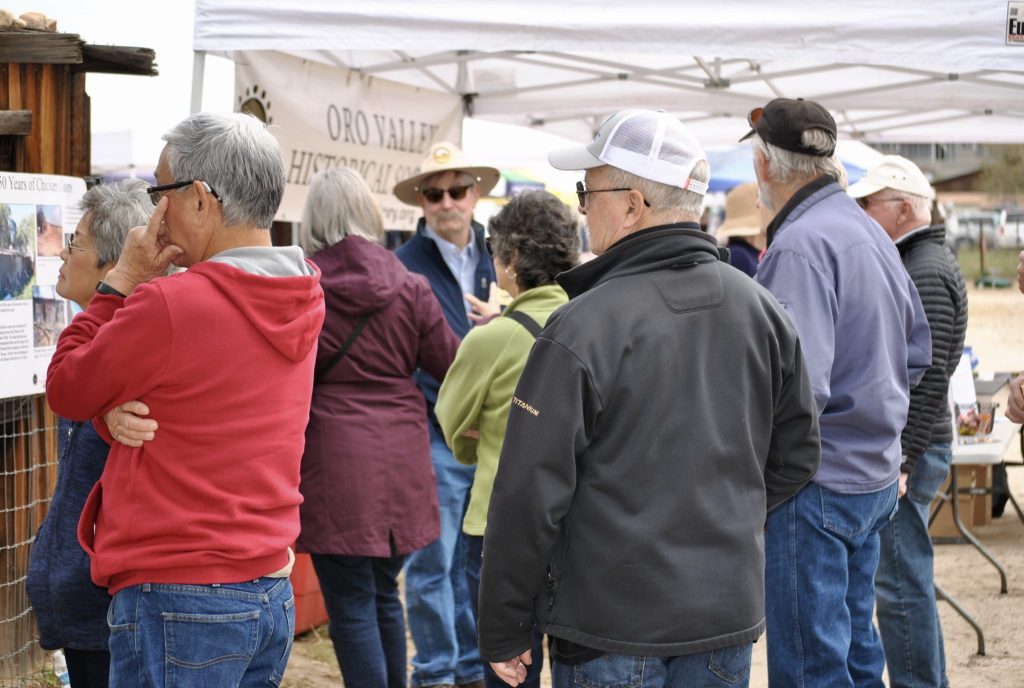
Paul Loomis Helping at OVHS Information Booth
Paul: Well, the elections take place like they have always taken place. The politics associated with it is significantly different. You have challenges associated with raising money if you’re a politician running for office. It’s gotten much more expensive. You have to do advertising, and advertising is not cheap. So nowadays you have a lot more teaming up of candidates. You have—the issues pretty much stay the same, but the candidates are working together as a team versus as individuals. And so you see a lot more of one team of candidates versus another team of candidates.
Jim: Are these teams based on the Democratic and Republican party or not?
Paul: Not necessarily. They’re normally focused on support of certain issues. Are you in favor of big government or little government? Are you in favor of active recreation services or passive recreation services, things like that.
Jim: What do you think of the increasing amount of money from developer and real estate finance advancing campaigns?
Paul: Well, that was always a challenge that everybody had. You had development versus no growth or controlled growth. And when I campaigned, I did not take contributions from developers. Others did, and normally my campaign expenses were much less than a lot of the opposition that was against me.
Jim: I noticed that almost every campaign you were in, you didn’t spend as much money as the other candidates did, but you still won. Why do you think that was?
Paul: Well, money does not necessarily get you elected, and I think that I had a lot of public support and I had a good team working with me. There were some close races and some that weren’t so close. But definitely, hopefully I did a good job.
Jim: What do you think of the emergence of independent political committees getting involved? Because when you first started, that was not a factor. But now the candidates have their own committees, and then there are independent groups who form committees who raise money also to influence the election.
Paul: Right. And that has certainly been a challenge. What you end up having is, as the national requirements have changed for contributions to political committees, that has flowed down to the Arizona election requirements as well. The individual candidates are limited by the amount that can be contributed to their campaigns by individuals. But the independent political action committees don’t necessarily have those requirements. And so they can get large contributions from single donors and use that to support their candidates or their issues. I think it is more supporting the issues than the candidates where they have to fall in.
Jim: You ran for reelection—well, you ran for election and then you were elected two more times. Then you were defeated the last time, right? What changed the last one?
Paul: I think the economic conditions changed significantly. That was 2010, and we were focused on getting through that recession, and the public was ready for a significant change. And so then fortunately I lost in the primary and didn’t have to go to the general election and raise any more money just to keep going.
Jim: I see in many newspaper articles, talking a long time back and even fairly currently, a lot of times people say that they mistrust the town government. They are suspicious of the motives of the people running the government. What do you say to that?
Paul: I say they need to get more involved. They need to become more active. They need to look at the issues and investigate them further and see that the government is trying very hard to do what they feel is in the best interest of the community. And if they say that a change is necessary, then they can get more involved and promote those changes.
Jim: One thing that strikes me, looking—I’ve recently been doing a lot of research on the water issue, and it’s very, very complicated. It has taken me a long time just to find all the information. But it strikes me that a lot of people frequently don’t know the big picture.
Jim: Some of the officials do. I’m not even sure all the people in the government always know the issues, but I think they know a lot more because they’ve attended many meetings on an issue like water. So, they kind of know all the limitations. For example, the fact that Oro Valley was limited when they negotiated the water issue—they were limited by previous agreements made with Rancho Vistoso, made with Tucson, and also what the water companies had made as previous agreements with Tucson when they bought the water company. So they were kind of stuck with what had previously been decided, right? So how do you make something that complicated clear to the general public?
Paul: Well, I think over time it has–basically, the public has accepted the fact that the town owns the water companies, that the town provides excellent service as a result of that ownership that was not necessarily there when it was in private ownership. With respect to the town, the advantage of being the water provider is that it puts the town’s destiny in their own hands.
Whereas water, in Arizona, is more valuable than gold. If you don’t have water, you’re very limited in what you’re able to do. That was one of the main drivers for the town getting the water companies—that by owning and providing the water service, we’re able to manage the growth through that water service and limit it, or in some cases provide it, and in other cases identify when that growth can take place because of a service that may not extend to that particular area and when that service is provided. So that’s a significant tool in the town’s toolbox, but it also is a service that the town provides that is significant to the community as well.
Jim: One of the big controversies in your second and third terms as mayor was the policy of granting economic incentives to Oro Valley Marketplace, Oracle Crossings, the Rooney Ranch complex, Sheraton, etc. There were more than that—I think there were about six or seven altogether. There was a lot of public opposition to it, and eventually the town reversed. New people got on the council and voted to eliminate it, and of course then the Supreme Court in Arizona pretty much negated it a couple of years later. Why did the town get into economic incentives?
Paul: That was a tool that you had to compete with other areas, especially if you were looking toward future growth and future needs of the community. As I said when we were talking about taxes, sales tax provides a significant portion of the town budget.
Originally, when I moved to Oro Valley in 1994, the only gas you could get was at Circle K on Oracle Road. That was the only gas station for many years. You had Smitty’s and Smith’s as the only two grocery stores, and you had really no department stores or other types of retail available in Oro Valley. So, when the Rooney Ranch area was developed, that was pretty much the first real shopping center that we had. Getting in Target provided a sales tax benefit, and then further development helped significantly. The challenges associated with the marketplace—while I was mayor, I saw three proposals come across my desk for developing that site, and two of them went away because of the cost to develop the site and the overall requirements.
Even with incentives, they didn’t pencil out. On the marketplace, there was significant infrastructure that had to be put in, significant work that needed to be done, and a lot of soil that had to be brought in. All those costs made it expensive to develop. Ultimately, you can say we can be patient and maybe one day that area will develop. With the incentives, we were able to get them to move forward with the development, and that was the case for the marketplace and Oracle Crossings.
Jim: There were predictions from the planning department about the amount of revenue this would generate for the town. Obviously, in most cases 40 to 45% went to the developers for a period of years. Has the town ever done a follow-up to determine how much revenue was really coming in compared to the predictions?
Paul: Initially, we got monthly or quarterly reports of what the development earned and what was spent. I don’t know if they still do that or if there was ever a final report showing what they ended up getting versus projections.
Jim: Were any of them given more than 10 years? I’ve heard that the Oro Valley Marketplace incentives just ended in the last year or two.
Paul: They ended last year or the year before. It seems they were about 15 years.
Jim: The original agreement was 10 years, so there must have been a modification,
Paul: Likely due to the recession when development didn’t occur as quickly as anticipated.
Jim: We talked earlier about annexations. The biggest annexation was Rancho Vistoso 5 or 6 years before your time, and then there was the proposal for Arroyo Grande, land north of Rancho Vistoso up to the county line. At the time, why was that considered a good idea?
Paul: It was a good idea because it would provide the northern growth boundary up to the county line. It was all state land, and we were very close to making it happen, but it never did. In 2008, when the Obama administration appointed Governor Janet Napolitano as Homeland Security Secretary, Jane Hall became governor and reappointed the state land secretary. They put all annexations of state land on hold and changed the requirements.
So, Arroyo Grande, for future annexation, is still the most important annexation Oro Valley can do. It’s undeveloped land with significant recreational and cultural assets, good commercial potential, and good residential development opportunities. When you annex undeveloped land, the costs associated with development benefit the community. When you annex existing developed land, you take on the cost of supporting that development immediately. If an area is undeveloped, like state land, it doesn’t require immediate services. Development puts in the initial roads and infrastructure, so town costs are minimized, and construction and sales taxes go to the town. That allows the town to build resources to provide services as the area grows.
Jim: From the articles I read, there was a promise that 50% of that land would remain open space. Is that still done today or is a promise like that only done at that time?
Paul: The agreement was never officially signed, and the annexation never happened. The requirements for annexation have changed significantly, and that proposal that included that 50% promise no longer meets current state land standards, which would require more development. The state still owns the land, even if annexed. The goal is the highest and best use so they can generate revenue for schools. People forget that the land doesn’t go to the town—it just becomes part of the town boundaries.
Jim: Was there a developer involved? The state was interested in selling it, the town was interested in annexing it. Was there already a developer who was interested in a layout?
Paul: The developer was the state land department. As far as I know, there was no private developer involved. The state would have planned it and then put it up for auction. The town would have agreed on densities, development levels, and open space, and then the land would be developed accordingly.
Jim: Even with 50% open space, projections estimated over 20,000 additional residents. Is there enough water for that?
Paul: You would have to get the CAP allotment from the state for that land. That was one of the requirements—that the CAP allotment would transfer with the land. The idea of 20,000 more residents—
Paul: But they—I think that that would have been probably optimistic compared to, you know, basically if you compare the estimate of what the planner said was going to go into Rancho Vistoso versus what it has developed at is much, much less.
Jim: You know, you and I had briefly spoke before and you mentioned a topic I don’t have on my list, but I think it’s kind of related to what you were just talking about, which was HOAs. HOAs came in in Arizona actually in the 1960s, but I don’t find any reference to an HOA in Oro Valley until the early 1980s. And of course, all of Rancho Vistoso was developed as HOAs. I mean, every—there’s 70 different communities in Rancho Vistoso and they each have their own HOA, and then there’s an overriding HOA for the, you know, for the entire development. Why do you think the town permitted or encouraged—I’m not sure what the right word is—HOA development as a way of developing properties?
Paul: Well, the advantage of an HOA in a subdivision, or in any sort of subdivision, is that the HOA provides for the needs of that subdivision, and overall management of that subdivision, so that the town services are the next level up from the immediate needs of the community. And so that is normal as is—I would say you provide fewer—the town provides fewer services to the areas that have HOAs than it does to areas that don’t have HOAs.
Jim: And is that a permanent relationship? In other words, the roads, the parks, etc. Has it been true that once a park or road system that’s been developed within the HOA in Oro Valley is the responsibility of the HOA, it stays that way forever?
Paul: It depends. It depends. Some HOAs have their roads as private, and they provide the services for those roads. They may want to turn them over to the town, but if they do turn them over to the town, then that community no longer can be a gated community. Number one is if the roads are public, then the public needs to have access to it. And so your HOA provides that sense of privacy that some communities may want, and so there’s that balance there. The other issue is that the town does have requirements for taking over private property and certain—some of those requirements, say for roads, is you have to—the road has to be at a certain service level. So they didn’t need—you know, if it’s all potholes, the potholes need to be fixed and repaired prior to the town taking over that road. You can’t just turn over a road to the town because it’s all broken down because you don’t want to service it. You as the HOA have accepted that responsibility.
Jim: So when a developer comes to Oro Valley with a plan for the development of, you know, 30 acres and they’re going to build houses on it, do they specify at that point that it’s going to be an HOA, or is that something that develops later on when they sell to the—they have to let the buyers know they’re buying into an HOA?
Paul: Yes. Yes, they do. And basically, the HOA is normally part of the requirements that are investigated by the town, and the CC&Rs and stuff like that end up being approved as part of the final plan.
Jim: Okay, I’m down to my last couple of questions. I’m sure I can think of—we’ve been doing good. Do you think it’s a good idea for the members of the council or the mayor to be paid a salary?
Paul: I think so. I think that, you know, it’s still a voluntary job and the salary is pretty insignificant for the amount of time that you put into that job. It is a stipend that, you know, I think if you didn’t give them that stipend, you would be as a town—you would be nickeled and dimed for a lot of additional costs, a lot of your mileage areas and things like that you’d be reimbursing your council members for. But right now I think that they need to go back and look at the report that was done prior to having the salary, and that would have been in the ’98, ’99, 2000 time. It would have been before 2000, I think, because 2000, I think, was when it started. But it would have been the year before they had—
Jim: –the public voted down the idea.
Paul: No.
Jim: Yes, it did. And the public voted it down. That would have been a long time. Well, about ’95, ’96, somewhere in there they voted it down. Among other hints and, you know, I guess I’ll send you—
Paul: –it could have been ’94. I know that Marana has done that and the City of Tucson constantly was turning down their request for salary increases. But I don’t know, I don’t remember going to the voters for a salary increase. We created a committee to examine it and make a recommendation. And that committee provided a report to the council and that provided a—you know, basically they examined cities and towns of our size and what they did. And basically they made a recommendation that the mayor should get, I think it started at 750 and the council members should get 600, and that they were not eligible to participate in the elected officials’ retirement system. And then after that, basically it was probably four or five years after we approved providing the salaries, we added the inflation factor to it where we said that the salaries for the mayor and council should be adjusted for inflation the way the rest of the town employees were. But that was the only thing I remember about there being—
Jim: This is a couple of things that came—I don’t know if I sent them on your original list because I thought of them later—but the wildlife bridge that was built along Oracle Road. Does the town own that little piece of land?
Paul: I don’t think so. I think it’s right-of-way. It’s Arizona State right-of-way. It should be right-of-way. And then for the other part of it, it was still Rancho Vistoso. So, on the Arroyo Grande side, it would be state land on part of it and then the Arizona ADOT right-of-way. The RTA paid for that. Paid for those. That was part of the RTA item. I don’t know—the town managed—did they manage the underpasses? They may have managed some of it, and they may have contributed to any of the overages, but I believe all the funds for the overpass and the underpasses were RTA funds. There may have been a minor couple hundred thousand contributed by the town, but I don’t recall. And that was after my time. We approved it and we were planning on it during my time with the RTA, but the actual award was after.
Jim: Was that considered sort of part of the thinking of the development of Arroyo Grande?
Paul: No. As a part of the development of Arroyo Grande, you had wildlife corridors identified from Big Wash. Basically going to the Tortolitas because you had a wildlife corridor that had been identified from the Tortolitas to Big Wash, and then from Big Wash going across to the Catalinas. And oh, by the way, the crossings supported that in the future. So, if they weren’t connected, how did it come about? It came about as—you know, there’s always been a desire for having a wildlife corridor between the Tortolita Mountains and the Catalina Mountains. And so, as part of the RTA plan when it was passed, it had an environmental portion of the RTA plan, and that included wildlife crossings for Oracle Road, for Tangerine Road, for Thornydale, and several down south. So that was all part of the RTA plan that was passed by the voters.
Jim: Okay. The last question is sort of—or last two questions are things that I’ve asked almost everybody. In retrospect, what do you think Oro Valley has done right and done wrong? And I’m talking about looking back over all the years, not just your time.
Paul: Looking back, done right: It’s developed in a quality manner that has been very good, and its public participation has been very good. The thing that they did wrong was they never went after a property tax in their early years. They never proposed or tried to get a property tax in the early years. Nowadays, I don’t believe the property tax will ever pass, and they did not necessarily have to implement the property tax, but they should have gotten authority to do it because ultimately when you reach build-out, you’re still going to have cost of services, and those costs are going to continue to grow. I don’t believe that your state-shared revenue and your sales taxes are going to be adequate for the services that the community desires. So, some of those services are going to go away because you can’t afford them. That’s the challenge that I see in the future.
Jim: It’s kind of the problem of democracy. People want things but don’t want to pay for them. Very current. Do you see any other challenges that the town faces with water or any other issues that may come up in the future?
Paul: Well, I think water is always going to be an issue. I think our plan is good. I think our future needs for our existing size town is adequate for the next 100 years. I believe that we were able to do that when we brought in the reclaimed water and when we got the CAP. I don’t believe that Oro Valley has a water issue as much as people think that we do. If we have a water issue in Oro Valley, then all of Arizona is going to have a water issue—it’s going to be because CAP is stopped or something like that. But we do have a pretty strong aquifer and, unfortunately, it’s not as big as it could be because you’ve got a couple of mountains that are isolated. But there is a lot of water in the ground. At least that’s what I was told.
Jim: Yeah, I do wonder about that because everyone—the aquifer here that they’re talking about for the Tucson area runs from 10 or 20 miles north into Pima or Pinal County all the way down to almost Nogales. You know, it’s a huge area and you have lots of different entities that are tapping into that same aquifer and they’re all claiming a 100-year assured supply. Yep. And that’s the challenge of it. Basically, for Oro Valley, you actually have two aquifers. You got a shallow aquifer that is basically above the Catalina part, and then there’s a second aquifer down below it. You got to go through a set of mountain outcroppings to get to the second aquifer. So, you have a shallow one and a deep one. And the shallow one is the one that goes up and down all the time that you’re drawing from and that they’re seeing recover basically because—
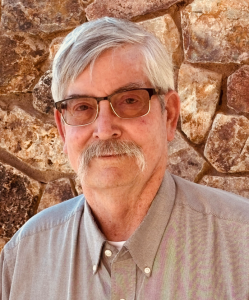
Paul Loomis
Paul: The conservation efforts that are going through and the use of CAP and the reclaimed water—their aquifer, their wells, are actually getting shallow, whereas, you know, down in Tucson, they’re having to dig deep. And then basically up in Tortolita, they’re under eye because they’re going to have to tap the deeper one. Their shallow one is not as deep as ours, but basically in the Tortolita areas, they’re constantly having to dig their wells deeper.
Jim: Kind of like what’s going on in California and Oregon right now. Yeah, same kind of thing. Yeah. Okay. Well, I thank you for taking the time to answer all these, and I know you thought about them in advance. I appreciate your comments, and you’ve certainly filled in a lot of little gaps and things and given me an opinion, like other people have opinions of what they’ve seen happen over the years.
Paul: If you need more, let me know. I’m happy to help because I know a lot of things happened during those 12 years.
Jim: You’re not kidding! All right. Thank you.
Paul: But it was a lot of different things and the significant changes in the community.