
Two conversations tracing the choices and voices that shaped Oro Valley’s growth
In these two conversations with Oro Valley’s past and present leaders, you’ll get a glimpse into the decisions, personalities, and community values that shaped the town across five decades. Together, they offer a rare, firsthand look at how Oro Valley grew—from a young municipality finding its footing to a confident, thriving community.
The first video, Oro Valley Panel Discussion with Three Mayors, the Oro Valley Historical Society hosted a 50th anniversary special panel bringing together three leaders who helped shape the town across nearly three decades: former mayors Paul Loomis and Dr. Satish Hiremath, and current mayor (in 2024) Joe Winfield. Moderated by historian and past OVHS president Jim Williams, the conversation explored why each mayor came to Oro Valley, how the community has evolved, the people who influenced its growth, and the accomplishments—and challenges—that defined their time in office.
The second video, former council member and mayor of Oro Valley and supporter of Oro Valley Historical Society, Dick Johnson, reflects on personal accounts reflects on the pivotal decisions that helped shape the town.
Links are below for each video along with transcripts of each of these events.
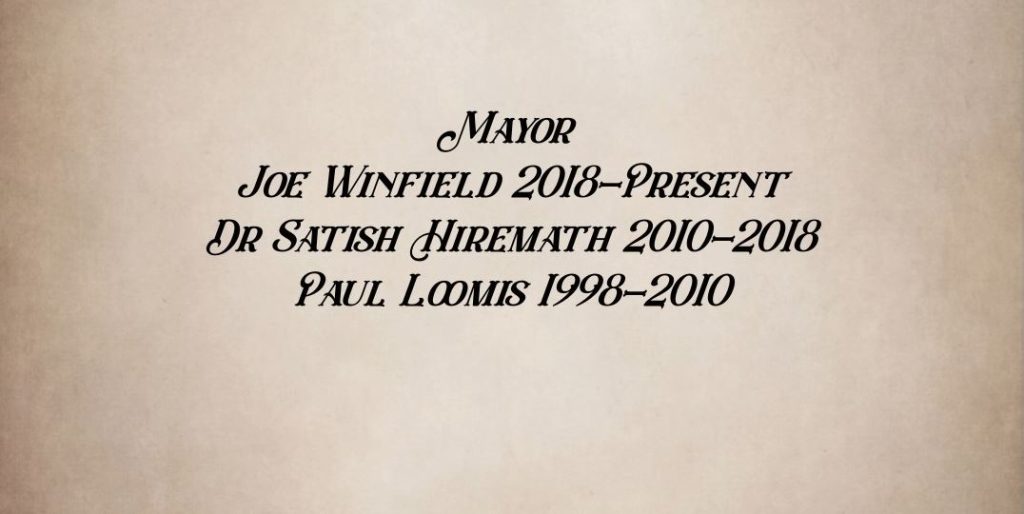
Dates Served
rough transcription: March 11, 2024
Devon Sloan: Welcome. I am Devon Sloan, Secretary of the Oro Valley Historical Society. I’m glad to see you all here today. This is going to be a fun afternoon. They may not think so, but we are thrilled that Jim Williams is one of our past presidents, our current historian, and author of Oro Valley: The First 50 Years. If you all haven’t read it, you should. Good stuff in here.
Anyway, the Historical Society this month is honoring Women’s History Month. Every Saturday from 9 to noon at the Pusch House Museum at Steam Pump Ranch—really, at Steam Pump Ranch—we would love to see you. Go to the farmers market and then just walk a couple hundred feet south to the Pusch House Museum and see amazing women in Oro Valley, including me. We’d love to see you there. Look for us in the parade on April 6th.
Jim Williams: Okay, great. Welcome again. My name is Jim Williams. I’ve been the chair of the speaker’s program for a number of years for the Historical Society, and this year we decided to have a series of panels and presentations related to the 50th anniversary of the town. Last month we had a presentation of community leaders. Next month, on April 8th, and there are flyers in the back, at the same time, 2:00 here, we will have some of the people who were involved in the very early years of the town. Of course, today we are lucky to have three of the former and current mayors of the town.
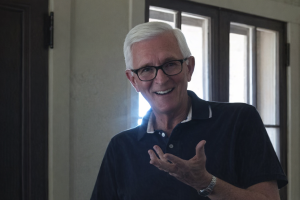
Jim Williams
We have on my far-right Dr. Satish Hiremath, who was a mayor for two terms, Joe Winfield on my immediate right, the current mayor serving his second term, and Paul Loomis in the middle, who served three different terms. I think he’s the only mayor who was elected both by the council and the public. Correct?
Paul Loomis: No, I was never elected by the council.
Jim Williams: Okay, all right, all right. So, I’m going to be asking some questions. We’re going to go probably until about three, and we’re hoping then for a few questions perhaps from the audience to finish up. I’m going to ask everybody up here to keep your answers to a minute or two if you can. I know you have a lot of war stories to tell. My first question, and I’m going to kind of hit each person as we move across, but I’ll start with Mayor Winfield. The question is: when and why did you move to Oro Valley? What got you here?
Joe Winfield: All right, thank you Jim. Our family moved to Oro Valley in 1996. A job brought us here. I work for the National Park Service. I’m a landscape architect by profession. The National Park Service happens to be the largest employer of landscape architects. At the time I was working at Redwood National Park. I accepted a job here in Arizona with the Rivers, Trails, and Conservation Assistance Program. Maryann and I at that time had six children. Our oldest was fifteen, our youngest was two. Schools were very important to us. I came out in advance of my family. As I surveyed the different school options, it was really Amphitheater or Catalina Foothills. Admittedly, being a landscape architect, I was certainly drawn to the Catalinas, the beautiful natural environment here in Oro Valley. Outdoor recreation is important to us. So, I found a home that checked all the boxes, and we’ve called Oro Valley home for about 28 years.
Jim Williams: Okay, Paul.
Paul Loomis: I moved to Oro Valley in 1994, just about 30 years ago next month. I moved to Oro Valley in 1994 from the San Francisco Bay Area. I had been working for the Navy at the Mare Island Naval Shipyard, and when they closed the base, I was able to get a job with the Defense Contract Management Agency down at what was then Hughes Missile Systems by the airport.
Jim Williams: Okay, Satish.
Dr. Satish Hiremath: I grew up in Kalamazoo, Michigan, and ever since I was six years old, I just wanted to live somewhere that had a nice sunny blue sky. In Kalamazoo, Michigan, you hit that three-month stretch of gray and it’s pretty dismal. I’m a dentist by trade. Junior year in dental school I played a lot of tennis growing up, played for the University of Michigan, played on the semi-pro tour for a couple summers before I took the easy way out and became a dentist. One of my old tennis coaches was the head tennis director at what is now the Hilton El Conquistador but used to be the Sheraton El Conquistador. Junior year I flew out, met him, stayed at the El Conquistador, fell in love with the area, and met a gentleman he was teaching who was a dentist in Tucson. He got me in touch with a gentleman who owned four dental clinics, and it was strictly a handshake deal. He said, “If you pass the boards, I’ll guarantee you a job.” A whole year went by, and I hadn’t communicated with him. I passed the boards and called him up and said, “Hey, I passed the boards.” He said, “When are you coming out?” I said, “In about three days.” That was June 11th of 1990, and I’ve been here ever since.
Jim Williams: Great, great, thank you. My next question: how did the area look differently then? Because many of you came a number of years ago. How did this area look different then when you moved here compared to now? Paul, do you want to take that one?
Paul Loomis: Sure. Oro Valley was just beginning to build subdivisions in 1994. Rancho Vistoso was beginning to expand. Most of the homes and subdivisions were new up there. Sun City was approaching build-out, and that was pretty much where it was. The town was in the process of annexing the Peninsula annexation, which was the area along Lambert and up into Catalina Shadows. That was the biggest annexation that Oro Valley had done at the time, and that’s how I got to be a citizen of Oro Valley.
Jim Williams: Great. Dr. Hiremath.
Dr. Satish Hiremath: In two distinct ways. One was geographical. It was relatively smaller back then. I think now it’s 36 square miles. Two was the percentage makeup of our residents. It was predominantly seniors. It was a pretty large retirement community next to a large metropolitan area, which obviously is the city of Tucson. In the 90s when I started coming here, more and more people became aware there were more jobs relocating here. What I saw at that time was the opportunity for Oro Valley to become more of a multigenerational, multifaceted community, primarily in those two ways: geographically and the makeup of the residents of the town of Oro Valley.
Jim Williams: Okay, go ahead Joe.
Joe Winfield: Sure. When our family moved here there were about 18,000 residents. Now we’re nearly 50,000, so the town has grown substantially, which has been a significant change. This library that we’re sitting in wasn’t here when our family moved here. If you’re here relatively recently, the four-lane divided roads were all two-lane roads. There were just a few signalized intersections. If you can imagine, Tangerine and First Avenue was a four-way stop when we first moved here. Ironwood Ridge High School wasn’t built, of course, and Painted Sky. There were very few restaurants and other retail establishments. We had a challenge even finding a place to buy gas when we first moved here. We had to drive some distance to get gas. So there’s been significant changes over the 30 years that we’ve lived here.
Jim Williams: This is kind of a follow-up to that. This town started with somewhere between 500 and 1,000 people. Now we’re close to 50,000. What do you think are one or two or three of the reasons why people have come here? What’s the attraction? Dr. Hiremath.
Dr. Satish Hiremath: One obviously is the physical beauty of where we live. It’s hard not to be mesmerized by the Catalinas when you wake up. Blue sky, the colors are so vibrant. But my administration—and I have to give much kudos to then Town Manager Greg Caton, our Vice Mayor Lou Waters, Joe Hornat, Mary Snider, Bill Rodman, Steve Solomon, Rhonda Piña—we all had a vision of how to make Oro Valley an end destination.
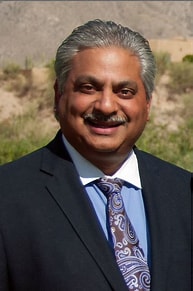
Dr. Satish Hiremath
People were moving to begin with to the town of Oro Valley, but it was really intentional by design. There is nothing that we did that happened by accident. Job creation, keeping Ventana Medical Systems here at Innovation Park, now Roche. I remember vividly sitting down with the CEO of Roche US. It was between Oro Valley and Indianapolis. My sales pitch to him was that we had low crime, great roads, and as Joe Winfield stated, good schools. And now we have even better schools.
My sales pitch was, “You know what you don’t have at this table right now?” He said, “What?” I said, “The mayor of Indianapolis sitting down here according to you.” That kind of sold it. Innovation Park was born. I was on the Arizona Bioscience Roadmap steering committee appointed by Governor Ducey. We intentionally created a bioscience, biotech lifestyle community, and that brought more and more people in. When you do that, they require a certain lifestyle. As we started building more amenities to become more insular rather than relying on the city of Tucson, it drew awareness. And I think by drawing awareness to that, we are where we are now. It’s not surprising to me that once people discover Oro Valley, they want to come down and move here.
Jim Williams: Okay, Paul.
Paul Loomis: Significant growth came to Oro Valley in spurts. In 1994 Hughes Aircraft had just taken over General Dynamics in California, and they moved most of their engineers and middle management out here. When Raytheon purchased Hughes Missile Systems, 90 percent of the people that moved from the East Coast ended up in Oro Valley. When they acquired Texas Instruments from Dallas, we got almost 100 percent of the people that moved in from the Dallas area. A lot eventually moved back to Dallas, but we had those spurts, and it gave us a much more diverse population than we had had when I was first elected. Most of the time it used to be if you ran for office, you spent your campaign up in Sun City. Now you have to spend your campaign all over town.
Jim Williams: Okay.
Joe Winfield: I think there’s a number of things that bring people here. Before the meeting began, I was visiting with some of you and asking what brought you here to Oro Valley. What I hear consistently as I talk with our residents is public safety. It’s something that drew many people here – the town’s reputation for being a safe place. I was visiting some businesses this morning and some owners explained how safe they feel here, especially if they have another business somewhere else in the Tucson area. That’s something that’s frequently referenced.
As I mentioned, what certainly drew me and others is the simple beauty of the area. The Catalina Mountains are stunning. Folks appreciate the beauty of the mountains, the opportunities for outdoor recreation. I talked to a few of you who are cyclists – the number of bike lanes, multi-use paths, and natural surface trails. The access to the outdoors is really wonderful. In fact, I’ve walked out my front door and gone backpacking in the Catalinas for a couple evenings and a few days, just to give you a sense. And I don’t live right on the foothills but just having that access to the outdoors is something that’s been so important.
The schools, as Satish said, have only gotten better since we’ve lived here, with BASIS and Leman, Innovation Academy. The schools are wonderful. Of course, we also have the University of Arizona with the veterinary school. So, all of these things, and of course job opportunities here in Oro Valley and in the region also bring people here. And you could add to that list of what brought you here.
Jim Williams: Okay, great, thank you. There have been many individuals who’ve had an impact throughout the history of this town—some in politics, some in volunteerism, and cultural activities. Who would you name as people who have had an impact on this community and the way it’s grown? Dr. Hiremath, you want to start?
Dr. Satish Hiremath: Certainly, the founding fathers who had the vision to be autonomous and not rely on the city of Tucson. They wanted to control their own destiny, their own direction, their own growth, and have their own identity, so you have to tip your hat to them.
On a very sad note, I was very dear friends with Lauren Rhude. His wife was the first secretary for the first town council in Oro Valley. At age 94 he recently passed away last month, and he was on the first town council. To have him watch this growth and where Oro Valley was from the decision to incorporate to where we are now. Hats off also to every single mayor and council that predated me. Each of us added our own vision and flavor to the town of Oro Valley. I was very blessed with a town council that understood the strength of relationship building—Lou, Joe, Mary, Bill, Steve, Rhonda. I can’t thank them enough.
Town managers had a certain vision as well, and last but certainly not least, town staff. The things you enjoy at a very high level are not done by mayor and council. We let them know what needs to be done and give them the financial and physical tools to go out and do it. When Paul was leading Oro Valley, he had a phrase: a community of excellence. That’s what we strive to be. Kudos to Danny Sharp, former chief of police, and Kara Riley, our current chief of police, love her to death. It was a philosophy that crime is going to happen, just not in Oro Valley. That makes it easier on us when you don’t have to worry about, “Gee, what part of town am I in when it’s getting dark?” Unlike other communities across the nation. Those are some of the individuals that I can thank, and I stand on their shoulders and hopefully did my part to make Oro Valley a better place to live.
Jim Williams: Great. Joe, you want to take that one?
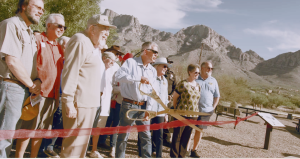
Mayor Joe Winfield Ribbon Cutting for Signs and 20th Anniversary of OVHS, October 2025
Joe Winfield: Anticipating this question, I’ve reflected a lot. A lot of individuals have come to mind. I was struck when Dave Perry was here on the panel, he mentioned Dr. Grogan at Ventana, then Roche Tissue, and that made me think more deeply. But admittedly I’ve come back to our staff, who have made such a huge difference.
I’m very grateful for Chief Kara Riley for her leadership as our chief of police. We enjoy a safe community because of Chief Riley and all the men and women who serve our community in uniform. We can certainly be grateful to them. A common thread amongst these individuals is that they’re very community-oriented and think about each of us as they serve our community.
We also enjoy wonderful roads and other facilities. Paul Kessler, our public works director, has been instrumental in ensuring our roads and infrastructure are in top condition. We hired Judge James Hazel as our magistrate, and he has done a tremendous job. Admittedly I suspect most of you probably have not been in our court, but if you have, you’ll find Judge Hazel is incredibly fair and holds people accountable. He’s an important part of what helps keep our community a safe place. I’d also like to mention Bayer Vella, who has been with the town for a number of years. He helped with the 2006 and 2016 general plans and is helping with the 2026 general plan. He has made a real difference in ensuring codes, zoning, and design standards are maintained. These individuals and of course others, but I just want to applaud the staff of the town of Oro Valley and the remarkable job they’ve done for us.
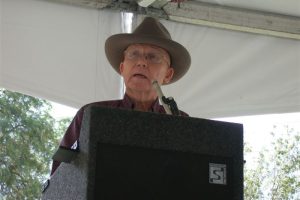
Jim Kriegh
Paul Loomis: You’re going to hear a lot of applause for the town staff. The people I thought about are a little earlier. Jim Kriegh was the founder of the town of Oro Valley and a good friend. He was my campaign manager when I ran for council in 1996 and lost, but also for my elections for mayor in 1998, 2002, and 2006.
Bill Adler was a community activist involved personally and financially in many activities. He gave the town his all. Don Chatfield was our development services director and set up the foundation for planning, development services, and economic development in the town. Chuck Sweet was the town manager for 12 years and he ran the town pretty tight, but he established much of the quality associated with the staff. He has to be remembered for doing a lot of stuff for the town.
Werner Wolff and Danny Sharp were chiefs of police. Bill Jansen was the town engineer who worked all the angles to get us funds to improve our roadways. He was involved in the initial rehabilitation of Tangerine Road and unfortunately passed away about two weeks ago. Believe it or not, Cheryl Skalsky is another one who also contributed quite a bit. I can’t believe I’m saying this, but she pushed the town and the public into acquiring the water companies, which really established our future with respect to growth. It was definitely a controversial activity, but she pushed it through. It’s been quite a change and there have been a lot of people who contributed to the success of the town, and many of them are still in this room right now.
Jim Williams: Thank you. On the question of things you did while you were mayor, what are several things you’re most proud of? Let’s keep it to a few.
Joe Winfield: Thank you Jim. There’s a number of things, and it was a group effort, not just one individual. As a council we hired Chief Riley, who has made such a significant difference. Hiring Judge Hazel, addressing the police pension shortfall has made such a difference in the financial welfare. Investments in parks and recreation and Steam Pump Ranch have been significant accomplishments, preservation of the Vistoso Trails Nature Preserve, a 202-acre site in the heart of Rancho Vistoso. The annexation of the Westward Look Resort, expansion of the multi-use path system, and mixed-use development planned for the Marketplace, working with Town West to make that happen. Something I’m personally proud of is making business visits on a weekly basis, something that started with Dave Perry. I was out this morning visiting a dozen of our businesses. It helps with communication with our business owners and has been a very valuable experience.
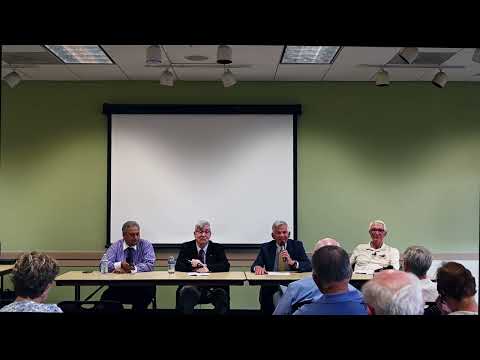
Oro Valley Panel Discussion with 3 Mayors, March 11, 2024
Jim Williams: Okay, we have to take just a one-minute break. We’ll come back to the question: what are some of the successes you’re happiest about in your time involved? Paul?
Paul Loomis: Primarily there was a lot that went on during those 12 years. The big one for me was infrastructure for the town. We did roadways, bridges, CAP water, reclaimed water, acquired land for parks and multi-use paths, and opened up regional cooperation.
In the beginning there were people in Oro Valley who would not shop in Tucson. That’s how far apart the two towns were. But we came together and made agreements with the city of Tucson for CAP water and with Pima County for reclaimed water. We did a lot of commercial development and brought in employers: the hospital, the Hilton expansion, Ventana Roche, Sanofi, the Marketplace, Oracle Crossing, and Rooney Ranch Center. Finally, a lot of things that were able to be done was because we also returned to civility by creating policies and procedures for the town that we had not had before. We changed the employee retirement system from a private system and added employees to the Arizona Retirement System. There was a lot we did, but the first thing that stands out is infrastructure. We provided the basis for what we have now.
Dr. Satish Hiremath: Jim will have to cut me off. In a nutshell: creating a live, work, play, learn community. The veterinary school happened because Ann Weaver Hart, the president of the University of Arizona at the time, was looking for sites to build a veterinary school. She was looking in Phoenix and Tucson but not Oro Valley. I had a good relationship with her, I approached her and she said, “There’s nothing up there, I couldn’t even get faculty to go up there.” She wasn’t making a decision for two years, so I said give me two years. After two years we had created such a live-work-play community that Oro Valley got the first veterinary school in the state of Arizona. That’s unheard of.
We developed the EZ zone for Innovation Park which is shovel-ready to get bioscience companies to come in. We did annexations. Tohono Chul was a crown jewel for us, for arts and culture. Getting private developers invested $130 million in our economy. Six senior assisted living centers were built during my administration with my council. We acquired the community center—324 acres of prime Oro Valley real estate with 31 tennis courts, 45 holes of golf, and facilities for summer camps – for the first time since 1974 – so parents no longer had to drive their children out of Oro Valley. There was also a developmentally disabled summer camp that ran concurrently so kids could learn respect and inclusion. We became a Purple Heart town. The Vietnam Veterans Traveling Wall came here. We created the Oro Valley Veterans Support Initiative focused on health, education, employment.
Leman Academy and Innovation Academy opened. Innovation Academy became the first public school in the country that labeled itself as a STEM school for K through five. Danny Sharp created the Dark House program and Adopt-a-Business program. The Dark House program – If you are snowbirds, you can call the Oro Valley Police Department and let them know when you’re gone and they will send a patrol car every night to check your residence. There are so many things I can’t even list, honestly. The Children’s Museum Tucson opened a location here. The first children’s museum that was within 50 miles of a parent company. Naranja Park was developed with professional-grade soccer fields. The New York City Red Bulls and another professional team practiced here. The aquatic center expanded and hosted international events. That’s why I said, Jim, I’m going to cut myself off because—thank you.
Jim Williams: Okay. By the way, I forgot to mention Oro Valley has existed 50 years. You up here see 28 years of Oro Valley’s 50 years right here in this room. Well, close to it. Joe, you’re still doing your term, but over 26 years of the community in here. My next question—and I found when I interview people for my book you always ask the tougher questions at the end anyway—is there anything you would have liked to have done differently since you’ve been mayor or currently, etc.? Joe, why don’t you start with that?
Joe Winfield: Well, since I’m still currently in my term, I don’t know that necessarily anything specific. There are a few things, I suppose, and I don’t know that this is necessarily limited to–
So, I guess maybe it’s a frame—what are things that Oro Valley could have done differently or better? A few things that come to mind. One is just our approach to parks and recreation. There were decisions made early on in the history of the town that parks would really fall on the responsibility of homeowner associations or developments. What that’s meant is a lot of what’s referred to as mini parks or smaller parks rather than larger neighborhood parks like Riverfront Park or James D. Kriegh Park. So, I would have liked to have seen some parks to the north of us, north of Tangerine. There are some parks, but they’re managed by HOAs, and there are pluses and minuses to that. I’m not sure that it was necessarily in the best interest of our residents. That’s my personal view. I think there’s probably been some missed opportunities in terms of recreational access and trail connectivity in the community. Those are some things that have come to mind. I’ll turn it over to Paul and Satish.
Jim Wiliams: Go ahead.
Paul Loomis: This is a hard question, but there are a couple of things that are still outstanding that I would like to see done. The first was a couple of completed annexations. Right towards the end of my terms, we were working with state land to annex the area north of Oro Valley all the way up to the Pima County line. It was an annexation called Arroyo Grande, and we were actually within two weeks of closing the deal with the state when Obama got elected and he took the governor to be his homeland security person. At that point we changed to a different administration that put all the annexations on hold and set up a different set of rules. So that annexation is still outstanding somewhere in the ether world. The other is the Tangerine Road annexations. That’s pretty much the last undeveloped land that borders Oro Valley, and it would be nice to close that gap.
The other thing that could be an improvement is the challenge of educating the public. There’s a lot of rules that the town has to live by, not just in planning and zoning but in how they do business, how they do a budget, how they get money, and things of that sort. Now with expanded websites and zooms and things like that, I think the training and education of the public would be a wonderful thing. You could do something townwide. We have the citizen academy and the police academy, but those are restricted to what you can fit in a single room. If you could get more people involved and educate them, it would be a lot less controversial when things come to the council for decisions.
Jim Williams: Okay.
Dr. Satish Hiremath: For me, I’m going to piggyback on Paul and talk about messaging. We did a poor job messaging, and so we left people to come to their own conclusions. I take sole responsibility for that. I was raised by my father who said, “If you ever need a pat on the back, here, let me show you something—reach around and you can pat your own back. You don’t need anybody else to pat your back for you.” The community center was a great example. Each tennis court costs $250,000 to build. One tennis court. For a million dollars we got 31 interest-free over three years. It was one day’s operating capital every single year. We paid cash for that.
So, the message got out there that said, “Oh, Hiremath bought a golf course because he loves to golf. He’s using your taxpayer money because he loves to golf.” Truth be told, I golf maybe a dozen times a year, and eight out of those times are charity events. I’m a tennis player by trade. But I didn’t feel it necessary to go out and defend the purchase, and I should have on behalf of my council, but I didn’t.
With Paul’s statement about messaging, there’s an old saying: the lie travels halfway around the world before the truth gets out of bed. I think we need to find better ways to let residents know what exactly is happening, why it’s happening, how it fits into the greater good not only of their individual lives but also the lifeblood of Oro Valley. At that time, Paul had it even worse than Joe and I do because there wasn’t really much game in town. It was pretty much the Explorer newspaper. During my administration unfortunately we had an editor who just wanted to dig up dirt. There’s a reason why news is all bad. I couldn’t figure this out, but in eighth grade I asked one of my teachers and she said the reason news is always bad is because nobody wants to hear good news because it makes their life feel not so good. Honestly, that’s the truth. That’s why you don’t really hear the good news, unfortunately.
To Paul’s point, we do have the technology nowadays, and I would hope that as councils move forward, they can somehow get the message out to let people know here’s why we’re doing it, here’s the truth of the matter. I apologize to my council. I should have stood up and said we need to correct this, and I didn’t.
Jim Williams: Okay, thank you. We’ve had many stormy political meetings in this community over the years, going way back to the beginning. There were many stormy meetings just creating the town in the first place, and we’ve had a lot of citizen involvement. How do you characterize the impact of citizen involvement? Has it been good, bad? What’s good, what’s bad? Paul, you want to start?
Paul Loomis: Sure. Citizen involvement has helped make the town decisions better. New ideas and options and alternatives are presented. Unfortunately, most of the time the public doesn’t get involved until it’s too late in the process to make changes. That’s step number one. The negative part of it is that the only thing you hear about is the negativity. We don’t blow our own horn showing how well we’ve performed and how well staff has done. Look around and see what the town looks like today. It is a wonderful community.
Jim Williams: Okay.
Dr. Satish Hiremath: For me, I don’t view things as good or bad. All residents have a right to be single-issue focused because that’s exactly what they come to these meetings for. That’s what their opinions are for. But my mandate to my council is that singular viewpoints have no place on a council. We have no place on a dais. We have to govern for the whole community.
So, it becomes a little challenging when people who can be singular don’t really understand how we create a comprehensive community. I use an easy example: if somebody likes vanilla ice cream and I like chocolate, no matter what I tell that person, I’m not going to get them to like chocolate, but we have to agree that we all like ice cream. Our council’s responsibility was to take our singular predilections and leave them out the door.
That’s why you see a lot of the things that went up during our administration. The vet school is a great example. All the development and rezoning. Under Paul’s administration he created the environmentally sensitive lands ordinance, and it got ratified during my administration. What that means is if you’re a developer and you have 100 acres and you can put one house per acre, we value open space so much that we say when it comes to a rezoning you still get the 100 homes but put them on 50 acres, leaving 50 acres open in perpetuity. Our administration with rezoning was able to save 480 acres of open space in perpetuity. That’s an incredible amount that really nobody realizes. They just talk about development. So going back to the original question—is it good or bad—we take into account everybody’s suggestion, but sometimes their suggestions don’t fit into a larger picture serving the greater good.
Jim Williams: Joe.

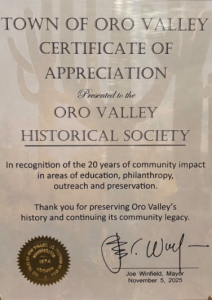
Mayor Joe Winfield presents Bob Kellar with Town of Oro Valley Certificate of Appreciation for 20 Years of OVHS, November 5, 2025
Joe Winfield: Our community is known for resident participation, so I have to applaud each of you for your interest in our community. There’s really a variety of ways that citizens have made, in my belief, a positive impact. We just have to look at our community to see the positive impact you’ve had. One of the important outlets for that is the development of our general plans. Since our family’s lived here there’s been the 2006, 2016, and we’re in the process of developing the 2026 general plan. I encourage you to go to ovpathforward.com. There was a survey—you’ve probably seen the signs around town. I don’t know if it’s closed or not.
Audience member: The 15th.
Joe Winfield: The 15th? Thank you. If you haven’t taken that survey, this is one opportunity to let your voice be heard. The general plan is very important to our community because it’s really a blueprint for the next ten years. It lays out the community’s vision, guiding principles, goals, policies, and actions. When you look at our community it’s really a reflection of that general plan and your voice as to what’s important to you. You make an incredibly positive difference. I know it can be frustrating at times to be involved, but I encourage you to participate and let your voice be heard. And go to ovpathforward.com. This is a great time to jump on board if you haven’t.
Jim Williams: Great, thank you. In my research I found that virtually all the great disputes in this town since the 80s have related to land use and developing the community. My question—I’ll start with Dr. Hiremath—is why do you think that is and what could be done about it?
Again, education. I’m equally guilty. I move here to a beautiful community, and I don’t want anybody else coming in. I don’t want more cars or more people to contend with. So, I think it’s being a little defensive and not understanding the greater concept of a community.
Messaging goes a long way. When I spoke with Roche Ventana, they said we need more mobile units—apartments, condos, townhomes—because their workforce is global. They used to buy 8, 10, 20 homes for employees, but employees stayed on average six months. They can’t have a situation where their employee has to liquidate a house in six months. That’s why you started seeing more multi-living facilities.
Same thing with the Arizona vet school. When I talked to President Hart, she said our students aren’t going to buy homes. So again, more multi-living facilities went up. But then people say they don’t want apartments. They think it’s riffraff or whatever you want to call it. They have to understand that providing living quarters for a viable student body or workforce – the Hilton is a great example – that serve us and serve our community is paramount.
Again, it goes back to messaging. How do you get the message out, so people know it’s not just a developer calling me and wanting apartments and I say yes? That’s not how it works. I’m going to beat this to the ground; it’s messaging about the direction we need to head to create that live-work-play-learn environment.
Paul Loomis: We all live in a wonderful community, and we want it to remain wonderful. We’re here and we don’t like change. We want to close the doors behind us and not see change. Unfortunately, that doesn’t happen. Things evolve. The town grows.
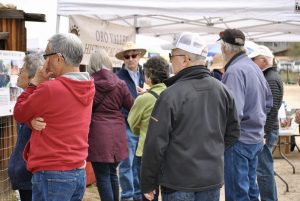
Paul Loomis Helping at OVHS Information Booth
One of the things I learned early in my civic career was to compare a town to the life of a person. A town starts young like a baby and needs to learn lots of things. Then it grows into its teenage years where it expands, looks at options, and gets into trouble once in a while. Then as it matures things settle in. I would consider Oro Valley being in our late twenties right now. We still have a long way to go and lots of opportunities for the future, but we have to recognize things change. One disadvantage is that Arizona still believes it’s the Wild, Wild West and is firmly set into private property rights. That means we’re sometimes unable to look at things as a community versus individuals.
Joe Winfield: I think a number of things have contributed to disputes over land use and development. One is that developers have contributed to political candidates and campaigns. I took a position that I would not take donations from developers. For me personally that’s been a huge, important decision. I think that has negatively influenced land use decision-making. Another thing is misunderstanding. Our family lives in Catalina Shadows off Palisades and First Avenue. For 20 plus years the land adjacent to First Avenue and Palisades was vacant. Neighbors became accustomed to that vacant land. I would have to explain that the land is owned and has entitlements and will eventually be developed.
People often think that vacant land will stay vacant, but it’s privately owned and will likely be developed. On the other hand, when someone buys a home expecting adjacent land to remain zoned a certain way and then it comes up for rezoning, that can make people unhappy because they bought with certain expectations.
Also, our residents’ median age is a higher than Marana or Tucson—it’s a little north of 50. And as I talk with our residents and constituents, you’re folk that this isn’t your first rodeo. You have lived in many places and chose Oro Valley because of the quality of life. They’ve experienced other types of development they didn’t like, so they fight hard to preserve the quality of life they want here. So, I think that also creates some of these disputes over land use.
Jim Williams: Great, thank you. I think you’re hearing some good analysis of the community of long experience here. We’re going to open it up to questions. If you have a question, stand up and say it clearly and I’ll repeat it, so we have it recorded.
Audience member 1: Hello, my name is Brett Sodovik. I’ve been a resident of Oro Valley since 1998. I ran a business nearby successfully that handled hundreds of millions of dollars. I don’t think what I did compares to the difficulty of being a public servant, so first I’d like to thank the three of you for your service. Second, I’d like to know what the heck made you want to do that.
Jim Williams: So, the question is why did you want to get into this? Dr. Hiremath, why don’t you start?
Dr. Satish Hiremath: My dental office opened in 1992. In 2008 I noticed that on average one and a half of my patients either themselves or someone they knew were losing their jobs or homes. I felt there had to be something local government could do where our statistics of foreclosures and job losses didn’t mimic state or national numbers. I threw my hat in the ring, won by 30 votes, and that’s what propelled me to serve people.
Paul Loomis: That was a good question. I got involved almost right after I moved to Oro Valley when the annexation occurred and the property next to my home was going to be developed as 428 apartments. I got involved and we fought that development. We lost a lawsuit with the town to try to stop the zoning, but we delayed the project long enough that apartments were no longer necessary at that time. The town eventually bought the property, and that is now Riverfront Park. That sort of got me involved in how development was happening and as a systems engineer, looking for ways to do it better. When it came time to run for mayor, I ran to help development occur in a better fashion than it was at the time.
Joe Winfield: I would say I’m naturally a community-oriented person. I like people and serving others. In my work with the National Park Service, I’ve worked with elected officials at all levels of government. What I saw was they were just individuals wanting to serve their communities. Working in Arizona for the Rivers and Trails Program took me around the state working with communities much like Oro Valley. Naturally, I saw things I wanted to see in my own community. So, it was really a desire to serve and make my community a better place for everyone.
Dr. Satish Hiremath: Is that why you ran, though?
Joe Winfield: Why did I run? Well, I ran because I wanted to serve my community and make it a better place.
Audience member 2: My name’s Grady Peer. I’ve been here about eight years. This question might raise some eyebrows. Are you familiar with the Casitas Bill making its way through the house and senate? The Casitas Bill passed the senate and it’s in the house now. Casitas means small house in Spanish of course. The point is to remove zoning restrictions at the local level. It’s bipartisan. It would allow small houses—maybe 300 square feet—and local zoning couldn’t regulate things like kitchen requirements, setbacks, or appearance. You can say nothing about the casitas that are about to be put there. They don’t have to conform to the existing roof line or appearance of the house. The bill is Senate Bill 1415, which is passed, and House Bill 2720 which is in committee. What do you think of this? If you’re not in favor, you may want to do something about it.
Jim Williams: The question is about the state considering a zoning change to allow casitas to be built in backyards. Mayor Winfield?
Joe Winfield: There have been a couple bills that try to remove local control. I would oppose anything that takes away local control. That goes back to why Oro Valley was first founded, was to preserve local control. There is a bill passed with similar implications, and we’ve written a letter to the governor asking her to veto it. This is the legislature’s attempt to address the housing shortage, but it would take away local control, so I oppose it.
Jim Williams: Any other comments?
Dr. Satish Hiremath: I’m glad I’m not mayor.
Jim Williams: Paul.
Paul Loomis: This is typical in government where you have local government, which is your town government, then county government, and the state on top. Each wants to control the destiny of what they represent. Local government is closest to you and has the most impact on individuals, so in my opinion it should be listened to. Back in my day we spent a lot of time at the state capital talking to legislators, lobbying and educating them about why cities and towns have different needs from the state.
Jim Williams: Any other questions?
Audience member 3: Rick Bergen. We moved to Arizona, Tucson, about 40 years ago and five years ago we moved to Oro Valley. There’s no going back to the east side or the county. It’s far superior up here. My wife and I just love it. We love the biking, amenities, roads are nice. I heard Oro Valley may someday build out where there’s no more land available. Is that true?
Jim Williams: The question is is Oro Valley eventually to be built out?
Dr. Satish Hiremath: Short answer is yes. Long answer is yes. We’re basically landlocked, that’s the reason for strategic annexations. Government 101: for the most part every penny that comes to government is through some form of revenue. Here the town of Oro Valley we have seven – property tax we don’t have. I’m not sure if everybody is aware of that but OV does not carry its own property tax. We also don’t have a commercial lease tax or renter’s tax. Our four revenue sources are mainly utility tax, which is 100% born by the OV resident and business so that’s a non-starter for our administration. The second is sales tax including state shared revenue, bed tax, and construction sales tax. We averaged about $6.5 million while preserving 480 acres over 8.5 years. Events like the Oro Valley Music Festival, Arizona Distance Classic, and El Tour bring non-residents who spend money here. Every time a non-resident spends money here, that’s less residents have to pay for things like public safety, roads, parks, and recreation.
Oro Valley is probably about 85 to 90 percent built out. That’s why annexation like Tohono Chul was attractive because it’s an end destination globally. When people visit, they stay in hotels and eat in restaurants, which offsets local costs. About 48 cents of every dollar coming into the town was from non-residents. But yes, we are landlocked and built out.
Jim Williams: Mayor Winfield.
Joe Winfield: Build-out is certainly a reality. Right now, forecasts say there is enough housing stock through about 2040 if there were no annexations. Mayor Loomis mentioned there’s about 880 acres to the west with the state land department and areas to the north, but water is a challenge there. The west area might serve Marana more than Oro Valley because of commercial development at Thornydale and Tangerine. If those areas were annexed, it would be largely housing. Which would provide some revenue in the short term but not necessarily in the long term. Eventually we will be landlocked. If you start looking at Tempe, Mesa, some of those areas, then you start looking at redevelopment, etc. So, until about 2040, we’ll have housing available.
Jim Williams: Paul, would you like to say something on that?
Paul Loomis: I could say a whole bunch about that, but I won’t. I want to thank you all for coming here and listening and being such a great audience. I also want to thank the Historical Society for sponsoring this event. Jim, you’ve done a wonderful job being the MC. Thank you.
Jim Williams: We’re videotaping this with the idea of having a record for the future. We’re hoping it will be online, but it will definitely be preserved because there may never be a chance like this again. The 50th anniversary is a big deal. Thank you all for coming. Thank you.
Dick Johnson: I’m Dick Johnson. I was a council member for Oro Valley from 1997 to 2004. During that period, I served as mayor, vice mayor, and council member. I came to Oro Valley in 1996 because of my wife teaching school at Mountain View High School. We needed to be closer to the school location, so we moved over to Oro Valley, and we lived in The Villages and rented initially. Then I had the opportunity to buy a house in The Villages and we did so.
Then I was asked in 1997 if I would accept a job as a council member when one of the council members resigned, and I said yes, I would welcome the opportunity. Then I volunteered and they selected me for the council in 1997, and from then on for seven years I served in various capacities on the council. Not long after I got the council position, we had some issues with the mayor. At that time the council selected the mayor, and this is right before Paul Loomis was elected mayor when we changed the way we selected the mayor.
At that time our mayor had some issues with citizens that were speaking on call to the audience, had problems with the town manager, and so on. So, I drafted up a letter to either have the mayor resign or we would bring it up as an agenda item on the council. She did not elect to resign, and therefore we brought it up as a council item and she was removed as mayor and appointed me as mayor of the town of Oro Valley. Following that, Paul Loomis was elected as mayor, and then from then on, we’ve been electing the mayor as a separate election issue. I applied to be on the council based on my previous history. Throughout my life, from school age through the Air Force and so on, I’ve aspired to be in a leadership position and welcomed the opportunity to use my God-given talents to help whatever organization I would belong to. I did not want to be a follower. I wanted to be in a leadership position. Therefore, I felt the opportunity, when it presented itself, was a good chance for me to make a difference in the community.
Devon Sloan (off-screen): You had not been involved in politics prior to that?
Dick Johnson: I have never. This was the first involvement in politics. I was interested in politics in the sense that I thought that politicians did not have to have a bad reputation. I think politicians are individuals that use their characteristics and their personal integrity to get the job done and help others make the community a better place to live. I never had the opportunity in the Air Force to get into politics, so this was a welcome opportunity.
Devon Sloan (off-screen): At the time you ran to be elected to the council in the early 2000s, these three things were important to you: preservation of open space, council-citizen communication, and providing a tax base for the town. Are those still important to you?
Dick Johnson: Well, I think it’s very important. Communications between the town and its citizens is really critical, really critical. Misinformation tends to get out there and we needed to improve the way we communicated with the citizens, and we did. We did some things in the council newsletters and on the websites and so on to improve that communication because I found that people use communications from different venues, different ways, from computers to newsletters to newspapers. We tried to use all three of the media to communicate.
The other issue of open space, for instance, we all valued open spaces, but one has to realize that Oro Valley is about 85 percent or so developed already. So open space was very hard to come by and most of the open space already had zoning on it. You can’t downzone legally, so you end up having to live with whatever is zoned. Through our general plan amendments and annual reviews of our general plan, we were able to make some changes of proposed uses.
Devon Sloan (off-screen): You also were talking about providing a tax base for the town.
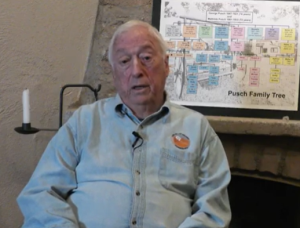
Dick Johnson
Dick Johnson: Yeah, I think the tax base is very, very critical to the success of a town. It depends on those revenues to provide the services that citizens expect. We can look at our tax base. We have sales tax, state shared revenues, and license fees, permit fees. I think to have a diversified tax base, or revenue stream is critically important. Right now, we have no property tax in Oro Valley. We have one for the county and fire districts, school districts, and so on, but you have to pay and have the revenue to provide those services we find highly desirable in our communities. We depend on retail sales tax, and as of now our retail sales taxes are up because of the change in the state law which allowed us to tax e-commerce. So, Amazon and Costco and all those pay sales tax now for all those orders that people in our community order.
Devon Sloan (off-screen): You were the council member that led the effort for the Oro Valley Library, parks, roads, schools, arts, etc. What were the issues and how were they solved, specifically for the library?
Dick Johnson: The library was very dear to my heart. I’ll remember when we initially looked out to get a library in Oro Valley. We went to the county Board of Supervisors and asked them to help us. Initially we were going to put the library as part of the Ironwood Ridge High School site, and because of the pygmy owl issue that high school site was really lagging in development. I got a hold of Mike Boyd, who was our supervisor at the county level, and thought we had that area north of the Town Hall that was vacant. I said, could we get the library built here? He came over, looked at it, said great. I brought the library board out from the county and they loved it, and we then had the Board of Supervisors in the county approve the relocation to the existing site. It was a labor of love building that with great views and all that. That’s why Paul’s name and my name are on the cornerstone of the library.
Devon Sloan (off-screen): What do you believe were the major issues during your time on the Town Council?
Dick Johnson: I really am proud, not being boastful or narcissistic, I really believe that our council did significant achievements during their tenure. Number one, we built and secured the Naranja Town Park site. We built the hospital. We built the library.
We built Oro Valley Marketplace, which became a revenue generator for us. We put in the multi-use paths along most of our major roadways and basically accomplished a lot in the short duration in our tenure. I’m proud of all those. We worked hard, we had obstacles, but we overcame the obstacles and built what we thought, and I think history has proven, were wise decisions that we made.
Devon Sloan (off-screen): How has Oro Valley changed since you left the council, good and bad?
Dick Johnson: Well, I think for the most part we pursued a community of excellence. We kept our focus on keeping good service, parks and recreation, and a balanced approach to all the issues facing communities. We looked at revenue streams. We thought carefully with vision of what we wanted this community to look like. As in national politics, local politics, and state politics, we’ve become more divisive, I think, since our time we were on the council. I think this is not good for the community. We have to be at the point where we agree to disagree on issues or compromise. There’s no such word as compromise now in the political body, and it’s all about my-way-or-the-highway kind of approach to governance, and I think that’s wrong. I think we need to have discussion of the issue and once the facts are all known and the vote is taken, accept it and move on to the next issue. I just think we’ve gotten away from that. It’s become personal and not what’s best for the community.
Devon Sloan (off-screen): The Johnson Family is a lifetime member of the Oro Valley Historical Society. What are your recommendations for the society and their relationship to the town?
Dick Johnson: Well, I think it’s a look back on the history of Steam Pump Ranch, for instance. I, James Kriegh and Hank Zipf and I went down and met with John Leiber, who lived on and owned the property here at the Steam Pump Ranch, and met in his office.
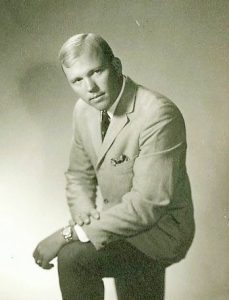
John Leiber Amphitheater High School Graduation June 1962
He wanted a rezoning for that for commercial purposes. I was adamant. I told him that our council, and I don’t believe any follow-up council, would approve the rezoning of our historical birthplace to make it into some commercial mall or some sort. I think he realized that his desire to make it into a shopping center was not going to happen. We ended up working with the county to buy the land. It was part of a bond issue that succeeded, and we got money from the county. The county then allowed us to develop the Steam Pump Ranch.
I think it’s significant that the Steam Pump Ranch should continue to evolve. My vision at that time was almost like we had an old western fort that had adobe walls around it, and when you entered through the gate you would enter into an old period of Oro Valley, with cattle and horses and the whole thing. Because my wife’s folks got water here on their way to their homestead in the late 1920s and early 1930s, I have a fondness for the Steam Pump Ranch. It needs to be committed to by the town council, basically making this could be essentially a revenue generating location for weddings or for parties. Moving the farmers market there was the right thing to do, and it’s shown by how successful it is. I just think Steam Pump Ranch can be a real positive income-producing asset for the town.
Devon Sloan (off-screen): You met your wife Roxy here in Tucson and you were both members of St. Mark’s Catholic Church, which you helped build. How did that come about?
Dick Johnson: Well, I met Roxy through her brother on a miniature golf course in Tucson, and it turns out that he belonged to the same fraternity as I did in Washington state, but he was in Arizona. He told me that he had some sisters and asked if I would like to meet them. I said sure. So, I went down and met my future wife, and we developed a relationship beyond that. She loved the uniform. I was in the Air Force at the time. So, what can I say? We got married and had a couple daughters and moved around the Air Force, not that much.
Devon Sloan (off-screen): You went to officer training school at Lackland Air Force Base in Texas and then were assigned, eventually selected for missile training. Tell us about that experience.
Dick Johnson: Well, that was a wonderful experience. [inaudible]. I was drafted in the Army after graduating from Washington State University, and I was heading for Fort Ord when I decided I’d run down to the Air Force recruiting office and see if they had any jobs for officers. I knew nothing about how they were selected. The recruiter said take this test. I took the test, passed the test, and they selected me to go to officer training school. So, I did that and actually flew out of Tucson to San Antonio. My dad drove me over to Tucson from Yuma, where his cousin was, and I took a flight into Lackland in San Antonio.
When I got my assignment, when I got commissioned, it was to be a supply officer in Tucson. I was assigned to the 303rd Bomb Wing, B-47 Wing. They phased them out and that’s when I was selected for missile duty. Initially I was going to Salina, Kansas, and I sent a message to SAC headquarters because we had a conflict with our wedding date. Naive as I was, I was thinking they’ll listen to that. I didn’t hear from them, so we moved up our wedding date. Then I got reassigned back to Davis–Monthan Air Force Base in Titan II operations. It turns out when I was at Wichita Falls, Texas, an announcement was made that the Atlas and Titan I systems were being phased out and that we would have the Titan II. So, I went back and got reassigned to Davis–Monthan. While I was in the Air Force there, I became an instructor crew commander and went up the ranks in the Air Force. Then Shepherd at Wichita Falls took over the Titan II training in Wichita Falls. I didn’t care for that too much, so I volunteered to go in the Minuteman program and went to Rantoul, Illinois, and subsequently to F.E. Warren in Cheyenne, Wyoming on the Minuteman I and Minuteman III systems.
On Minuteman III I was working on a crew reduction program and went to Boeing’s. We did a lot there, but I also got acquainted with the personnel people. I wanted to go back to Davis–Monthan, and I was a major at the time and up for promotion to lieutenant colonel. I knew lieutenant colonels weren’t on crew force, but the vehicle to get there was through going back on the crew. Well, I did that. I got promoted and then left the crew force and did staff work. When they phased out the Titan II, I was going to Minot, North Dakota. My wife suggested that they would remain in the sunny climes of Tucson, and I said I had a job offer in the private sector, and I said I’m not going. [inaudible]
I spent about 21 and a half years in the Air Force. While in the Air Force I went to a lot of professional military schools where I learned leadership and management and a lot of very valuable knowledge about leadership and management, which I applied when I was on the city council. You can only study it for so long. You don’t want paralysis by analysis, and that’s the approach I felt in working at the Town of Oro Valley.
After leaving the Air Force I had a job offer with an architectural firm. We were designing La Paloma Golf Resort Hotel, and I was the business manager for the architectural firm. We did a lot of work in and around the City of Tucson with Seaver and Associates. Then I worked for the University of Arizona in the physics department as their project business guy. It just happened that my wife was going to UA and my kids were in the university and NAU, and we had a good deal with tuition about that time as an employee of the university, so that worked out really well. Subsequent to that I founded a company with another guy where we sold children’s furniture to Warner Brothers and all over the country out of Marana, which was really interesting. Diversified career, I guess.
Devon Sloan (off-screen): We’re going way back. You were born in Omaha, Nebraska, and grew up outside of Seattle, Washington, oldest of four children—three boys and a girl. Your dad was an accountant, your mom a stay-at-home-mom. Tell us a little bit about your early life.
Dick Johnson: My early life was very interesting in the sense that we moved from Omaha, but World War II was beginning, and my dad needed to move to Seattle for a job that had a defense relationship as an accountant. We moved several times within Seattle, and then we moved out into the countryside in Snohomish, Washington. There we grew up kind of on a small farm where we had to raise chickens and do those kinds of things. I think the whole aspect of this all my life—I’ve worked hard. I worked hard with goals in mind, and that by working hard and having integrity and all the characteristics I feel that I have, honesty, and that kind of thing helped to formulate my behavior and the sense that I did anything I could do to reach a goal that I needed to do.
I did this in university at Washington State University. I was the house manager of a fraternity, a sorority hasher. I swept out the chemical engineering building and did all this to stay in school. So that aspect of my life formulated how I feel about life in general and, beyond, I’ve felt a deep, deep obligation to help others. I’ve been on the United Way board for Southern Arizona for nine years, Junior Achievement for nine years. I worked in other “Christmas in April” projects where we renovated neighborhoods for five years on the board. I just felt that God gave me talents that I needed to use wisely, and I did so, so I’m proud of that without any narcissistic attitude.
Devon Sloan (off-screen): What do you believe was your greatest achievement with respect to Oro Valley?
Dick Johnson: I looked at that question. What my greatest achievement was working with the council, and probably the biggest thing that had a long-term impact on the community was the buying of the Naranja Town Park. There were over 220 acres in the center of our town, and we had the opportunity to buy it. It was being sold by the Arizona Trust to raise money for education, so it went to the highest bidder. The mayor, and I, and the town manager, and the finance guy were down in the courthouse, and we secured that property. I was so happy, so happy. It was actually an emotional thing for me because we could have lost that bid, and Naranja Town Park would not be in existence. It would have been developed into housing and whatever.
I look at the library and the hospital, two other major keystones of what we accomplished. Paul Loomis, I, and the other three council members at that time, we had a mayor and four council members. We did a lot in a short period of time of significant nature. And I will share that with anybody: that we did things that we can look back on and say, wow, we accomplished that.
Well, I’d like to add that people move to Oro Valley for a reason. If you ask people that move here why they moved here, it’s a quality of life. It’s a sense that this is a great community. It’s a safe community, and it’s got great education. Look at all the ingredients of what this community has. You can see no reason why people wouldn’t want to live here. I think that aspect should be foremost in their minds: why they moved here, and stop dealing with the small things, like trying to shut golf courses down, trying to change the whole sense of the community. No growth has unintended consequences. We depend on growth—smart growth, not inconsistent growth, but smart, environmentally sensitive growth that should be nurtured and valued. I cannot see some of the small items that become significant in the minds of some citizens. We need to work and help each other make this community even better in the future, having a vision of the future, not just thinking about what’s going to happen tomorrow, but what’s going to happen five or ten years from now. If it’s done right, we will always be proud of our community.