
Layers of History: Building and Beyond (with Pat Spoerl)

Video Tour and History of the George Pusch House as told by Pat Spoerl.
Pat Spoerl, archaeologist and Oro Valley Historical Society co-founder, explores the construction of the George Pusch adobe house, restored to its 1870s–1920s appearance. She also highlights later additions by the Procter-Leiber family and the ranch’s 2007 acquisition and later restoration by the Town of Oro Valley.
Hello. I’m Pat Spoerl. I’m an archeologist, retired, and have been involved in historic preservation work for a long time. In 2007, I was a member of the Oro Valley Historic Preservation Commission, and that was the year that the town of Oro Valley purchased Steam Pump Ranch with Pima County bond funds.
The town allowed the family who lived here, the John Lieber family, to continue living here for a year until mid-2008. So, during that time, the town prepared a master plan for this 15-acre property that we’re on today. And that master plan identified potential uses of the building, which one should be nominated to the National Register of Historic Places…all kinds of things related to the preservation of this property. So, it was not until 2008 that the town was actually able to get on the property, start the cleanup process and determine what the restoration priorities were.
There were two of us on the Historic Preservation Commission who are archeologists, who were asked by the town to monitor the cleanup here to make sure that nothing of historic importance was put in the trash, carted away. Whatever. So, we monitored that, and it was a great experience. I’ve been watching this house and the site ever since then. This house is called the Pusch House because George Pusch and his family lived here, but this house was lived in for well over a hundred years – from the 1870s until 2008, when the town acquired the property.
The first building to be restored, rehabilitated at the ranch here was the Pusch house here because it was considered the most historically significant – and that work was done in 2010.
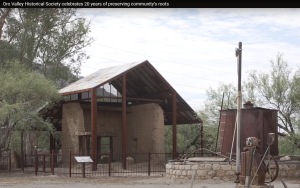
The pump house over to my left was likely built around the same time as the Pusch house. It was in worse condition, and it has currently a ghosted rough structure over it – and that work was done by the town in 2015. So, let’s go back to the 1800s for a minute and look at this setting. We’re standing here on the edge of the Cañada del Oro wash. It’s right over a berm here. You can’t see it as well today, but the CDO runs from high in the Santa Catalina Mountains all the way to the Santa Cruz River. You have the Santa Catalina mountains on this side. We’re in a floodplain – lots of dirt, sand and water. This area that we’re standing on was once part of Mexico. Until the Gadsden Purchase in 1854, this was in northern Mexico. The Gadsden Purchase allowed lands south of the Gila River to the Mexican border all become part of the United States. So, Tucson was just a remote northern Mexican outpost at that time.
By 1860, a trail over here to my left that is now Oracle Road had been improved enough to be a road that was used primarily by the military traveling north out of Tucson to Camp Grant on the San Pedro River. And it was used by stage lines. Apache also traveled this area quite frequently. So, into this setting, which was pretty vacant land.
In the late 1860s, a young man named George Pusch immigrated from Germany in 1865 to New York. Another young man, the same age 18, immigrated to New York from Switzerland. They met in New York City. They both worked in a butcher shop. They stayed there for a while and then traveled west. George Pusch went all the way to California and then was thinking about being a cattleman. So, he started a little eastward track to Prescott and then to Tucson. And he got to this area and said, “This is where I want to be a cattleman!” He and John Zellweger, the other young man, got together. They established a butcher shop downtown Tucson in 1876. And about the same time, they established the PZ Ranch and registered the PZ brand
George Pusch dug a well, and he obtained a steam pump made in Germany. We don’t know exactly if it was shipped from Germany, likely not, or was in this country, so that he had a constant source of water and he started building this house. Our best estimate is that this house was built about 1876 to 1878. We think that there was nothing here before then. No other buildings. The closest ranch at that time was Francisco Romero’s in Catalina State Park. So Pusch, probably with the help of others, started a house here. He married in 1881. He had nine children, seven of whom lived to adulthood. He had a house in downtown Tucson. He had a house here, and in the mid-1880s, he started purchasing a second ranch in the San Pedro Valley with a very large house there…and he ran cattle there. So, he also became quite prominent in Tucson as a businessman with his butcher shop, community service, and he served on the Constitutional Convention for Arizona statehood. He died in 1921, and this ranch and the one on the San Pedro were sold in 1925. It was kind of the end of the era of open cattle range, and there had been drought so business was not particularly good.
I mentioned that this house has been occupied for over 100 years. During that time there have been additions, changes made to the original house. Indoor bathrooms were added, fireplaces, rooms, glassed in porch, all kinds of things. – All of these were done without formal blueprints, without any formal plans. So, I’m going to talk mainly about the house from the 1870s to the 1920s, rather than the more recent additions during the period where Pusch owned the house as part of the Steam Pump Ranch Master Plan. The recommendation was to take this house back to the late 1800s, not the way it appeared in 2008. There was a wall around here. This was glassed and there was an addition that way. You’re most likely would not recognize it as the same house. So, the decision was, rather than trying to maintain that and preserve it, that it would be taken back. That this would be an example – we would try to uncover the original portion of this house. And that was a major challenge for architects, engineers, archeologists; it was a complicated process.
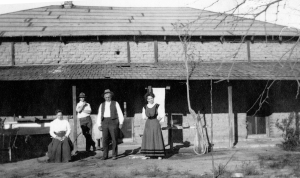
Some of the Pusch Family in Front Yard – Mathilda, George Jr, George Sr, and Gertrude c.1900-1905
The one thing we had to go on was a photograph – and this is an important photograph. It is the family standing on the porch here in 1900. You can see the adobe walls. They were not plastered as they are today – The roof. The porch was open. This was the guidance for taking the house back. Houses in the 1800s were built without blueprints. There weren’t any blueprints to them. And typically, they used locally available material. Where we’re standing here, you have dirt, you have sand, you have water. That’s basically all you need to make adobe blocks, maybe a little straw if you need to stabilize it. So, this original house was made of adobe. I’m sure the adobe was obtained right in this area. The bricks were made here. As a side note, when the restoration was done in 2010, parts of walls that had deteriorated, needed new adobe bricks. Those were made right here on site by people working with the contractor, so we know there is good material here. There weren’t plans, but there was considerable traditional knowledge. The Spanish Mexican architectural tradition had gone back for centuries. Houses in Mexico made of adobe. There was always adobe and there was always some rock for a rock foundation. And so that knowledge was here. There were people who knew how to build homes like this. They may start with square, one room, rectangular, add to it generally in a line. Sometimes there was an L-shape. Those were the typical house forms of the late 1800s. Adobe houses also typically had very thick walls, like 20 inches thick. They were oriented to capture the breeze so between the wall thickness and the windows, it would be cooler in summer and warmer in winter. And I was here working for two days in June of 2008, and it was perfectly comfortable in this house. So that has been retained, and the original floors were packed adobe. Typically, you might have a flat roof, saguaro ribs, other kinds of wood used as roofing materials. So there was your basic blueprint to build the house. This house is called the Sonoran Ranch House tradition, meaning that rooms typically had a door that opened to the exterior and also a door that opened to the interior of the house. There’s your basic plan. There are a few of these that remain, ranch houses like this in southern Arizona, and there are few in the Barrio district of Tucson, but basically most have disintegrated or been destroyed for modern development. Adobe does not last forever without maintenance. It depends on I don’t want to say the quality of the mud, but the consistency and the mixture of the mud and the sand. I have made adobe bricks and nothing much added to them at all. And they were stable. Sometimes straw is, sometimes cow manure has been added as a stabilizing, heavier substance. I don’t think they would have seen a Hohokam pit house like is on the property now, that those would have collapsed, that there were very few adobe structures. Unless you went to Tucson and further south even at the Romero ruin. If you’ve been there, it’s very rocky. Francisco Romero used rock. He used what was right there and then added adobe to it. So, I don’t think there were many examples to follow. It was the knowledge.
For somebody like George Pusch coming here…he had probably seen a lot of adobe homes in his travels, especially from California to Prescott to Tucson. So I’m sure he had a pretty good idea of what he wanted needed in a house. Before we step inside, I would like to point out one of several truth windows that were put in during the house restoration. These are to show the different layers of occupation and changes over time. You can see some of the original adobe walls here and then more of a concrete surface. There was a concrete plaster often put over adobe, which wasn’t the best thing to do to adobe because it trapped the moisture in there. But in the case of restoring this house, the decision was made of rather than showing adobe bricks and having the maintenance challenges of that, that we would go with the overall adobe exterior. Okay. Now we’re inside the Pusch house and in one of the rooms that is certainly an original in this house. I’d like you to look at this floorplan. It shows six rooms, which was the original configuration…at least we thought there were six rooms. That was somewhat standard at the t ime…you can come in from any room and exit. The other lines here where additional rooms added in later years – bathrooms, bedrooms, expanded kitchen, dining room, all that sort of thing that goes with a house that is occupied for many, many years. Just to note up above here is the Pusch family tree. There are still members of George Pusch’s family here in Tucson. One of them, Barbara McIntyre, gives tours occasionally. And this is an illustration of the Pusch family crest in Germany. And there are still members of the Pusch family in Germany. And we have communicated with them, which is very interesting in terms of making the connections to this old house and people still living in Germany. Okay. A couple of things I would like to point out to you.
As I said, when this house was first built, there was packed adobe flooring. Later probably in the late 1920s-1930s, wood floors were added and then carpet. This room, the next room, the living room, all were carpeted. We were very pleased to pull back that carpet in and 2008 and find this beautiful wood floor. An interesting bit I will point out here is a section here that perhaps you can see outlined, and it sounded hollow. We were able to lift the wood up and there was nothing underneath. No pot of gold. There is also one of these in the living room, so whatever that plan was, we do not know. The doors here, this particular door and this doorway was one of two original doors that were found in the house. It was put in storage, saved until the reconstruction work was done so it was used as a model so that the doors that you see are based on what was an original door from the 1870s. The ceiling is a nice tongue and groove ceiling. When work started on this house, we thought that this was the only room where this ceiling was preserved and it turned out that ceilings had been added since that time, particularly in this room, next door, that we’ll enter next. That was collapsing in 2008, but the original tongue and groove ceiling remained intact. This photograph shows the tongue and groove ceiling in another room of this house. It was painted pink.
One other thing to point out in this house is that several of the rooms had wood burning stoves in them, and those were also uncovered during the restoration work. This metal plate is where the flue of a stove went up and through the attic. I believe there are four of these in the house, all covered over with electric plate. In this particular one, when it was uncovered, it was found with newspaper sticking in the flue that dated in 1941. So just a little bit of trivia and how modifications occurred and occurred. And you could never really anticipate what might be where, particularly since there were no blueprints. Okay. Now we’ll take a look in the second room here. Now we’re looking at the second room, and I would like to point out this corner fireplace that had been greatly remodeled over the years but also had deteriorated inside.
So, it was restored to look as a late 1800s fireplace might look, was stacked adobe from the base to the ceiling. This is one of the interior truth windows that shows the different layers of wall covering from original adobe to there was paint, there was lime plaster applied, there was scoring of that lime plaster and painted again, some of the original colors that you can’t really see here included a light green. Now we’re in the living room. This is the large room that did not have a middle wall between it as had been expected. So, it is quite a room for the late 1800s or even the 1930s and 40s. What I would like to point out here is this area marks a staircase that goes to a basement. We don’t know when this was installed. Our best guess is maybe the 1930s or 40s. It was tall; I mean, you could stand in it. There was a closet area in it. It was used until 2008. It is closed for safety purposes now because it had a metal staircase that was very steep. But one of the mysteries of the house and we don’t think it was used as a root cellar. It just did not seem to fit that particular use. We’re here in the kitchen now and this is likely one of the original rooms of the house also had adobe packed flooring. Some was added after that and another layer of cement probably as a base for tile added after that. So, this floor had considerable time depth. The thing that was one of the biggest surprises in the work at this house was finding evidence for a cellar in this corner of the room. When the floors were stripped away, there was a top concrete step and then several wood risers. It was narrow. It seemed very fragile. So, the archeologists did not go further. There was quite a bit of discussion. Should we put plexiglass over it so people can see, what our options? But it ended up the best option being to cover it over. We have photographs of it and talk about it. The archeologist who did the work for this said this likely could be the oldest cellar in southern Arizona because homes did not have cellars in the 1800s. We would expect that it might have been used for roots, vegetable, storage of food in the cooler, you know, under the floor. It was somewhat narrow. And when the newer basement was excavated in the living room, the wall of the closet done for that, bumped into the stairwell. It wasn’t known at that time that there was another cellar in the next room over just that something had been excavated. So, this is very significant, even though you cannot see it right now historically, in terms of the building and the use of this house.
On the opposite wall in the kitchen, the exterior side, we have one more truth window, which was a brick area that was used as a stove flue that went to the outside. Later in time, a room was added behind this wall, but this would have been fairly early that this construction was done. In the house you’ve probably noticed that there are exhibits and photographs. They have been done by the Oro Valley Historical Society who uses this building as a museum, which is open for tours on Saturdays, changes, exhibits monthly. So, it is a great place to come to learn more about the history of this house and the people who lived here over the years. So now you’ve seen the inside of the Pusch house as best we can know it, and it’s a pretty, pretty special early ranch house for southern Arizona. I’d like to add a more recent times information, just to put this in context of the additions and changes that were mentioned inside the house, the Pusch family sold this ranch in 1925, also their ranch on the San Pedro Valley.
It was probably vacant here for a little while, but the next major owner was Jack Procter. He came to Tucson to manage the Pioneer Hotel in downtown Tucson and purchased this ranch in a series of complicated transactions. Between about 1935 and 1943, he built the ranch house, which is located north of here just a little bit, and he added bunkhouses and chicken coops and considered this ranch his favorite diversion is what he called “coming out to the ranch”. He would take chickens to the hotel restaurant. There were all kinds of connections between his work downtown and his time on the ranch. Jack Procter and his wife had a daughter named Betty, and she married a baseball player named Hank Leiber. He was very well known until he got hit in the head one too many times and had to retire from baseball. So, he and Betty came here and they lived in this house. I’m sure by that time, which was about 1940, there was indoor plumbing. There’s two bathrooms inside. The kitchen had been expanded, new windows had been put in. The wood flooring was there. It was a very nice house for them. They had two sons, John and Henry, also known as Butch, who grew up on this ranch. And when Betty died, Hank moved to another part of Tucson for a while.
The son, Butch and his wife moved into this house in the late 1970s, did extensive remodeling, added a large fireplace in the living room, changed out all kinds of things that were removed in the restoration process. His brother John and his wife lived in the ranch house and one of their sons was still living in this house in 2008, when the whole family moved out of the ranch.
In summary there have been years of remodeling of this house, all without blueprints, all without formal plans. But it was done. As what often happens to the path of least resistance – We have a high ceiling, but we want a different ceiling. So, one is added, not ripping out the original one. Windows are changed. It’s following the original lines of the house, adding to it and what at times can seem as a very haphazard manner. But that was the way houses were enlarged and changed and to a certain extent still are today. From an engineering standpoint, this house was very important because when the additions were removed, the original house was in very good condition. It had been built well, strong adobe bricks. And what helped was the additions had covered a good portion of the exterior walls, so they had been protected over the years and with the whole idea of the least path of least resistance, flaws were uncovered from the late 1800s walls, surfaces, ceilings. So, we really have a wonderful piece of history here today.