
Apache Relationships to the Land and Lifeways of What Is Now Oro Valley, AZ.
The relationship between the Apache and the Oro Valley area developed through patterns of movement rather than any permanent settlements. For centuries, Apache bands traveled through the foothills, mountain corridors, and desert lowlands of what is now northern Pima County as a part of seasonal cycles. These cycles were tied to subsistence, trade, and social organization. The movements were deliberate and crafted using detailed knowledge of the local water sources, game patterns, and various plant resources. The land surrounding present-day Oro Valley functioned as a transitional zone within Apache territory – used repeatedly over time, rather than occupied continuously.
Because Apache life emphasized mobility, their historical presence in the Oro Valley region is not mark ed by large architectural remains. Instead, it is reflected in temporary camps, travel routes, and oral traditions that document long-term use of the area. Though this type of land use differs significantly from the agricultural societies that constructed permanent villages (like the earlier Hohokam nation), it does not represent a lesser connection to the location itself. Interpreting Apache history in this region requires us to recognize that movement itself is a central organizing principle, rather than viewing permanence as the primary indicator of any sort of historical significance.
The Apache are Southern Athabaskan-speaking Indigenous peoples whose homelands have historically extended across much of what is now Arizona and New Mexico. Rather than a single unified nation, the Apache consisted of distinct bands – each with its own leadership, kinship networks, and seasonal territories. These bands shared language and cultural patterns while still maintaining local identities that were tied to specific landscapes.
By the fifteenth century, Apache bands were moving through and using the lands that include the present-day Oro Valley area, which lies along the northern edge of these Apache lands. This area was not a fixed homeland marked by permanent villages but were instead part of a broader network of places that the Apache bands traveled through regularly. Mountains, washes, and desert corridors were known, named, and remembered. The absence of permanent settlements does not indicate the absence of people. Instead, it reflects a way of life built around movement and adaptation.
Apache presence in this region is understood through a combination of archaeological evidence, oral histories, and historical records. Together, these sources point to a long relationship between Apache bands and the land surrounding the greater Tucson area.
As I mentioned, the Apache way of life was rooted in seasonal mobility. Bands moved throughout the year to take advantage of changing resources, while following game, harvesting wild plants, and seeking reliable water sources. The foothills near Oro Valley offered shelter, cooler temperatures, and hunting opportunities during some seasons, while desert lowlands provided different foods and travel routes during other seasons.
Apache subsistence relied on a flexible combination of hunting and plant gathering adapted to the desert environment. Game animals such as deer, antelope, rabbits, and other small species provided meat, while plant foods included mesquite beans, agave, cactus fruit, and numerous seasonal desert plants. Apache groups also used fi re in controlled and purposeful ways to manage vegetation, support plant regeneration, and improve hunting conditions. These practices reflected an accumulated environmental knowledge that was developed through long-term observation and a repeated use of the landscape (rather than incidental or careless interaction with the land).
Land was not owned in the European sense. Instead, it was shared through kinship ties, customary use, and long-standing relationships with neighboring Indigenous peoples. Trade networks connected Apache bands with communities such as the Hohokam and later the Tohono O’odham. These interactions included the exchange of goods, shared resource areas, diplomacy – and at times conflict.
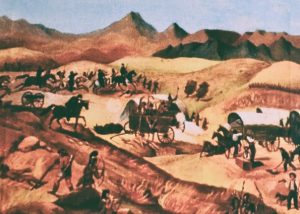
Tully and Ochoa Wagon Attack, May 1869 – article linked below in OTHER RESOURCES
Apache groups were already well-established in southern Arizona by the time Spanish explorers and missionaries entered the region in the late seventeenth century. Spanish colonial records often describe Apache bands as raiders or enemies, but these accounts reflect colonial concerns rather than the full reality of Apache life. From an Apache perspective, resistance to Spanish settlement was a necessary defense of land, resources, and autonomy.
Contact with the Spanish brought profound changes. Horses transformed Apache mobility, allowing bands to travel farther and more quickly. Metal tools and new trade goods were selectively incorporated into existing systems. Livestock became both a resource and a source of conflict, particularly as Spanish settlements expanded into areas long used by Apache bands.
In the Oro Valley region, Apache groups continued to move through familiar landscapes, adapting to new pressures while maintaining core cultural practices. Relationships with Spanish authorities were complex and shifting, involving trade, negotiation, and violence depending on circumstances.
After Mexico gained independence from Spain in 1821, conditions along the frontier became increasingly unstable. Mexican authorities struggled to control the region, and
violence escalated as competition over land and livestock intensified. Raiding and retaliation became more common, fueled by economic hardship and political instability.
Apache bands in the Oro Valley area relied on their deep knowledge of the terrain to navigate these dangers. Seasonal movement and flexible social organization allowed them to avoid permanent entanglement with colonial authorities while continuing to use ancestral lands. This period further reinforced Apache strategies of adaptation and resilience.
The mid-nineteenth century marked another turning point with the incorporation of southern Arizona into the United States following the Gadsden Purchase of 1854. Increased settlement, mining, and military presence dramatically altered the region. Roads, forts, and towns disrupted traditional Apache travel routes and access to their traditional resources.
While famous Apache leaders – such as Cochise and Geronimo – are often associated with southern Arizona, there is no direct evidence that they were active in the Oro Valley area because their movements were centered farther south and east. The Apache history of Oro Valley instead reflects the experiences of local bands whose names were rarely recorded in written sources, but whose presence was still very real and important.
Unfortunately, military campaigns and forced removals eventually led to the confinement of most Apache people on reservations such as San Carlos and Fort Apache. This process involved immense hardship and loss, including separation from ancestral lands like those surrounding Oro Valley.
Despite displacement, Apache culture did not disappear. Language, ceremonies, and oral histories continued to be passed down even under restrictive conditions. Knowledge of ancestral landscapes remains alive through stories and teachings, preserving connections to places no longer freely accessible.
Today, Apache communities continue to maintain cultural ties to their ancestral lands. Efforts to preserve language, revitalize ceremonies, and protect traditional knowledge are central to contemporary Apache life. These efforts are not just about reclaiming the past, but also about sustaining living cultures in the present.
Oro Valley exists within a landscape shaped by Apache movement, memory, and knowledge. Recognizing this history requires listening to Indigenous voices and acknowledging that the absence of visible ruins does not mean an absence of history.

Photo: Apache Baskets Often on Display at Pusch House Museum – See Burden Basket article in OTHER RESOURCES section below.
The Apache story in Oro Valley is not one of disappearance, but of endurance. It is a history carried in memory, in landscape knowledge, and in living communities. By
understanding this region as part of a broader Indigenous homeland – rather than a blank space between settlements – we gain a more complete picture of southern Arizona’s past.
The history of the Apache is still part of the landscape of Oro Valley, even if it is not always easy to see. Paying attention to that history helps acknowledge the generations who moved through and depended on this land and also helps to keep the culture alive.

Brittnie Smith, OVHS Volunteer
Brittnie Smith is a stay-at-home mom and historian with a BA in Public and Oral History. She has worked in a variety of roles within the historical community, including editing for an award-winning history journal, volunteering as a museum docent, and tutoring both adult learners and high school students. Her interests focus on public history, community storytelling, and helping make history feel accessible and relevant. She is currently a volunteer researcher with the Oro Valley Historical Society, where she assists with research, documentation, and digitization related to local history.
Basso, Keith H. The Cibecue Apache. New York: Holt, Rinehart and Winston, 1970
Borderlandia. Tucson: The First Reservation in the Southwest, Accessed 2026
Ciment, James, with Ronald LaFrance. Scholastic Encyclopedia of the North American Indian, New York: Scholastic Inc., 1996.
Cremony, John C. Life Among the Apaches. Lincoln: University of Nebraska Press, 1983
National Museum of the United States Army. Fort Apache, Arizona, Accessed 2026
Southern Arizona Guide. Southeast Arizona: The Apache Wars, Accessed 2026
Southern Arizona Guide. Tucson Pioneers Perpetuated Apache Wars: Part of the Civil War, Accessed 2026
Read more about the Tully and Ochoa Wagon Attack, May 1869
Honoring Heritage: The Story of the Burden Basket (Stories Woven in Fiber: Pima and Apache Burden Baskets)
Poster: Apache “Shis-Inday” Leaders / Chiefs, copyright Red Marie’s 1996
The Hohokam and Huhugam, An Enduring Presence in Oro Valley and the Greater Tucson Basin, by Brittnie Smith, January 2026
The Tohono O’odham: Desert Lifeways, Continuity, and Presence in the Tucson Basin, by Brittnie Smith, April 2026