
An Arizona Life Remembered: Ranching, Politics, and Family Stories
Join Hank Zipf—grandson of pioneering homesteaders George and Mathilda Pusch—for a captivating look into the history of Oro Valley and the San Pedro Valley. Hank reminisces about the realities of early Arizona ranch life, peaceful relations with local Apaches, and how author Harold Bell Wright’s stay in a local line shack inspired the region’s first guest ranch. He also details the property’s mid-century transformation into the Oro Valley Estates, family ties to Major League Baseball player Hank Leiber, and a firsthand memory of the day film star Tom Mix met his tragic end. This unique oral history offers an unforgettable glimpse into the deep family and cultural ties that shaped the region.
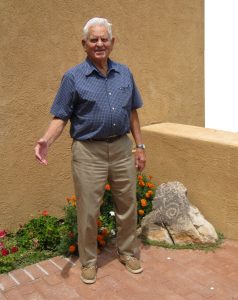
Henry “Hank” G Zipf and Petroglyph
Hank Zipf: George Pusch came to New York, the best I can determine, in 1865. He was 18 years old, and I think he came from Bavaria in Germany. I think, too, that his folks had some money. He was accompanied by a fellow by the name of John Zellweger; they were close friends and they were meat cutters. For about ten years, they worked their way from New York across the country to San Francisco. I think that was a business they were involved in because, evidently, both of them saved up some money or had gotten money from their parents in Germany.
In about 1874, George moved from San Francisco to Prescott, Arizona. I think he intended to go to Phoenix, but he ended up here in Tucson in 1874. Around that time, he also prevailed upon John Zellweger to join him. I think John had gone to San Francisco, and he came on down to Tucson from San Diego.
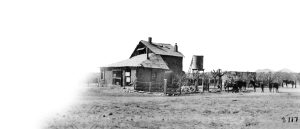
Pump House at Steam Pump Ranch
They located the Steam Pump Ranch, which is the ranch at Oracle and First where the old Steam Pump building was first located. They established that ranch because water was close to the surface—water is good there today. They established or built a steam pump that was fired with mesquite to bring the water to the surface. In those days, of course, if you dug a well, you had to hand-dig it; you didn’t have equipment to dig a well, so ranches were always located where there was a water source. They had found this ranch with good water, and for a long period of time, they watered horses or cattle that were brought to Tucson or Red Rock for shipment. The old-timers in Pinal County would ship out of Red Rock or Tucson, and they’d bring their cattle to Steam Pump to water the night before because it added weight to the cows. Old George and John Zellweger got 10 cents or 15 cents—I’m not sure which—per cow.
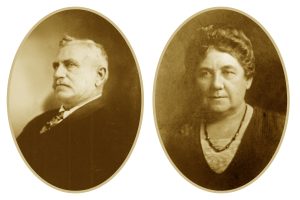
George and Mathilda Pusch, c.1912
About that time, a 20-year-old girl from Frankenberg in Germany named Mathilda came to Tucson to visit Zellweger’s friend, whom we called Aunt Sophie. Here she was, 20 years old, traveling across the ocean to Tucson, which was a dusty little town of about 3,000 people. Mathilda and George Pusch were married a year later. They had nine children. The first two children were twins and they both died, but seven survived. My mother, Gertrude, was the oldest, and she lived to be almost 90 years old, dying in 1974.
The Steam Pump was not the main ranch; they used that more as an overnight stop to travel from Tucson to the Feldman Ranch. They had a home on Jackson Street in Tucson, about a block south of Broadway and west of Stone Avenue—part of the area that was demolished when they put in the community center. They would travel from that home in a horse and buggy to the Steam Pump Ranch, stay overnight, and then head to the Feldman Ranch in the San Pedro Valley.
That area they traversed from the Steam Pump to the San Pedro was called the Antelope Plains at the time. My mother told me many times that they had to stop the wagon to let the antelope go by. Also, my grandfather never carried a gun. The Apaches lived not far from the ranch in the San Pedro, where the Aravaipa Canyon flowed into the San Pedro, which was close to the ranch. Those Apaches were always friends. In fact, some of them would commit crimes and so forth in other parts of the San Pedro Valley, but they never touched my grandfather and never cut a fence. Mother told me that on occasions, while driving from the Steam Pump to the San Pedro and crossing the Antelope Plains, the Apaches would meet them and circle them. I had two aunts—the youngest girls—who had long blonde hair, and the Apaches would reach over and rub their hands through their hair. They were really interested in those women with the long blonde hair. My grandfather would say, “Just leave them alone, don’t get upset with it,” but they never really bothered him, and they were actually helpful on the ranch.
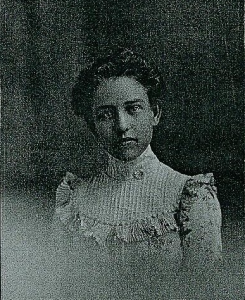
Young Gertrude Pusch
My dad was Henry William Zipf, and he was married to Gertrude, the oldest daughter. I lived out there on that ranch for two years. We had a one-room schoolhouse, and we didn’t have any of the niceties you have today. You got up in the morning at daylight and you went to bed at night. The only heat we had—we had a large ranch house with a porch all around it—were a couple of fireplaces, little kerosene stoves, and a big stove in the kitchen. Of course, food wasn’t that available, and there was no ice or anything like that, but it was an interesting time. I spent two years there as a kid, went to a one-room schoolhouse, and we had a teacher by the name of Kay Kirkpatrick from Winkelman who taught the one room with kids in there from the first to eighth grade. It was a real experience.
The Apaches had a camping spot in the Catalinas above the old Steam Pump. I say camping because I used to go up there a lot as a kid with my brother, and we’d find all kinds of pottery, but there wasn’t anything to indicate that they had any permanent residence. I think they were hunters who came through and maybe spent a few days up there. My mother told me that on a number of occasions, they’d show up at the kitchen door of the ranch house at the Steam Pump and ask for food or maybe provisions. The cook would always mumble and groan, but my grandmother would say, “Take care of them, we don’t want any problems.” So, she’d see that they had sugar, salt, or whatever else they asked for, and they got along with the Apaches. They never seemed to have any trouble.
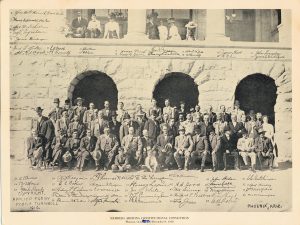
Arizona Constitutional Convention Signed, December 10, 1910
My grandfather was active in politics. He was a member of the territorial legislature when the state was still a territory, and later he was a member of the Constitutional Convention that drew the constitution for the State of Arizona. He was also on the council in Tucson. The only thing about my grandfather was that he was a Republican, and in those days, Republicans didn’t get very far in elections. The registration was about four or five to one Democrat. Many of the people that were in that Constitutional Convention with him became governor. Mo Udall’s grandfather was there as a delegate. There was a fellow by the name of Hunt who was governor for six terms, another Democrat—I remember him because he looked like a walrus with this big mustache. Osborn, another Democrat, also became governor, so it was quite a gathering of prominent people in Arizona at that time.
My mother spent a lot of time at the Steam Pump; she loved it out there. Prospectors would come to the Steam Pump to water their burros and to get provisions to go into the Catalinas, and she learned from them about a mine called the Mine with the Iron Door. It was supposed to be a mine up there in the Catalinas above the ranch where this old prospector found a fabulous vein. So, these fellows would come in with these burros, load up, and head up into that part of the Catalinas. The Catalinas did have some mining; there was a mine on the other side of the Catalinas up near the top of the mountain, and there was also mining in the Cañada del Oro up near Oracle—quite a bit, in fact, there’s a mine there today. But these old prospectors headed up into the hills. I don’t think they ever found anything, although you can go up there now and find holes.
The Cañada del Oro country is really a beautiful area. My dad used to take me out there to one spot where we’d go down into the canyon and pan for gold. There were miners down there working, and he’d get colors, but they never got anything very big, although I think during the Depression some people made enough money to get along.
It was in 1922, I think, that Harold Bell Wright came to Tucson. Harold Bell Wright had tuberculosis, and he came here for his health, as many people did at that time. He built one of the first subdivisions out off of Speedway and Wilmot and had a beautiful home out there; that subdivision exists today. Anyway, he would stop at the Steam Pump Ranch, and he and my mother became great friends. She told him about the Mine with the Iron Door, so he learned about this fabulous mine.
Later, he met with George Wilson up at Oracle to ask him to provide a spot for him to go where he could be by himself and try to recover from his illness. George Wilson owned the Linda Vista Ranch—it wasn’t a guest ranch then. He came to Oracle originally for his health, too; he’d had some kind of problem with his lungs, and he established this ranch near Oracle. He permitted Harold Bell Wright to go up to an old-line camp on the Cañada del Oro where he’d be alone, be able to be there, and try to regain his health. He had an old fellow there at the ranch he’d send up to the line shack with provisions so Harold Bell Wright had food and that type of thing. He was up there for about six months, and during that period, he wrote The Mine with the Iron Door. It was very popular, and the Principal Pictures Corporation in Hollywood decided they wanted to film it. He agreed that they could film the picture provided they filmed it at the Linda Vista Ranch because he wanted to repay old George Wilson for the help he’d given him.
They filmed it there, and in order to accommodate all the extras, movie actresses, and so forth, George had to build some cottages. Well, when they got through with the filming of the picture, he had these cottages at the ranch, and he decided that he’d start a guest ranch. He started the Linda Vista Guest Ranch, which was really the first guest ranch in Arizona. The Cañada del Oro where the Linda Vista Guest Ranch is located is beautiful. The stream usually ran, and when you look back into the Catalinas, there’s a trail that goes all the way to the top of the mountain from the ranch on the backside. There’re all kinds of game in there, and, of course, it was isolated, so people from all over the country came to the Linda Vista Guest Ranch. People like the actresses Rita Hayworth, Gary Cooper, and I guess Clark Gable, yeah. Also, prominent politicians like Herbert Brownell, who was Attorney General of the United States, and Vice President Dawes. Boyd Wilson, who was a good friend of mine and George Wilson’s son, told me that Thomas Dewey came out there after he was defeated by Truman.
I bring up the Linda Vista Guest Ranch because other guests came to that guest ranch and later bought ranches in the area. They included Walter McDonald of the McDonald Press in Cleveland; he owned Rancho Vistoso—the whole ranch. He had a big home back in there after you cross the Cañada on Oracle Road. Another guest was Joe McAdams, and he owned all of Rancho Romero. Robert Nicholas of the Johnson & Johnson pharmaceutical company owned land and a ranch up there where Catalina is today. So, the Linda Vista Guest Ranch brought these prominent people to this area.
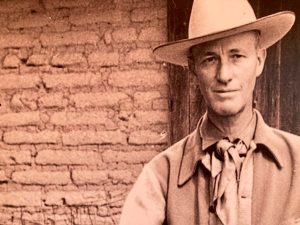
Jack Procter in Cowboy Hat
In 1933, Jack Procter, who ran the Pioneer Hotel in Tucson and I think probably had an interest in it, bought the Steam Pump Ranch from my grandmother’s estate for $10,000. Jack Procter was a prominent man in Tucson; he was on the board of the Consolidated Bank and active in civic affairs. He had a daughter, Betty, who was a beautiful woman with long red hair and was Miss Arizona one time. She had a shop there, and she married Hank Leiber.
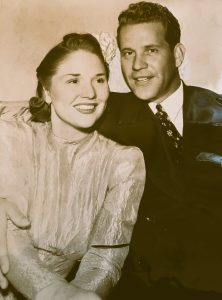
Hank Leiber and Betty Procter Engagement Photo MLB Press Release, November 17, 1940
Hank Leiber went to the University of Arizona where he played football and baseball, and later became a member of the New York Giants, and I think he was also on the Chicago Cubs team. Hank Leiber was married to Betty Procter, and they moved into the old Steam Pump ranch house after Procter had bought the property. Procter also built himself a home adjacent to the old ranch house, so Hank and Betty lived out there in the old Steam Pump house—the house that my grandfather had built—and they fixed it up real nice. It was a nice place; we spent a lot of happy times out there. Hank would bring in the whole Cleveland baseball team and cook steaks, and they all loved that area because of its proximity to the mountains and the beauty of the area.
Jack Procter would take his favorite guests out to the ranch; in fact, some of them stayed out there. One of his guests was Francis Rooney from Tulsa, Oklahoma. Francis Rooney was the president of Manhattan Construction Company in Tulsa, and they had other interests in Tulsa. Francis became interested in the adjoining ranch—now, that ranch I think they called the Cañada del Oro Ranch—so he purchased that. It included all of the property that’s now occupied by the Oro Valley Estates, the golf course, and the land across the Cañada. He had a cowboy on the ranch named Pancho Mendoza, and old Pancho ran cattle on the property and was a caretaker. Also, my Uncle George Pusch—son of George, George Pusch Jr., I guess—occupied the home on the Cañada del Oro Ranch. They had an old adobe home there with big, thick walls, a big home, and he’d occupy that as a caretaker for the benefit of the Rooney family.

Laurence Francis Rooney Sr.
In 1958, Rooney sold a portion of the Cañada del Oro Ranch to a fellow by the name of Jerry Timan, who afterwards organized the Horizon Land Company. A fellow by the name of Lou Landon, who was from Chicago, had been out looking at the property because he was interested in establishing a golf course. There were only two or three in Tucson at the time, and this area out here was isolated; there wasn’t really anything much in the Oro Valley area, just a dirt road. I think a fellow—I forget his name—had some chickens on Linda Vista, some chicken shacks, and a couple of ranches, but nothing else out here. Well, anyway, Lou Landon prevailed upon Jerry Timan to sell him 175 acres for $187,000. I handled the deal for Lou, and part of the requirement in the sale was that he build a golf course within a certain period of time, because Timan recognized that if they built the golf course there, it would increase the value of this property. So, Lou had about 15 or 16 Chicago investors; they all came out from time to time, and they invested enough money for him to buy the property and build that golf course.
Property out here then was, like I say, ranches, and I think zoning was four acres to a house. The Oro Valley Estates called for acre zoning for each house, so we had to go before the Board of Supervisors to get the property rezoned. Timan and Landon held a news conference at the Saddle and Sirloin restaurant on Oracle Road. The press was there, and they unveiled this new project out here in Oro Valley. They suggested that there was going to be all kinds of developments: lakes, golf courses, tennis courts, a big deal. The Arizona Daily Star came out the next day and the headlines said: “$44 Million Investment in Oro Valley.”
Procter died a number of years ago, and he left the Steam Pump Ranch to his grandsons, Henry and John. Henry has a ranch up in Montana, and John’s a lawyer here in Tucson. John lives on the ranch, and until about a couple of years ago, Henry Leiber and Betty Leiber lived there. Betty Leiber died, but Henry Leiber occupied the old ranch house until his death.
Tom Mix spent his time at the Santa Rita; he loved the Santa Rita. The day he left, everybody tried to stop him from leaving. They were worried because he’d been drinking, and he loved to drive a fast car. It happened that that day I was working with The Citizen, and part of my job was to deliver papers to Casa Grande, Coolidge, and Florence. I was coming back on the Florence Highway, and I got there about just maybe half an hour after he had run off the road and killed himself. They were putting in a new culvert, and he was going so fast he couldn’t control his car. I guess he rolled, and it was in the afternoon. He’d left the Santa Rita and was on his way to, I guess, California.
Hank Zipf: I told you at the time I talked about what he did, and right now I can’t recall it. I might come up with it, but he was with some company. I maybe will come up with it; it’s in one of my talks. I heard of McDonald, but I never knew him. I just knew of him, and he had a big home back there.
Question: Do you know if he has any relatives left in the area?
Hank: Boyd Wilson is dead.
Response: Yeah
Hank: Did you ever talk to him?
Response: No, he died before I came here.
Hank: Boyd knew him well. Boyd could tell you about him. But Boyd’s son still runs the ranch.
Response: I thought they sold that off.
Hank: They just sold off part, yeah. The whole old home—the homestead—he still runs that. His name is Ralph.
Response: Ralph, yeah.
Hank: I bet you Ralph would tell you. There’s another fellow that used to be the cowboy that took care of the Rooney Ranch. His name is Gene Mendoza (M-E-N-D-O-Z-A). Gene was born on the ranch. His dad was there before him; we called his dad Punch. I remember him, a nice old cowboy. He sort of took care of the properties, and Gene was born there. Gene took care of the property after his dad died for the Rooney’s. Gene knows about the whole area. Now Gene lives—I think I have his phone number.
Response: Oh, that would be great.
Hank: He lives over by Vail. He’s sort of retired. He was born on the ranch, yeah, and he’s a good friend of mine. I’ll see if I have his number. I saw him maybe a year ago when I was in Sonoita, and he’s great.
Response: Good. I’d like to give him a call if you have the number.
Hank: I think he would know more about that area than anybody else because he was born up there and everybody knew everybody else. I knew the guy that had the ranch on the right side up there in the hill. McAdams. I knew McAdams well. I used to go there, and they’d have me over for dinner. But he had all the land that came to be—McAdams owned the land that is now Catalina State Park.
Response: Yeah. Oh, okay.
Question: And did he get that from the Baileys? Did McAdams get that land from the Baileys?
Hank: I don’t know where he got it, but he owned that whole 5,000 acres. And he had a son that lived there, too. There’s another house. The McAdams house was up on the hill where you go up the hill on the right. And before you get to his house, there was another house off to the right—that’s where his son lived.
Question: Do you know—did you know Dr. Russell?
Hank: No, I just knew the Russell Ranch, yeah. They had a little place right out there.
Question: Was that part of what used to be McAdams?
Hank: No, McAdams didn’t own it. That was a little island in there.
Response: Oh, okay.
Hank: I remember that place. But McAdams and his son were going to develop that whole ranch into a residential and manufacturing area. They had all the planning done, and I don’t remember the year—I’d have to go back—but they came up for zoning. They had a developer from Phoenix—and I can’t remember his name right now—and they were going to make that whole ranch into a residential and commercial area. What’s the name of it? Catalina State Park, yeah.
Anyway, the developer came into my office when I was practicing law, and I told him, “I’ve got a [Raúl?] Castro here in the office.” At that time, a local attorney was running for governor, I guess. I said, “He doesn’t know a thing about zoning, but you get him to represent you and you probably will get it.” Because you had a board that was a three-man board; two of them were Democrats, and a lot of that stuff was political. Well, he didn’t hire that attorney. The group that was against the development—there were a bunch of them—they hired him instead. On the day of the hearing before the board, which was held at the top of the Pima County building, he packed it with the opponents, and they turned the development down. The developer had spent a lot of money putting that thing together.
So then they worked a deal where they traded the area for Rancho Vistoso. The park went into the McAdams property, except for his house, and the Vistoso area was developed instead. Otherwise, the whole area where McAdams lived would have been a development.
Question: So the Vistoso area was not owned by McDonald? It was owned by McAdams?
Hank: No, no. McDonald owned it. But when they made the trade to get rid of the development where McAdams was, whoever the state and everybody else went in and put that deal together. So McAdams traded his land where they have the park for Vistoso. I knew his son; McAdams’ son was, in fact, he gave me a desk, and I knew him quite well. Of course, McAdams is dead and his son’s dead, but they were the ones that then put together the Vistoso development. But they didn’t actually do the development; they sold it. They traded McAdams’ holding on this side to the other side, and they sold it, and then it was developed.
Question: And Vistoso was developed by—is that Del Webb?
Hank: Well, no. Del Webb came in later and bought it. The guy that bought Vistoso initially—I was all involved with that because I was on the council and I helped annex it—but the guy that developed all of Vistoso was a crook from Phoenix. I can’t think of his name. That’s another story; there were a lot of things going on.
Another thing that you didn’t write up in your book—when I was a kid, I used to go out with my dad to visit John Nelson. He had a ranch right on the Cañada. John Nelson was a really great guy. He lived out there, and he had his wife and her sister living there. He had a little ranch, and he was also the Sheriff of Pima County. He was a Republican. My dad was an ardent Republican who hated all Democrats, and we used to visit old John Nelson. He had this place right down in the Cañada, and I think that’s the place that is now the YWCA—the women’s retreat. I think that was his old place. John Nelson’s family also owned a home right across the street from us on Stone Avenue. We had a home there. His wife’s sister lived with them, and she worked at [inaudible]. She was a client of mine; she knew everything about Tucson, but she’s dead now. Her relatives—John Nelson’s relatives—were still in Tucson.
Question: Are they Nelsons? Is that their last name?
Hank: Yeah. I did some work for them when I was practicing law, but it’s been quite a while. I don’t know whether my old secretary can dig that up, but they have a good family here. I noticed you didn’t write about that in your book.
Response: I really didn’t get any information. The only information I got about Nelson was that when one of the Sutherlands died and their land was for sale, John Nelson came in and bought it. And that’s by Sutherland Wash now, north and over on the other side.
Hank: He was the Republican sheriff. A nice, really nice man; they were sweet. I represented his wife until she died. It’s been probably seven or eight years ago; she lived to be almost 100. Her sister’s name was Melgren (M-E-L-G-R-E-N). She worked as a scientist, and she was [Steinfeld?]’s accountant—kept all the books. She lived right across from us on Stone Avenue. We lived at a place at 640 North Stone, and she lived across the street from us. Every day she walked from there down to Congress Street or Pennington, and every night around 9:00 or so, she’d walk back. In those days, it was no problem for an old lady all by herself to walk down there every day. She worked for them for years. Nelson’s grandsons are still living in Tucson; they’re a nice family.
Question: Could you maybe give me some direction on how I can find them?
Hank: Well, my secretary might be able to tell you. She kept all my records and stuff. We threw a lot of that out, but she might be able to help. She was with me for over 30 years and she knows all that stuff. Her name is Pat LoBiondo (L-O-B-I-O-N-D-O). She’s really sharp. She might remember their names. But Nelson was one of those people who lived right down there.
Question: How did he die?
Hank: I don’t know, I was just a kid. My dad used to take my brother and me out there. It was a nice old ranch and there was water. My dad was one of these people that believed in mines and gold and all that stuff. We used to go out there and see old man Nelson, and then he’d go up in the hills of the Catalinas. We had one of these metal detectors, and we were always looking for the old iron door mine. My dad was full of that stuff, and of course, we had a lot of fun because my brother and I liked to go with him. We’d stop to see Nelson and get water, and probably my dad would get a drink of whiskey. They were good people.
Question: Did John Nelson make his own whiskey?
Hank: I don’t know. He was the Sheriff of Pima County. When they knocked over a still, everybody got liquor—all the supervisors and the people in county government. My dad was the Street Commissioner for Tucson for a while. When the police chief would knock off a still, he’d come home with a gallon of whiskey, you know.
Response: Sharing the wealth. That’s a great story.
Hank: Yeah, they’re one of the pioneers.
Response: He had a ramshackle place like everybody else back then.
Hank: If you could find a Nelson, you’d probably get some pictures.
Response: Yeah, well I certainly will try now that I’ve got some leads.
Hank: That’s good, yeah. Because they were there—John Nelson was there when I was just a kid, probably 75 years ago. I remember going there with my dad.
Question: And he lived on the ranch; he didn’t live in Tucson?
Hank: Well, in those days, the old ranchers that could afford it would have a home in Tucson too. We used to go over to his house in town; in the backyard, he had more fig trees than I’ve ever seen. We’d go over there and collect figs by the bucket. He lived there with his wife and her sister.
Question: Did he run cattle up under the Cañada?
Hank: I think they ran a few cattle. It wasn’t a big ranch, but it was a nice spot. I think it’s where the YWCA is now, an area there on the Cañada where there was water.
Question: Was that called the Rail N?
Hank: No, I don’t know. I’ve heard of the Rail N, but I don’t know if I can place it. I don’t think it was that; it might have been called the Nelson Ranch.
Question: Was it where the railroad stopped? The proposed railroad, I understand, never quite got to the Steam Pump. Your grandfather was involved there.
Hank: Yeah, they were going to put a railroad in. The old bed was there for a while; they were going to put a railroad down through that wash.
Question: I have a brand here, I don’t know what it is. What is the real Bar V Bar? That is supposed to be George Pusch’s.
Hank: Yeah, that’s true.
Question: Was that at the Steam Pump? I don’t know when you think this photo was taken.
[inaudible]
Hank: I found another picture, Jim.
Question: One of the things that I learned from you is that when you were living in Oro Valley—do you have any pictures of you or the house you were in? I know you ran for office—I was going to say sheriff, but it wasn’t sheriff.
Hank: What do you want to start with?
Response: Where do I want to start with? It’s a good question. Let’s do the pictures.
Hank: Okay.
Response: So this one is obviously an old man there.
Hank: Yeah, I don’t recognize those trees; I don’t think they had trees like that on the ranch. I don’t remember that, but that’s George Pusch.
Response: Okay, how about these people?
Hank: Are you ready?
Response: Yep.
Hank: You want me to start on this side? This is Fred Pusch. Fred, yeah. He’s one of the sons. Okay, and this is his wife. Okay, what was her name. I think it was Elsie. I had a cousin, Robert Knabe (K-N-A-B-E). He isn’t in the photo, but this is his wife, Marie (M-A-R-I-E). Her maiden name was Condit; she went to the university. This is Viola Zipf, my brother’s wife.
Response: Where’s your brother Frank?
Hank: Here is my brother next to her, Frank. Okay, he was a railroad engineer in Portland, Oregon.
Question: He was also in the Navy, wasn’t he?
Hank: Yeah, he was in the Navy in World War II. Because of his railroad experience, he was in the engine room of a ship that saw a lot of action in the Pacific. He handled the steam engines and that kind of thing. It was a miserable business because they were in the Pacific, and he was down there in all that heat. He hurt his back because he jumped off the fantail of the boat to go into the ocean to get away from the heat. He hurt his back and he always had problems with it after that. This is Wilhelmina.
Response: Oh, really? The one with the baby?
Hank: Yeah, and her married name is Knabe.
Response: And that’s your aunt, isn’t it?
Hank: Yeah, she’s one of the daughters. Okay, there’s my mother. I don’t know whose baby that is; I’m trying to figure it out, but I’ll see if I get back to it. Here’s another baby. I think that baby is probably her baby.
Question: Wilhelmina’s? Is she the youngest?
Response: I don’t know whether she or Mabel was the youngest. There was another one, Mabel, but Wilhelmina was either the youngest or next to it. I think that’s her baby, and this is her baby. This is George; he’s George Pusch, the first son. He was a great guy—everybody loved him. He was full of stories, but worthless. He went through the family fortune. You wrote that in your book.
Response: [Laughs] I tried to be kind to him.
Hank: Well, in the old German tradition, the first son runs things. My mother was actually the oldest, but he was the first son, and since she was a woman, she was shoved to the side.
Response: But the truth of the matter seems to be that she really took care of the business
Hank: She was involved because this guy was over in California goofing off.
Oh, this is his wife; her name is Bert. I always called her that. And this is Gustav (G-U-S-T-A-V); they called him Gus Knabe. He’s this woman’s husband.
Response: So you’ve got a bunch of Knabe’s here.
Hank: I think that baby’s a Knabe, yeah, and Knabe, and Gus.
Response: There’s one down at the end, too. That’s the woman next to him—
Hank: That’s his wife. This was taken out at the Steam Pump. You see back in here? I’m not there because I was off fighting the war for my country. So this was taken in the 1940s during the war. My brother later went into the Navy after this, so it must have been in the early part of the war because he’s still here. And Gus is going into the war, too; he was a colonel in reserve, so he goes off. It must have been taken during the war. I’m not there; if I hadn’t been away at war, I probably would have been in it.
Question: Now tell me about this photo. Is this the Steam Pump? It looks like ranch activity.
Hank: I don’t know, that may not even be the Pusch property. I found a bunch of old pictures. I spent some time up in the Chiricahuas one time on a ranch with my brother, and I think maybe that looks more like where we were. We had horses up there, and I think probably that is not part of this ranch.
Question: Do you have any ranch pictures of the Pusch Ranch—you know, the cattle or that part of it at all? Steam Pump?
Hank: I’ve given whatever I had to the Society. This one here, I think that’s my mother. Yeah, and I think they used to go to Mount Lemmon. Mount Lemmon was approached in those days by the back road that went through Oracle. I would guess she’s up there on Mount Lemmon climbing one of those towers. They had a fire tower on Mount Bigelow and a tower on Mount Lemmon, and I suspect that they went up there.
Question: Do you think she was married at that point, or was she a young lady?
Hank: I don’t think she got married until she was fairly, maybe 29 or 30 years old. You know more about when she got married than I do.
Response: This is a great shot. If I can screen this to specifications, I’d like that to be the cover of the book. That’ll be one of my suggestions anyway. Who are they, do you know?
Hank: No.
Question: Do you know about when it was taken? Early 1900s? Late 1800s?
Hank: There are the mountains here in the background. It’s evidently at the Steam Pump. There were a lot of people who would go out there and visit because they had a large family. That big picture right there, that’s where they would all go.
Question: Do you think one of them is your mother?
Hank: I don’t recognize any of them; they must be friends. They would entertain a lot because for Thanksgiving and Christmas, we all had to go to Steam Pump. I don’t know who that is.
Response: But this, I think, is Uncle Walter.
Hank: Yeah, Uncle Walter. We had a Chandler automobile, and it had a jump seat in the back. So every Sunday, we’d go over to my grandmother’s house, and we’d all get in the car and go for a ride. Frank and I hated it, but we were hungry.
Question: Why did you hate it?
Hank: Because the whole family was crammed in there, and Uncle Walter would drive.
Question: This photo is labeled the Steam Pump Ranch, and I was wondering if that is the house that was built first? Is that the old Steam Pump?
Hank: That’s the old Steam Pump Ranch. But when Procter bought the property from my grandmother, I don’t know how soon after, Betty Leiber and Hank Leiber moved into the old house. Betty Leiber was Procter’s daughter. She was a great gal—a beautiful redhead and one of my good friends. Betty fixed the house up; she added porches and she had a porch with a bunch of plants on it. Betty and Hank lived there. Old Hank was probably the best athlete that ever came out of the University of Arizona. He was born in Phoenix—a big man—and he played baseball and football. He even played for the Giants and the Cubs. He was beamed twice in the head by a fella back in the days when they didn’t wear helmets, and after the second time, they wouldn’t allow him to play anymore. So, he came back, and I spent a lot of time with him. He had a real estate office in Tucson, and he ran that out of the Pioneer Hotel because Procter ran the hotel. So, Hank had a nice little office there. Anybody who came to Tucson would go to Hank Leiber; he got all this real estate business, and since I was his good friend, I would be the lawyer. That’s the way I got involved with all of that. First, I met the Rooney’s, and then Lou Landon came out from Chicago with his group to start the golf course. The first guy he went to was Hank Leiber, and then Hank got me in on it. Hank and Betty lived there. Betty died some years back, and I visited with old Hank the night before he died. He was in his house in bed.
Question: And he had his sons with him? Did they stay there?
Hank: Well, the sons were in the old Procter house. Procter built the house next door, and John lived there, who is a lawyer. Butch had left because he has a ranch in Montana. So, this is the old ranch house—the walls, the roof, and there’s a basement in it. We used to go down to that basement because in those days, the old-timers had basements where they would keep barrels of apples and all kinds of canning stuff. We’d go down to that basement and swipe that stuff. I remember they had a king snake down there—a big snake—and they kept the snake down there so it would get the mice. My mother told me that one time they were having a party, and the snake came slithering across the floor, and somebody reached out with a butcher knife and cut it right in two. That was the end of the snake.
When old Hank lived there, he’d always have the Cleveland baseball team out there. When the Cleveland Indians came to Tucson for spring training, Bill Veeck was the owner. They trained at a ranch on the northeast side called the Rocking K, and old Hank would have the team over for steak dinners all the time. I met all those big-time baseball players. We’d all go out here and have steak and do a little drinking. Play ball. Hank threw a lot of parties. I lived on the northeast side at Ina and Oracle, and I spent a lot of time out there with Hank; my first wife and I spent a lot of time there.
Question: Do you know anything about this photo here?
Hank: It’s hard to tell. I think this looks like my mother on the right; she always dressed like that. It must be some big soiree, and I don’t know where it is.
Response: It could possibly be at the Steam Pump–
Hank: I don’t think I ever saw anything like that there. It could be up in the Catalinas because you’d go back in there. You know, there is another thing about the Catalinas that no one ever talks about, but right above the Steam Pump, there was a flat area, and we used to go up there and find a lot of Indian artifacts. My mother found bone bracelets, pottery, and all kinds of things. I’ve lost all that stuff now. There was a little spring there. The Indians didn’t live there permanently—you can find Indian ruins anywhere in the valley where there’s water—but I think it was a hunting party camp because there was a rock at the end and all this broken pottery. I think they would hunt and camp there. If you keep going back in that valley, clear on the other side, there’s another beautiful valley that I don’t think has ever been developed. The Forest Service put two catchment tanks back there to catch water for the bighorn sheep,and that’s where I used to hunt. It’s beautiful back there.
Question: Is that clear on the other side still part of the Steam Pump?
Hank: It is still to this day part of the Steam Pump as far as I know, but you’ve got to go clear back into it.
Question: If you’re going north, it’s on the right-hand side?
Hank: It’s a pretty valley. I took George Johnson back there one time—the one who developed El Conquistador—and I told him, “You ought to put a hotel back here because it’s surrounded by mountains and there’s a spring back there.” We used to go there because there was always game coming in. I never shot anything because I wasn’t much of a hunter, but I spent a lot of time back in there.
Question: Could that be Buster Spring?
Hank: I don’t know much about old Buster. [Bailey] I’d see him at the Steam Pump, but I just knew of him. He’d come see me and talk about the old days, but he was a friend of John. I’d see him when I went over there to visit John. For a while, John was in our office; we had a law office on Speedway, and he rented one of our offices there. We were out there about a year ago when his daughter got married. He had a wedding out there in the front, and he rode up in an old buggy with her before she walked down the aisle. John and I are good friends, except for the fact that his grandfather bought that ranch from my grandmother for $10,000, and every time I go out there, he makes a little point about the fact that he owns the ranch.
Response: Well, he’s very unhappy about the way things turned out.
Hank: He is? Why? He’s always been unhappy.
Response: He’s difficult.
Hank: He got $5 million for it, so he ought to be very happy!
Response: But you know John—he wonders why it wasn’t $10 million.
Hank: Anyway, see my mother there? I think that’s my mother; that’s the way she dressed. I don’t know the others; they must be friends. There are the mountains in the background.
Question: Now, this photo is the Steam Pump, right?
Hank: Yeah, I gave this copy to them. I had it in my mother’s things, and that’s from before it all fell down. This old area over here is where they had the opening.
Response: There’s another picture I have. I’m not very good about other views. Let me find this one.
Hank: I gave them this one, and I found it among my mother’s stuff.
Question: Which one is your mother—the left or the right?
Hank: This one; she always dressed like that.
Question: Is this the other end of the Steam Pump Ranch?
Hank: Yeah, they had this old ladder here, and they used to keep hay here. The steam pump used to be out here somewhere—well, I guess it was—but there was a tank out on this side of it.
Response: Oh, okay. All right.
Hank: Together, those are pretty good pictures.
Response: Yeah, they are. That’s your mom? Yeah, she’s a good-looking woman.
Hank: She lived to be 90, and she was very happy with everything she did. She loved life, and she loved that ranch.
Question: Did she ever visit it after Procter bought it? Did she ever go back to the ranch?
Hank: Well, that’s another story. Procter ran the Pioneer Hotel, and when friends of his or guests would come to town, quite often they became friends. He’d take his good friends out to the Steam Pump because they were visitors from somewhere else, and he’d take them out there. I think he even kept rooms out there; I think he had enough room.
Francis Rooney came from Tulsa. He was a man who had a big construction company, and he and his wife would come to Tucson in the winter and stay at the Pioneer Hotel. He had a pot full of money, and so Procter took him out to the Steam Pump. By going to the Steam Pump, Rooney learned about the property immediately south of the ranch. It was called the Cañada del Oro Ranch.
Response: Weren’t they all called the Cañada?
Hank: Well, I’ve also heard it called the Johnson Ranch. Anyway, Rooney buys that ranch. He’s a guest of Procter’s at the Steam Pump, and he buys the adjoining ranch. That ranch encompassed all of the Oro Valley Estates. It ran clear across the Cañada. Is it the area where the golf course and country club are? No, it didn’t include the El Conquistador resort. It’s on the right side of the road; it included all of that. So Rooney buys that.
Now, he sells a portion of that to a fellow by the name of Jerry Timan (T-I-M-A-N). [Inaudible]. Then Timan sells a portion of what he bought from Rooney to Lou Landon and his group, who put in the golf course and the country club. Lou Landon (L-A-N-D-O-N) was from Chicago. Lou was a great golfer; he loved golf. He came out here to Tucson on several occasions because he liked the area and he liked to play. There was nothing out on that side at the time. My uncle ran cattle on the area where the golf course is now. There was a fellow who had a chicken ranch on Linda Vista—I forget what his name was—but there was nothing else out there. Lou put this group together of about 15 or 16 investors and bought that area for the golf course from Jerry Timan. It was a tough thing because it was only about the third golf course to go into Tucson. I think there was El Rio, the Tucson Country Club, and a municipal course. This was a new golf course in a new area, and it was a tough go for a while. Landon, of course, coming to Tucson, met Hank Leiber. Hank Leiber handled the deal when Landon bought the property, and I got to be the lawyer. It all worked out pretty nicely.
Here’s my mother again. They must have all been friends, you see, because they’d all go out there for parties. My mother loved the ranch, the Steam Pump particularly. She rode a lot, too; she was a good rider.
Question: Was she?
Hank: Yeah, she rode horses out there a lot. Besides the Steam Pump, the ranch, and the San Pedro property, they had a home on Jackson Street, about a block and a half west of Stone Avenue. That was a large home. It had a patio in the middle, they had stables there, and they kept horses there that they used for the buggy.
That’s my grandmother with a baby. I don’t know whose baby it was. That was taken probably over at 428 South Fourth Avenue. After they had been successful, my grandfather left the home on Jackson Street, and they built a brick home at 428 South Fourth Avenue. It was two stories, with about five or six bedrooms, a big living room, and porches. It was a big place, and they had a tennis court. So I think this photo was taken there. This is “Mama”—they all called her Mama—and man, she ran things. I don’t know who that baby is. Incidentally, they razed that brick house. The guy who owned it later was a lawyer, and he thought the freeway was coming in, so he tore the house down. It was a well-constructed, beautiful old home. It’s just sad he took it down because it was in good shape.
Response: You’ve got to watch those lawyers.
Hank: Well, some of them! I don’t know who these people are.
Question: Does that fence look as if it was on the Steam Pump property?
Hank: It probably was, but it looks like they’re all out on an outing.
Response: You may not know who they are either. Here’s another group, a lot of women.
Hank: My mother went to the University of Arizona, but I don’t think she got a degree because I don’t think they had a full four-year program at that time. She went when it first started. A lot of these friends probably had to do with the university because I know she went there. I think they had a two-year program or something. The streetcar used to run up there from downtown; they had a streetcar up Third Street that went right by our house at 428 South Fourth. A lot of this stuff is probably university-related. It’s too bad she’s not around to tell us.
Response: That’s all the pictures that I had where I didn’t know what they were. You said you were going to show me something?
Hank: Well, I have some. I didn’t know what you wanted.
Response: I brought something from the house you lived in when you lived in Oro Valley.
Hank: Yeah, I’ve got a lot of stuff around here. I don’t know whether you want any of this junk.
Response: Well, let me see what kind of pictures you consider junk.
Hank: A lot of this stuff is more about me than my mother.
Response: Well, you did live in Oro Valley. And I hate to tell you this, because I don’t want to hurt your feelings, but your history—
Hank: Did what?
Response: I don’t want to hurt your feelings, but you are part of the history!
Hank: I know these are all pictures of trips. I don’t think you want this stuff.
Response: No, I want Oro Valley. Whatever you have from when you lived in Oro Valley.
Hank: Well, I had a whole book on my campaign when I ran out there, but I gave that to [inaudible], I think. Let’s just run through this.
Response: Okay. Now, Jack August has been to see you?
Hank: Oh, yeah. When is Jack going to call me?
Response: I don’t know.
Hank: Months ago, his mother was sick with a heart attack.
Response: But he’s in Tucson now; I caught him on the road when he was driving to the hotel on the corner. He said he moved in—or came down—the other day and is going to be here for a month. I’ll email him and tell him to call you.
Hank: Yeah, well, he’s got a bunch of my stuff. Look and see if any of that stuff is there. I had a whole thing. Look at this—my gosh, I didn’t give that away.
Response: Weren’t you a good-looking man? You were such a good-looking man.
Hank: You just said I was history! You just told me I was history, and now you’re trying to make up for it. How do you like that?
Response: You know what, can I take this with me and mail it back to you?
Hank: Yeah, I don’t care.
[inaudible]
Question: Here is your campaign song. Do you feel like singing your campaign song for me? You want me to sing it? What a wonderful day. What about these pictures here?
Response: I know this one is your mother, but I bet these others are important.
Hank: This is my dad, my mother, Frank, and me. This is our house on Stone Avenue,
Response: Not Oro Valley? It was a nice house. It’s still there.
Hank: This is my dad. He was a [inaudible] in Tucson, and before that, he was with the city. At one time, he had a hay and grain store, and at another time, he had a men’s store.
This is my dad when he was postmaster. Yeah, he was the postmaster of Tucson when Roosevelt was President. That’s a picture of him. Men in those days had all kinds of ventures; they would go from one thing to another. They used to call him Sir Walter Raleigh because he’d put his coat down when someone was crossing the street.
Response: You have had a very colorful life.
Hank: Yeah my life has been colorful. We got married when I was 80. Yeah, 80.
[inaudible]
Question: Tell me about these pictures here.
Hank: Oh, this is when I was in the service. This is Santa Ana Free Flight. This is another part of my life.
Question: You were a pilot?
Hank: I was a navigator.
Question: A navigator in which branch of the service?
Hank: The Army Air Corps.
Response: Well, my dad was a Navy pilot. There’s a picture up there I was looking at.
Hank: Yeah, that was over in the Pacific.
Question: You knew Barry Goldwater, huh?
Hank: Yeah, I was his administrative assistant for about a year and a half. Then I came out and ran for Congress against Stewart Udall and got defeated. Then I quit fooling around and started practicing law.
Question: Do you know John McCain?
Hank: Do I know him? Yeah, I met him. I used to be a close friend of Dick [inaudible], and when McCain would come to town, a group of about 20 of us would go meet with him. I haven’t seen him or had anything much to do with him lately.
Response: I used to play bridge with him when he was a young Navy pilot. We would go to his house and play, or he would have parties.
Hank: He was a good drinker.
Question: How was his bridge game?
Response: Oh, yeah, he was a good bridge player. I don’t think he’s changed much. He has no tolerance for anything, he is totally unforgiving, and he was very narrow-minded. When he was a Navy jet pilot in Pensacola, Florida, he was at that officers’ club pool every single day. He had a party every night. He thoroughly enjoyed life.
Hank: There’s some stuff there on the little ranch. I don’t know, you probably have records of it. He also finished pretty far down in his class.
Response: I think he was very resentful of that. These are probably a couple of pictures from the ranch. Is this at the Steam Pump?
Hank: Yeah, that’s my brother and me at the fence.
Response: And how about this one?
Hank: That’s Wilhelmina with a baby, and this is at the Steam Pump, I believe. You can have these if you want them.
Response: Okay, thank you. I appreciate that. She was my one of the younger ones.
[inaudible]
Response: Well, you certainly gave a lot to the Historical Society.
Hank: Ninety percent of what they have is stuff that my mother kept about me and the family from way back. I’m glad I kept it all.
Response: Little did you know that it was going to be the mainstay of the archive. I’ve got this picture here. Here’s another picture I’m considering for the book. I’ve got to submit five pictures for the cover, and this is another one I’m going to submit.
Hank: That’s my mother on the left.
[inaudible]
I have a whole album on my campaign.
Response: You could have given it to Jack. The only thing the Oro Valley Historical Society currently has is a card that you handed out when you were running for vice mayor, was it?
Hank: Yeah, I don’t know. I’ve got that card somewhere. Well, I gave Jack my campaign materials for Congress, and I told Ruth that after he…