
Desert Lifeways, Continuity, and Presence in the Tucson Basin
Desert Lifeways, Continuity, and Presence in the Tucson Basin
When the summer monsoon clouds gather above the Santa Catalina Mountains and rain begins to fall across the desert washes of Oro Valley, the landscape responds in ways that have guided human life here for generations. Water flows briefly through the sandy channels, plants awaken from the heat of early summer, and the desert shifts into a season of renewal. For the Tohono O’odham, these seasonal cycles have always shaped patterns of movement, food gathering, and ceremony.
The O’odham peoples share a common ancestry and language but are distinguished by the landscapes that shaped their lives. The Akimel O’odham (River People) lived along the Gila and Salt Rivers, maintaining ancient irrigation canals and river-based farming traditions. The Tohono O’odham (Desert People) lived across the southern desert and foothills – including the region surrounding Oro Valley – where they practiced floodplain farming, gathered desert foods, and moved seasonally with the rains. The Hia C-ed O’odham (Sand People) lived in the deep-western desert near the Pinacate region, adapting to extreme conditions through trade and knowledge of rare springs.
Despite these environmental differences, all O’odham peoples are united through the Himdag, the O’odham lifeway that emphasizes balance, reciprocity, and an enduring relationship with the land. Understanding the history of the Tohono O’odham in the Oro Valley region requires looking beyond modern city boundaries and recognizing the deeper Indigenous landscape that existed long before them.
The lands now called Oro Valley lie within the traditional homeland of the O’odham peoples, including the Tohono O’odham, whose communities have lived throughout the Sonoran Desert for countless generations. Long before modern political boundaries divided the region, O’odham families moved across deserts, mountain foothills, and river valleys, building lifeways adapted to one of the most ecologically diverse desert landscapes in North America.
In O’odham history and oral tradition, the ancestors of the O’odham peoples are
often referred to as the Huhugam, meaning “those who came before.” Archaeologists
commonly use the term Hohokam to describe the ancient desert society that flourished
across southern Arizona between roughly 300 and 1450 CE. For O’odham communities,
however, these ancestors are not viewed as a vanished civilization but as part of a continuing cultural story.
Across the Sonoran Desert, these earlier communities developed extensive agricultural systems, cultivated crops such as maize, beans, squash, and cotton, and maintained trade networks that connected desert communities to distant regions. In the Tucson Basin (including the foothills and washes surrounding present-day Oro Valley), villages were often located along seasonal waterways where flash floods provided fertile soils for farming.
Over time, environmental changes and shifting settlement patterns reshaped communities throughout the region. Rather than representing a disappearance, these transitions reflect long processes of adaptation through which O’odham lifeways continued in new forms. The knowledge of desert plants, seasonal water flows, and movement across the landscape remained central to the cultural traditions carried forward by the Tohono O’odham, whose descendants still live throughout southern Arizona and northern Sonora today.
The Tohono O’odham developed ways of life suited to one of the most demanding environments in North America. Unlike the Akimel O’odham, whose communities centered on major rivers, the Tohono O’odham lived in desert basins where permanent water sources were rare. A detailed knowledge of seasonal change was required to survive this environment.
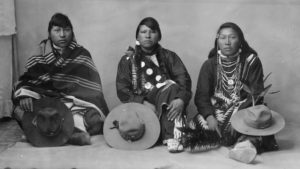
Tohono O’odham People https://historykeen.com/tohono-oodham-tribe/
Communities moved throughout the year between different ecological zones. During cooler months, they often lived near mountain foothills where hunting opportunities and plant resources were abundant. In warmer seasons, people moved closer to desert washes where farming could take advantage of flash floods produced by monsoon rains. This agricultural method, known as ak-chin farming, relied on capturing brief flows of rainwater in low fields where crops could grow quickly in the moist soil left behind.
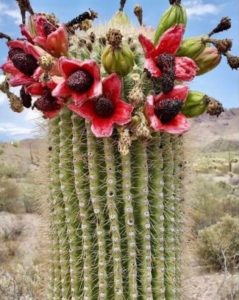
Saguaro Cactus with Fruit. Photo by Paul Canez, 2026
Alongside farming, desert foods played a central role in sustenance. Saguaro fruit, mesquite beans, cholla buds, agave, and many other plants were gathered and processed using techniques refined over generations. These foods were not simply survival resources but were deeply embedded in ceremony and seasonal traditions. The annual saguaro fruit harvest, for example, marks the beginning of the O’odham New Year and remains one of the most important cultural events in O’odham communities today.
Through these practices, the desert was not seen as an inhospitable place but as a landscape filled with opportunity for those who understood its rhythms.

San Xavier del Bac Mission
Spanish expeditions entered the Sonoran Desert during the late seventeenth century, bringing new political and religious pressures to Indigenous communities throughout the region. Jesuit missionary Father Eusebio Kino established missions among O’odham communities along the Santa Cruz River, including the well-known Mission San Xavier del Bac near present-day Tucson. While the Oro Valley area itself did not host a mission settlement, the influence of Spanish colonization spread across the region. Missions introduced livestock, wheat cultivation, and new forms of trade, while also attempting to “reshape” Indigenous religious life.
For the O’odham, these changes were complex. Some communities participated in mission economies or adopted new crops, while others maintained distance from colonial institutions. Despite missionary efforts, O’odham communities continued to practice ceremonies, maintain oral traditions, and follow seasonal subsistence patterns rooted in their relationship with the desert. The Himdag remained the guiding framework through which these changes were interpreted and negotiated.
During the eighteenth and nineteenth centuries, the Sonoran Desert became a contested frontier between competing colonial powers. Spanish rule eventually gave way to Mexican governance following Mexico’s Independence in 1821. For O’odham communities, these political transitions often had limited immediate impact on everyday life. Seasonal movement, farming, and trade continued largely according to long-established traditions. However, pressures increased as colonial settlements expanded across southern Arizona.
The most dramatic change came in 1854, when the Gadsden Purchase transferred much of southern Arizona, including the Tucson Basin, from Mexico to the United States. This new international border cut directly across O’odham homelands. Families who had once traveled freely between desert regions suddenly found themselves divided by national boundaries. American settlement soon followed. Mining operations, ranching enterprises, and growing towns began to reshape the landscape around Tucson and the surrounding valleys. These developments disrupted traditional travel routes and access to water sources that had long supported O’odham communities.
By the late nineteenth and early twentieth centuries, U.S. policies increasingly sought to confine Indigenous peoples to defined reservations. In 1917, the Tohono O’odham Nation was formally established through the consolidation of several smaller reservations across southern Arizona.
Although the reservation preserved portions of O’odham land, it represented only a fraction of the traditional territory that had once stretched across the Sonoran Desert and into northern Sonora, Mexico.
Many O’odham families remained connected to communities near Tucson and the surrounding valleys. Some worked in agriculture, ranching, or urban labor while continuing to maintain ties to traditional cultural practices. Even as settlement expanded across the Tucson Basin, O’odham knowledge of the land persisted through family traditions, stories, and seasonal gatherings.
Despite centuries of colonization and displacement, O’odham culture has never disappeared. Language, ceremonies, and environmental knowledge have continued to be passed down through generations. Desert foods such as tepary beans, cholla buds, and saguaro fruit remain important parts of cultural identity.
In recent decades, O’odham communities have led efforts to revitalize traditional practices and preserve cultural heritage. Language programs, educational initiatives, and cultural events help younger generations reconnect with the Himdag and the landscapes that sustain it. These efforts emphasize continuity rather than recovery. O’odham culture is not being rediscovered – it has been maintained all along.
Although Oro Valley is now a modern suburban community, the surrounding landscape remains part of the ancestral geography of the O’odham peoples. Washes, foothills, and desert plant communities that supported earlier generations still define the region. Archaeological sites, including nearby ancestral villages, remind us that Indigenous history in this area stretches back thousands of years.
For O’odham descendants, these places are not simply archaeological resources or historical landmarks – they are part of a living landscape connected to stories, ceremonies, and family histories. Recognizing this deeper history allows us to see Oro Valley not only as a modern town but also as a place shaped by generations of Indigenous knowledge and presence.

Brittnie Smith, OVHS Volunteer
Brittnie Smith is a stay-at-home mom and historian with a BA in Public and Oral History. She has worked in a variety of roles within the historical community, including editing for an award-winning history journal, volunteering as a museum docent, and tutoring both adult learners and high school students. Her interests focus on public history, community storytelling, and helping make history feel accessible and relevant. She is currently a volunteer researcher with the Oro Valley Historical Society, where she assists with research, documentation, and digitization related to local history.
Arizona State Museum. Tohono O’odham Foodways. University of Arizona. Accessed 2026.
James Ciment, with Ronald LaFrance. Scholastic Encyclopedia of the North American
Indian. New York: Scholastic Inc., 1996.
Suzanne K. Fish, Paul R. Fish, and John H. Madsen. The Marana Community in the
Hohokam World. University of Arizona Press. Accessed 2026.
National Park Service. Native Peoples of the Sonoran Desert: The O’odham. Accessed 2026.
Tohono O’odham Nation. “History & Culture.” Accessed 2026.
The Apache – Apache Relationships to the Land and Lifeways of What Is Now Oro Valley, AZ., by Brittnie Smith, March 2026
The Hohokam and Huhugam, An Enduring Presence in Oro Valley and the Greater Tucson Basin, by Brittnie Smith, January 2026
Honoring Heritage: The Story of the Burden Basket (Stories Woven in Fiber: Pima and Apache Burden Baskets)