
The Day a Tucson Freight Train Fought for Survival
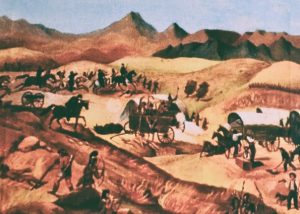
Tully and Ochoa Wagon Attack, May 1869
This is a reproduction of an oil painting by Edward Zinns, a Colorado miner and artist who was traveling with the wagon train for protection and witnessed the attack firsthand allowing for a rare, accurate depiction.
Tully & Ochoa was a Tucson-based freighting and mercantile company. On May 11, 1869, wagon master Santa Cruz Castaneda led 14 men, nine wagons, and 80 mules from Tucson to Camp Grant. Near Cañada del Oro (by today’s Biosphere 2), about eighty Apache warriors confronted the train. Despite a warning to abandon it, Castaneda refused and revealed a hidden “surprise” cannon (visible in the painting).
The battle lasted from morning until sundown. Three teamsters were killed and many wounded; Apache fighters also sustained injuries. Soldiers from Camp Grant joined the fight, but when ammunition ran out, Castaneda surrendered the wagons and escaped with military help. The Apache took the freight and mules and burned the wagons.

Attack on Tully and Ochoa May 1869 Smoke Signal Publication
The original painting, likely commissioned by Tully or Ochoa, passed through several prominent Tucson owners: Sam Katzenstein, owner of the Cosmopolitan Hotel, and then to Sam Hughes founding member of the Arizona Pioneers’ Historical Society. It is now part of the Arizona Historical Society’s collection.
as featured in OV Style Magazine, May 2026, Page 11
We’re going back to 1869. Here are the players – Wagon Master Santa Cruz Castanida and his teamsters, Sergeant Warren Allison and his soldiers, Chief Eskiminzin and War Leader Cisco, of the Aravaipa Apaches, and painter Edward Zinns.
Here’s the background – Pinckney Randolph Tully and Esteban Ochoa owned the Tully-Ochoa Freight Company in Tucson and regularly moved freight within Arizona and as far away as Kansas. In May 1869, supplies were being delivered under the leadership of Santa Cruz Castanida on what is now Oracle Road to troops at Camp Grant (located between Mammoth and Winkelman) which had actually been built in the center of a main Aravaipa Apache village. Since 1849 American settlers had been taking over Apache territory to develop their own mines, ranches and farms. This, of course, destroyed Apache homes, crops and other food sources including animals they hunted. Naturally, Native Americans had wanted to prevent outsiders from occupying their territory throughout the Southwest.
The Tully-Ochoa wagon train consisted of 9 wagons, about 80 mules, and 14 teamsters. They stopped for the night on May 10 about 27 miles north of Tucson. With only 25 miles to go to reach Camp Grant on May 11 about 8 a.m., they were attacked by Chief Eskiminzin and Cisco along with approximately 200 Arivaipa Apaches. Later in the day, members of the Pinal tribe joined the fight as well as seven cavalrymen under the leadership of Sergeant Warren Allison, who was simply bringing his troops back to Tucson. The fight lasted for 10 arduous hours. Finally on May 12, 18 surviving soldiers and teamsters headed back to Tucson, abandoning wagons and mules. The Native Americans had succeeded in securing food and supplies for their tribes. They hadn’t wanted the fight, but they needed the freight.
Oral histories confirm the details of the altercation, but the best interpretation of those 10 hours is a painting created by Edward Zinns, a young miner and talented artist from Colorado. He was traveling north that fateful day in May and thought he would be safe riding with men equipped with guns protecting valuable cargo, heading to a fort which would be shelter from marauding Native Americans. Think about this – a young man who is not a soldier is caught up in a battle between those transporting him and the very thing he wanted to avoid – and he has the courage (?) to paint what he is seeing? Instead of showing just one moment of the battle, Zinns depicted various stages of the battle on one 28” X 54” masterpiece, with so many details – bows, arrows, face and body paint, headbands, stripes and chevrons on sleeves of army personnel, the various types of guns used in the fight, the various types of saddles, spokes on wagon wheels, labels on cargo, the view and the skyline, the terrain and the plant life, oak trees, cactus, manzanita. It’s all there for anyone to see what the battlefield looked like and who was involved. Don’t you wonder why his hand wasn’t shaking the whole time? With the detail Zinns provides, today it would have meant using our camera phones for videos, not just pictures, and the outcome probably would have been blurry and batteries would have expired.
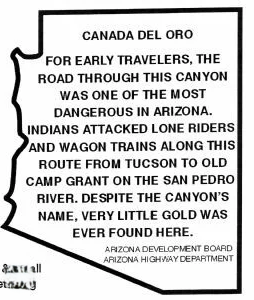
Cañada Del Oro Historical Highway Marker, Removed Around 2016
It is believed that the painting was commissioned by Tully or Ochoa themselves so that there would be a visual record of the bravery of the day and their lost cargo. The Cosmopolitan Hotel in Tucson (formerly at Main and Pennington) was its home until 1893. Currently the painting “When No One Had a Camera” is with the Arizona Historical Society and can be viewed upon request.
A sign like this was at one time on Oracle Road and removed about 2016.
The Apache Nation did not surrender for 17 more years. Tully & Ochoa’s business ended after the railroad arrived in Tucson, about 1880.