
An OVHS Historian’s Look at the Ranch’s Changing Hands and Changing Times
Jim—retired history teacher, author, and past OVHS president—has spent decades researching the people and stories that shaped Oro Valley.

You can purchase Jim’s book at the Pusch House Museum.
Jim Williams: [Inaudible] Steam Pump Ranch for about 10 years, and some of it was included in my first book. Since I finished that book, I had kind of said to myself I’m never going to write another book. But then COVID came along. I had an awful lot of free time, and you remember that period of about six months where you really couldn’t go anywhere or do anything. So, I kind of got back into the research again and decided to go further with Steam Pump Ranch and other things about Oro Valley.
Steam Pump Ranch is kind of unique to this area. I don’t know that there’s any other property in the Tucson area that quite qualifies like this, maybe one other, where you have two eras of ranching on the same property and buildings and artifacts and things from both eras: the Pusch era and the Procter-Leiber era. I’ve calculated that between the two families they occupied this property for 131 years, and only about five percent of the time since the first buildings were built were neither of those families here. So, they really have a long impact on the area.
One of the things that is wonderful about research now is that this is the first time I’ve ever had a research project where I could do about 75 percent of it at my own desk. There are so many sources now that make it easy. Newspapers.com over there on the right is a great resource. You type in a name, a thing you want, and bingo, all of the newspaper articles come up. Some of you may remember the old days of looking at microfiche and microfilm readers and how tedious that was. It’s much easier today.
I used Ancestry.com quite a bit because that leads you into all kinds of information about individuals and documents that appear there that are amazing, where they come from. Of course, the federal government has this one up here, the General Land Office online. It is part of the Bureau of Land Management, and you can research any property, the origins of who owned it, and some of the early information about it all from that source. So, there are many, many sources today, and I was able to find some information that wasn’t available approximately 15 to 20 years ago. It just would not have been available. You would have had to travel all over the United States.
People used to do genealogy by going from historical society to historical society literally all over the United States. That material now—in fact when I’ve used Ancestry.com recently, I used it about four years ago and came back, and now they have built artificial intelligence in there that sends you right to what you want and organizes all the information you want. It’s amazing.
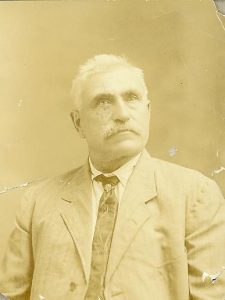
George Pusch
So, George Pusch—we know that he was born in 1847. He lived in a town Echzell in the principality of Hesse in Germany. Germany was not a country yet; it was a group of principalities, of which Prussia was the largest, but there were I think 40 or 50 different governments within Germany.
The records again from Ancestry.com, the New York passenger lists, you just quickly start looking and there’s George Pusch. We knew that he came here around 1865, and this identifies that he came here. I can’t determine what the date is because the writing is so poor, but it was in October of 1865. He came on the bark, Tireland, and sailed from Bremen, Germany, and he was already identified as a butcher. So, he was already operating. He was about 18 years old at that point. The principality of Hesse, where he lived, was about 30 miles north of Frankfurt, if you’ve ever been through the Frankfurt airport.
His later friend Johan Zellweger—John Zellweger—the ship records show that he came on a different ship, the Bellona. He sailed from London. He arrived about the same time, within a week or two of George Pusch, and he was a Swiss national. Some people have said that they knew each other before. I think that’s probably impossible. They came from entirely different countries and sailed from different places, but they both came to New York City and both became involved in butcher work. Then they traveled all over the United States—San Francisco and other states. Very common, by the way, in those days. A lot of people—you may have heard of the Sutherland Trail, William Sutherland. He was an early resident of this area. I think he lived in six different states before he finally settled down in Arizona. So that was fairly common in those days.
But we know they came here. They probably met each other in New York City, and then they traveled around the United States doing butcher work. Pat Spoerl found the census record that was taken here, so we know that Pusch was here. There’s his name. He was here in 1874, but he was probably in Prescott before that, Los Angeles, and other places.
When did they start their business here? The only reference that I can find—when you type in and look for Pusch and Zellweger and butcher and things like that—you find a series of ads towards the end of 1876. It’s the same ad printed over and over again and refers to the partnership. They have a meat market. They called it the Palace Butcher Shop. It was in the downtown area, which is kind of the area where a lot has been bulldozed and redeveloped in the 1960s. Of course, they then had a butcher shop pretty much from this time until 1917 in that area.
We know they had a successful butcher shop. These men are growing in wealth steadily. They may be considered among the solid ones that steadily—may say rapidly—prospered. They were selling horses by 1877 and doing other things by 1879. They had a butcher shop. They developed a slaughterhouse where Oracle Road meets Fort Lowell, and they got involved in cattle raising. Cattle raising in those days was the way to make a quick buck. You weren’t worried about the environment. You weren’t worried about what you’re going to do to the ground or the water supply or anything. The idea was to get your cattle out in the open area.
Almost everything—there are no fences yet in this area in the 1870s and 1880s. You brand your cattle with your own brand, and the brand is owned by the Historical Society today. You let your cattle loose between the Santa Catalina Mountains and the Tortolita Mountains, and this whole open area is filled with different head of cattle.
Nobody owns the ground. The federal government owns the ground, and this is great because you can use the resources of the federal government—the water, the grass, the land—and you can use it for free to make a fortune.
Of course, other people got involved in that quickly, and the cattle had the tendency to take the grass in the ground and pull up the roots. So next year there was no grass in that spot. They quickly dissipated the value of the land as far as that, but again their idea was to make money fast and maybe go live in some other place like San Francisco or someplace that may be more glamorous.
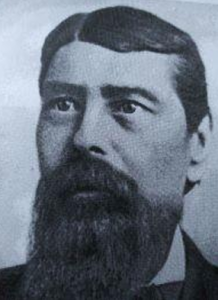
Francisco Romero

William Henry “Idaho Bill” Sutherland
We know there were other ranchers in the area. Francisco Romero had a ranch that operated—he and his son—over in Catalina State Park. William Sutherland would be in the northeast corner of Catalina State Park and from there north. There were many other people operating here. Everybody has built a little ranch. They have some corrals. They probably built some sort of a well, and they’ve let cattle loose.
We know there was an open range because there are notices in the newspaper periodically between 1885 and 1910. A notice like this is common in the local newspapers, and it is a notice of a rodeo. A rodeo is a roundup where the cowboys for these various people—Pusch, Samaniego, Romero, Charouleau, and other people—would get together and they would appoint a place and begin to round up the cattle. They would use all those skills that we think of related to the rodeo today. So we know that these things took place. We know there was a large area and that all cattle were branded. They would bring them all together and then take them to some place, either to a slaughterhouse or more commonly to a railroad depot where they would be shipped to another area.
They found out very quickly that the forage here was so minimal, the grass was so minimal, particularly after they had let these cattle loose for several years, that they could only raise the cattle here to about the second year. Then they would put them in a stock car and take them to California or some other place where there was more grass, and they would fatten them up there.
This map has been shown a number of times. It’s even in a book somewhere. If someone drew a line here to show the area owned by George Pusch, it goes all the way from Florence, you know where the prison is, all the way to the edge of Tucson down here. It’s inaccurate. The map means nothing because nobody owns any of this land in here at this point. Different people have established adobe houses, corrals, and ranches out here, but the federal government hasn’t surveyed it and they haven’t made it available for purchase. So it’s kind of, you know, anybody can do whatever they want in that area, and most of the people want to be somewhere near a stream.
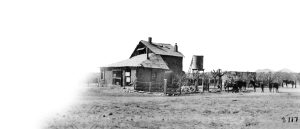
Pump House at Steam Pump Ranch
When did they establish the steam pump? I haven’t found anything definitive. We know that in 1883, when there was a sale of some property and some equipment, they mentioned a caloric pump. This article in 1879 mentions a large redwood tank on their ranch north of town. I don’t think you’d have a large redwood tank unless you had something that could bring a lot of water into it. So my guess is that somewhere in this period, maybe a year before this, they were able to bring a fairly large steam engine back from the east by rail, so far, and then probably by wagon part of the way because the railroad didn’t come to Tucson until 1881. So part of that way that heavy piece of equipment would have had to be brought, probably in pieces, to Tucson.
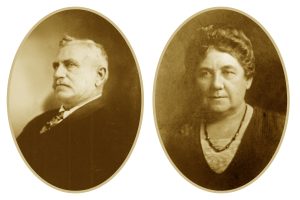
George and Mathilda Pusch, c.1912
We know that his wife Mathilda came here through Baltimore. She was aged 23 and lived in Prussia, which is the far eastern part of Germany. It’s now part of Poland and part of it is part of Russia. She departed from Bremen in Germany, arrived in Baltimore in June of 1880, and then did that long trip by rail all the way across the United States and then probably by stagecoach part of the way. [OVHS Note: further research indicates that she arrived in New York in 1876 at the age of 15.]
Family memory is that she came here to visit her sister, a Feldman. I largely doubt that a woman in those days made a trip all the way from eastern Europe to the coast of Europe, to Baltimore, and then all the way across the United States just to visit. My guess is that they had pretty much agreed on a marriage in advance, but that one I have no proof of. They married approximately a year later, and Pusch and Zellweger broke up their partnership.
There’s a bill of sale which is in the Oro Valley Historical Society records, it’s a legal sale of things. It talks about transferring land, but they’re transferring land that they don’t own. They have no title to it. They do have title, obviously, to the steam pump and to cattle, the slaughterhouse, a meat market, and livestock.
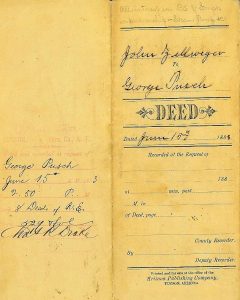
Zellweger Deed of Steam Pump Ranch to George Pusch June 15, 1883
So, there were two sales, in 1883 and in 1887, in which Pusch took over all of this, the transfer. They put on the deed, or the bill of sale, that they had transferred $32,000. We all know that sometimes what is written on legal documents as far as transfer is not always the exact amount of money that is really transferred, but this would be the equivalent of about $500,000 today. Even though Zellweger and Pusch broke up their partnership, they got back together on many other things later on. So, it’s not like they’re separate. They just separated on this one area here and things related to that area.
The federal government steps in. By the way, this map was created by the Town of Oro Valley’s mapmaker for me. I wouldn’t have the ability to create something like that. He shows that Oro Valley has a dividing line here and here. This is where First Avenue comes in, so the Lutheran Church would be right about here. The large Lutheran church. The town offices are over here. This line and this line are survey lines that were created to create one township, two townships, three townships, four townships. They are not townships like you would think back east. They were not created with the idea that that was necessarily going to be a government. A township is a way of dividing the land so it can be surveyed and sold.
Between 1900 and 1922, different people came out here on horseback and they put a chain in the ground, a long chain of about 100 yards, and they would mark these. By the way, these markers still exist. If you see them anywhere, you should make a note of it. The ones that would be in Tangerine Road have long since disappeared because they would probably be in the exact middle of Tangerine Road and they were taken out. Some of them were just a stone about this tall in which they would etch numbers. Later on they’re pipes that sit about this high off the ground and they have a cap on the top of them. The cap has the particulars telling where it is and what township. So you have this large area, and then this will be divided into forty-acre sections across here, all the way across, and those will be available starting in 1900.
This township here was the first one available for sale, and of course Steam Pump Ranch is right in here. There’s Oracle Road, First Avenue, Steam Pump Ranch right here. This is a relatively small township because a lot of the land over here is federal land that eventually became part of a forest preserve, which is now part of the whole huge area that the federal government owns involving the Santa Catalina Mountains. So this township is actually the smallest in terms of its development in Oro Valley. These of course are much larger in terms of area.
Once they were surveyed, you would also have people come. If you notice, by the way, these lines are very equidistant. If you ever get in your car and drive from here to here, you will find that’s almost exactly a mile. Just watch your odometer go and you’ll see they’re very, very close. I’ve heard some people say these streets were established within about a six-foot range of accuracy, so pretty close, done all by hand. The only major road here that is not part of this grid system is Oracle Road because it precedes all of this. Oracle Road is an old Native American path, probably that goes back who knows how long.
So it was surveyed in 1902. Now people can begin to actually claim land and legally own it. The fee overall, if you look at the beginning and end fee, there was an entrance fee and then a deed fee at the end, but you’re talking about $35 to buy this piece of land right here if you want it. It will be pretty big.
When you start looking at some of these maps in the 1890s and the 1920s, you start to see lines appearing because these are the survey lines. This would be the earliest map and all they have are the township lines and their Steam Pump Ranch over there. You’ll also notice on this map from 1922 there is a Steam Pump Ranch down here and another ranch that the Pusches had up in Honey Bee Canyon. I’ve been doing some research on that and found the ruins of that up there, but there’s not much here.
You have the Sutherland Ranch, you have the Steam Pump Ranch, the Pusch Ranch, the Locus Ranch, and a few others. But you can see they’ve been dividing these into smaller sections. So George Pusch put a claim in for forty acres in 1903, and that was the minimum he could claim. He could have claimed 640 acres. Exactly why he didn’t, I have no idea.
The General Land Office records are great because the map and the current streets are shown where these are. So there’s Oracle Road and there’s First Avenue, and this is the original forty acres that George Pusch had. So it’s not until 1903 that they own anything, but virtually nobody owned anything prior to that in this whole area. Lots of information is provided there. My own drawing looks like this, with a house being in this corner down here. Home Depot would be right over here just a little further down.
He had a business associate, Edward Perrin. Perrin never lived here. He had been a surgeon for the Confederate Army, and after the war he had to wait three years to get a pardon. He desperately wanted a pardon because you could not deal in federal land, buying and selling it, without that pardon. When he received his pardon, he began buying and selling land. If you type in his name in Arizona records, pages of information come up because he had land all over the place. He was a business associate obviously of George Pusch because he claimed this land. Pusch’s land is right here, and Perrin claims these three forty-acre sections over there.
If you look at the letters of documentation in the Historical Society, he actually transferred these over to George Pusch before he really owned them. So, there was some kind of a deal that went on there where he traded something for something. So, George Pusch has this, and these three sections added to it. That’s the ranch in 1904, about 120 acres.
Not adequate for a working ranch. By the way, as soon as people got these, the first thing they began to do is put up barbed wire because “it’s mine and I don’t want you letting your cattle onto my ground and ruining it or drinking all the water.” That little stream over here was a flowing stream, and this drainage ditch over here was a flowing stream probably until the 1930s. You don’t want people on there, so people are starting to put up barbed wire all over the place. That’s the end of the open-range ranching. The last reference I could find to open-range rodeos was 1910. Gradually people are claiming land and separating it and holding it for themselves.
This is a picture probably from the 1920s, and we know from family records and from other references that Pusch was using the steam pump to water his cattle, particularly the ones that were coming from his ranch on the San Pedro River north of here. It’s a much bigger river. It’s still the only flowing river in central Arizona, the only small river that flows all the time. It’s better to raise cattle there than here. The water supply is smaller, but you would bring them down Oracle Road and then they could be watered, and other people would pay to water their animals there.
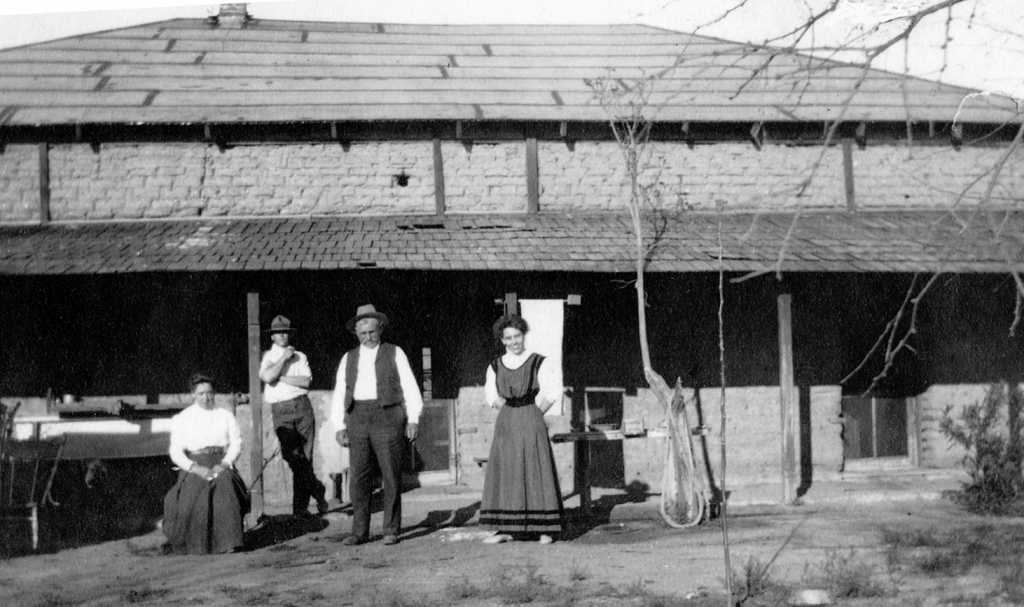
Some of the Pusch Family in Front Yard – Mathilda, George Jr, George Sr, and Gertrude c.1900-1905
Steam Pump Ranch was a visiting point. Several of the family members mentioned that they really used it as a stopover to get to the San Pedro Ranch. The San Pedro Ranch building is much bigger, the home. But they would come out here for entertainment. They have a lot of family pictures of them coming out here on an automobile or a wagon and picnicking out here and that kind of thing. In the sense of this being a big functioning ranch at that point, it really wasn’t.
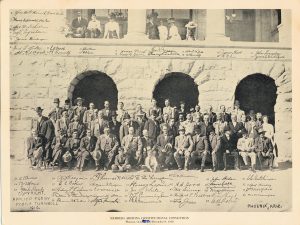
Arizona Constitutional Convention Signed by each person, December 10, 1910.
George Pusch in his later years had served on the constitutional convention that established the state in 1912, and that was about the end of his political career. He had been a town councilman and a state legislator and the family had him declared incompetent after medical issues around the beginning of the First World War. So, by 1917 he was still alive, but the family had taken over everything. We know that Pusch and Zellweger finally closed the butcher business in 1917. It mentions in the article that for 42 years they had been operating. Pusch was ill and Zellweger decided to retire.
They did have a business that continued along, but the other elements of their business they had separated. The family created a corporation, and this certificate is in the records of the Historical Society. This is a blank, but there are ones that are filled in.
George’s wife Mathilda received 99 percent control. She did not grant her children a big share. Her oldest son got one share, and her oldest daughter got one share. They were part of the corporation, but she controlled things. Also in the local records here are a series of letters that talk about buying more land. Nine hundred sixty acres were purchased adjacent to the ranch between 1916 and 1918. I can’t find an exact deed, but it was transferred. This letter is from 1918 saying that it’s done.
This is land that was taken from the Hopi tribe in northern Arizona. They fought and got the land back, so the railroad that got the land was given these 960 acres as compensation. You probably remember from your history classes that they gave land to railroads in a checkerboard pattern across wherever the railroad went, miles in each direction. The Hopi contested that and got a lot of the land back, so the federal government granted this land as compensation to the Santa Fe Railroad, which eventually became the Atchison, Topeka and Santa Fe.
So, by now the Steam Pump Ranch is a little over 1,100 acres. What we’re looking at is the house here, the original ranch here, and all of this here has been added. The Hilton would be down about here, where the entrance is to the Hilton El Conquistador. They had land in the back. A lot of this land is where La Reserve is today, very hilly. A lot of it was not good for pasture. The main pastureland was right along here, that relatively flat area where there are a lot of stores and businesses along there today. This is the biggest that the Pusches ever owned, but this is right before they lost everything.
They incurred a lot of debts in the 1920s. I don’t know what happened. Did they try to expand their business too quickly? Did the family need money for various reasons? But they began to take on mortgages. Different people in town would lend the money, but they also got something written in the deed that said you owe me this much money. The Steinfeld Company, which had a department store in town, loaned them money. Most importantly, a man by the name of Lee Orndorff lent them quite a bit of money. There is a whole series of letters that the Historical Society has that Barbara McIntyre donated just a year or so ago that outline what happened when he wanted his money back and what the family had to do.
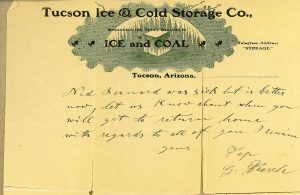
Postcard from George Pusch on Tucson Ice & Cold Storage card
They were forced to sell their ice and cold storage company. They were forced to sell their downtown properties. All of this occurred before the crash of 1929. It has nothing to do with the great crash in the stock market.
Orndorff was a young businessman from El Paso. His mother ran a hotel here in Tucson, the Orndorff Hotel, in the early twentieth century. He had a lot of interest in hotels and was one of the major people who loaned them money to keep going.
The Pusch family was forced to sell Steam Pump Ranch in 1925. Regardless of what people have said in the past, this is the deed. They sold it to Joseph Nickerson, the whole thing. They also sold him the San Pedro Ranch and some other things. Interestingly, the deed mentions that they’re still owing $10,000 to Lee Orndorff, so whoever accepts the property also accepts the debt as part of the arrangement.
Nickerson’s 1,120 acres were pretty much the same as the original ranch as it had been since 1917. Nickerson lived on the ranch they had on the San Pedro. He had a house servant. He formed an oil company and tried to explore for oil and gas around here. That was a failure. He was sued by a government finance corporation in Tucson for debts, and ultimately there was a legal notice that he wasn’t paying his taxes in 1932. He’s one of many people who were going to lose properties in the Great Depression. There were a lot of gamblers in those days. A lot of people would borrow money, buy things, build, build, build, and expect that they were going to make a fortune. Some of them did, but a lot of them lost everything. The Sutherlands lost everything, the Pusches lost everything, the Romeros lost everything. They all lost all the land that they had in this area.
The farm was for sale. We have information from the census. Nickerson’s brother was living there. They had an illegal still on the property, and federal revenue agents raided it and arrested somebody. A gentleman went to jail for making illegal alcohol in 1933. It should have happened a year later, because then it would have been legal. The Steam Pump Ranch was taken over by the bank, Pacific Coast Stock Land Bank in San Francisco, in 1931. They held it for a number of years afterwards.
So, the Pusch family is gone. They come out here to visit the area, they come out to picnic, but they don’t own any land in this immediate area. Lee Orndorff gradually purchased the Steam Pump Ranch and then gradually sold it to John Procter. We know that in 1937 he purchased part of the ranch. It’s very complicated. There are all kinds of deeds that go on and on through this period, but gradually between 1937 and the early 1940s he got control of all the property and then began to sell it to a gentleman by the name of John Procter, Jack Procter.
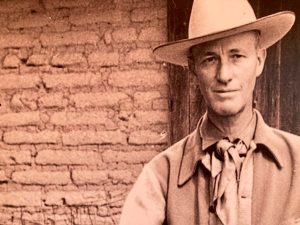
Jack Procter
Jack Procter bought this area right here. That was his first purchase. So, he purchases kind of a triangular shape, sort of like half of the forty-acre section like that. Of course, the house is right here. In 1937 it mentions in the deed that it includes the ranch buildings. He gained full ownership by 1943.
This is a very important article because it mentions that the old home had recently been remodeled, and it also mentions that Procter is living in another ranch house across the street. It doesn’t mention anything yet about the Procter-Leiber house, so I’m guessing, that it probably had not been built yet. The probable location of that—this is a later map—but you see Steam Pump Ranch and then a few hundred yards north there’s another house over here. This is on his property, this is on the ranch, so that’s probably where he was living in 1943.
Then in 1946 there was an article that said guests were at Jack Procter’s home on Steam Pump Ranch. Which house that is we’ve been trying to figure out for a long time. Procter made additions to it. These two little areas here and here were homestead lands that he bought. If you were willing to pay full cash, you could buy them right away. He paid maybe about $1,000 for each one of those. He also owned some additional land up here and some additional land over here, but it wasn’t attached to this ranch. So, we’re talking now about 1,250 acres. This is the largest the ranch probably ever was in contiguous lands.

Laurence Francis Rooney Sr.
This is the era of what I call the wealthy ranchers. Wealthy people from back east came out here, vacationed here, liked it, and they saw all this open land. Much of it was available from people who had homesteaded it who couldn’t afford it, couldn’t pay the taxes, and so you could buy up a lot of land. So, we have about a 5,000-acre ranch of Dos Cabezas, about a 5,000-acre ranch of Romero where Catalina State Park is, about a 1,200-acre ranch of Procter’s, and then the Rooney Ranch which is probably another 2,000 acres just south. The ranch house of the Rooney Ranch was just south of Steam Pump Ranch. These people bought up a lot of land. Perhaps they had a vision that this area would eventually become valuable. But if I was a homesteader and I paid $35 for a square mile and I could sell it to somebody for $1,000, I did very well.
Of course, some of those people held on to those and some of them ended up selling those square miles for $600,000 or $700,000 in the 1960s if you could hold on and pay the taxes. By the way, the real estate taxes on 640 acres would have been about $12 a year because it’s vacant land, and this is about 1950. A lot of people didn’t have the $12, so they sold to these people, and they consolidated a lot of the land.
Jack Procter was a businessman in town, manager of the major hotel in town. He was on the state Turnpike Commission or the state highway commission for a period of years. He used the ranch as a getaway. He brought friends out here. He raised horses and cattle.
Pioneer Hotel Postcard Stationary
You know over there is that dilapidated front porch, that large front porch that looks at the mountains. This was a beautiful sitting area. It’s the center of the house. Power lines came in in 1940 and 1941, so you could have electricity, lighting, and things of that sort. He was a friend of the governor. He managed the Pioneer Hotel, president of the Chamber of Commerce, and so on.
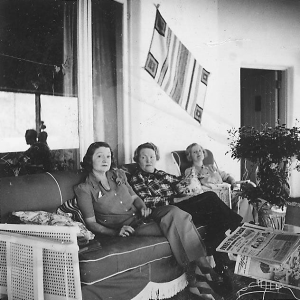
Three Women in Procter-Leiber Sun Porch
At some point he built that house. It was a small ranch. It took approximately thirty acres to support one head of cattle here. In Iowa it takes one acre because there’s a lot of grass, but here there’s not much grass. Thirty acres means if you have a 1,200-acre ranch you really can’t support all that many cattle. So these are small kind of gentleman farms. You have ranch hands and a foreman that take care of it, and you periodically come out and see what’s going on and check on things, but it’s not really a big money-making ranch like in Texas or some other states. People think of this as a cattle state. It really was never a big cattle state. It’s too dry here for large amounts of cattle.
Procter sold most of the ranch to the Rooney family, all of the land on the other side of Oracle Road, in the early 1970s just before he died. So what’s left is this area over here. Then Oro Valley annexed the ranch and zoned it for a planned residential development in 1988. What is left here is about 56 acres on the west side of Oracle Road, which is where we are today.
Different groups tried to develop the ranch. One group attempted a Notre Dame development. They went bankrupt in 1993 and were not able to complete the project. You have so many years to make a planned residential development happen or it lapses. Then Diamond Ventures and Harkins Theaters had a plan for Steam Pump Village in 2000.
Of course, in the early 2000s people began to be concerned about saving this property, particularly the little bit of acreage on one end where all the historic buildings were. The original documents back in this period had really said nothing about the historic significance of the property. It was just kind of left as an open issue what was going to happen to it. So, the town committed around January of 2003 that they wanted to save this as a historic site. The county came along with a bond issue at the end of that year.
It hasn’t happened as much recently, but for many years about every five years the county would issue a bond and call for a bond issue. They would develop all sorts of projects, maybe $100 million or $200 million, and they would try to get the public to vote and adopt that. In this case the public did vote to adopt it and included was money for Steam Pump Ranch.
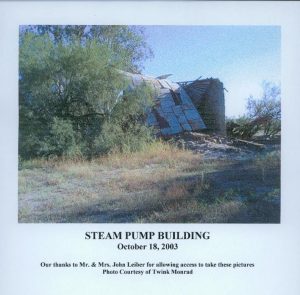
Pump House Building at Steam Pump Ranch October 18,2003
The town negotiated and bought the property between 2005 and 2008. Then a task force—there are several people here who were involved in that—looked at what to do with it, looked at what these buildings looked like.
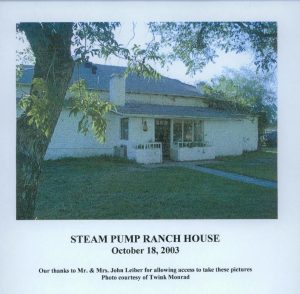
Pusch House with Leiber Additions October 18, 2003
This is the steam pump building. The Leiber family had very much modified the original Pusch ranch house to the point where it really didn’t look like a historic building. So, the town made a commitment to take it back to its original look in the nineteenth century. Then we have these houses added during that period.
Any questions?
Local Author Jim Williams Wins 2025 AASLH Award of Excellence!