
OVHS Video Series Featuring Barbara McIntyre, Great-granddaughter of George Pusch
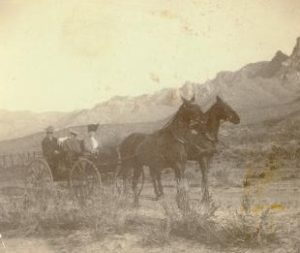
Pusch Family in Horse and Carriage
In this engaging series of presentations and interviews, the great‑granddaughter of George and Mathilda Pusch shares family history, personal memories, and stories in conversation with Barbara McIntyre.
Scroll down for rough transcripts and photos for each of these videos
Check out our entire OVHS Video Series collection or subscribe to the OVHS YouTube channel.
One of the stories Henry mentioned earlier is that George was in the corral one day when a steer charged him. He ran for the fence, but his belt came loose, his pants fell down, and he tripped. One of the cowboys shot the steer. When George got up, he used one of his favorite sayings, which is “Py Gott, that was a close one!”. [Gestures to sign, written “Bie Gott”]. This is the pronunciation of it, that’s the true [spelling] which means “By God.” So that was one of his favorite sayings and even when I was growing up, I heard different family members would say that from time to time.
George was also a businessman. He started the Steam Pump, had the cattle and had everybody come here. He quickly learned he could make more money selling beef than selling cattle, so he opened the first butcher shop in Tucson with John [Zellweger]. They also had a slaughterhouse. And they also opened around 1903; they opened Tucson Ice and Storage.
When I was growing up, we had an ice pick – with the tip on it for safety. I always thought it came from his icehouse. Later, I learned it was from Arizona Fuel and Supply. I’m in the process of doing research to actually find out who owned it. On two sides it says, “Arizona Fuel and Supply,” another side says, “Ice and Coal,” and on the third side it says, “Phone Number 34.”
The first commercial telephone in Tucson was installed in 1881 at the Tucson Daily Star editorial office and Western Union. It was a party line. When we moved to Broadway and Swan when I was one year old, we also had a party line. My twin sister [Nancy]– who couldn’t make it today – worked for the phone company for 30–35 years, and even in the 1970s they still had party lines. Now, of course, we have cell phones, and we don’t need party lines. [Gestures to painting]
Picture of Steam Pump Ranch in the branding time. There are people who look like a group of cowboys, maybe at round-up time. But the people on the fence – this man has a bowtie, and they may have been looking at branding and breaking horses.

Arizona Constitutional Convention Signed, December 10, 1910
Besides being a cattleman and businessman, George was a politician. In 1891 and 1899, George served in the legislature. The Arizona legislature territory drew up laws between 1864 and 1912, when Arizona became a state. George was a member of the Constitutional Convention held October 9–10, 1910, where the Arizona Constitution was drafted. Arizona became a state in 1912. [Gestures to picture]. In this picture on the bottom, there are names listed of all the delegates. Up here in the top, right in the middle, is George Pusch, number 12. On all the pictures there are numbers, and George Pusch is right here at the bottom. There are women pictured in the top, but there were no female delegates at the convention.
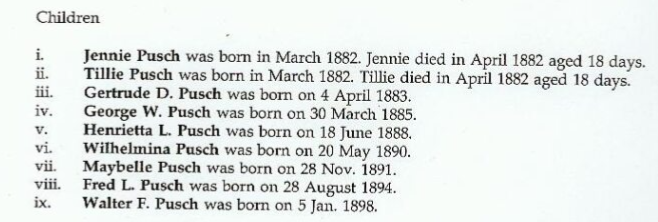
George had nine children: seven survived. The first two were twin girls born in 1882. One lived 18 days, the other 19. They were named Jinnie and Tillie. At Evergreen Cemetery, their graves are marked Jinnie and Tillie. Looking at Oliver’s family tree, it says Jenny and Mathilda, so I think Tillie may have been short for Mathilda. [Gestures to picture]
This photo shows six of the seven children. Fred, Henrietta (my grandmother, known as Eda), Mabel (Aunt Mabel), Frank, Willamina (Aunt Mimi) and her husband Gus, and Gertrude (Aunt Tutsie), the oldest daughter. George Jr., the oldest son, is also shown with his wife.
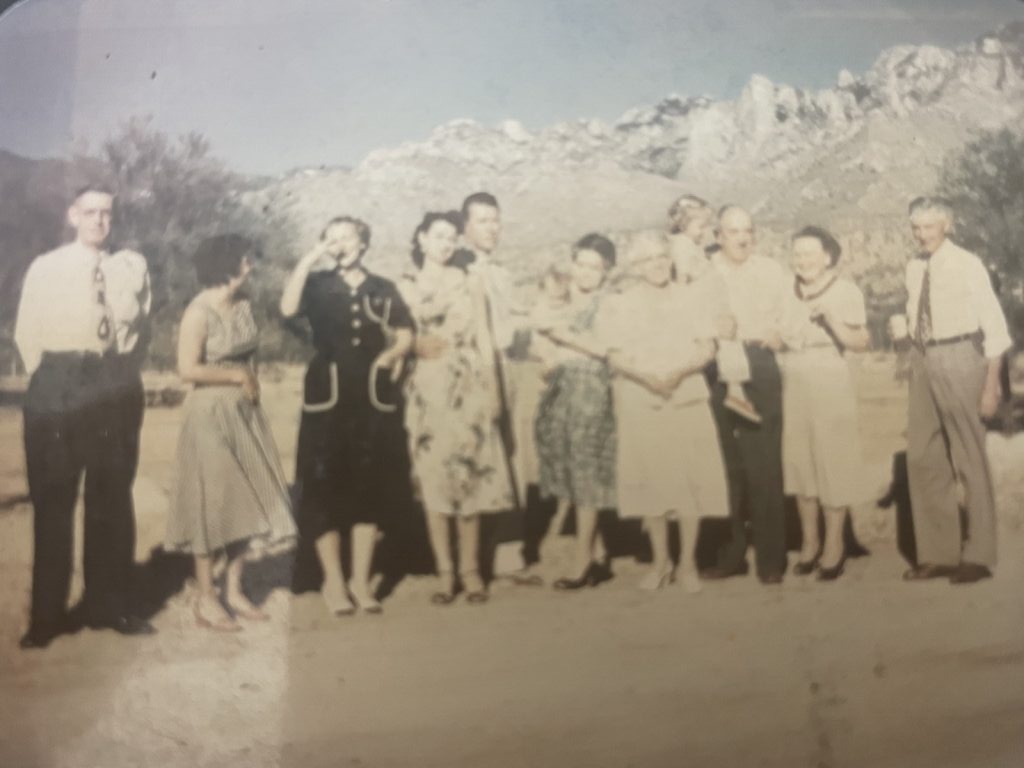
Large Pusch Family Gathering (May be Canada del Oro Ranch or Steam Pump Ranch)
Gertrude was one of the first students at the University of Arizona. In my earlier research, I found a note stating she was editor of “The Review,” possibly a university paper. She married Henry Zipf and had three children. Aunt Tutsie loved the ranch. She would go hiking and once encountered Apache people camping nearby. She simply sat down and talked with them. Her husband Henry was a state parks commissioner, involved with politics, and served as postmaster for about four and a half years. During that time, Gertrude worked as an assistant at the post office; there is a signed oath of office in the historical records. Several of the women in our family worked—we have a long history of working women. [Gestures to picture]
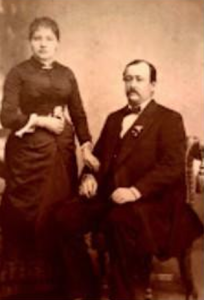
Sophie and Johann Zellweger
In this picture, Gertrude is right here. This is George Sr., Mathilda, and George Jr. This is my grandmother, and there’s a woman next to her. After she arrived in Tucson, her good friend Sophie came, who eventually married John Zellweger. This tall gentleman right here in the dark shirt is my grandfather Hugh Ballinger.
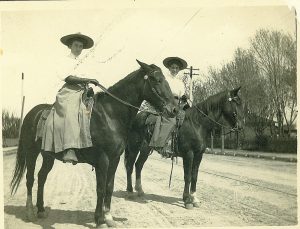
Gertrude “Tutsie” Pusch (on right) with Woman in Skirts and Long Gloves on Horses on Dirt Road
Gertrude was known for riding a black stallion*. People often joked that the horse might be the death of her, but she lived to be 91 and passed away peacefully at her dining room table. <*Note: purchased by her son, Henry “Hank” G. Zipf.>
George Jr. managed the Cañada del Oro Ranch. The Cañada del Oro Ranch, where we grew up visiting, was located just south of the Steam Pump Ranch near what is now Home Depot. By the time I was here, the Steam Pump Ranch had been sold to the Procter’s. Oracle Road at that time was a small two-lane road.
My favorite memories of the ranch are at Christmastime. Every Christmas Eve, our family gathered at the Armstrong house for tamales. My husband and I have continued that tradition for 40 years. On Christmas Day, we went out to the ranch. We rode horses, ran around, and played. When we couldn’t ride horses, we climbed onto a large propane tank and pretended it was a bareback horse. Frank, also known as Poncho, managed the cattle. We played in the hay barn, climbing bales and jumping off them. [Gestures to picture]
To give you perspective, a recent photo taken from the [Mattress Firm] doorway shows the modern stoplight at Oracle Road near Home Depot. The skyline of Pusch Ridge looks exactly the same as it did in the early ranch photos.
Henrietta, my grandmother, attended the University of Arizona and was in a sorority. She married Hugh Ballinger, a World War I veteran who started Ballinger Fuel and Supply in 1920. He later worked for the Internal Revenue Service five years prior to his death. They had one daughter, Louise—my mother. [Gestures to picture]
What I found interesting while going through these photos was the way people dressed at the ranch. The men often wore suits and bow ties, along with hats, even outdoors.
The first rider in this photo is my grandfather. It may have been taken the same day as the other picture where the group was standing together—he was on the far end in that one. He’s wearing what looks like the same dark shirt and hat, so either it was the same day or that was simply his preferred outfit.
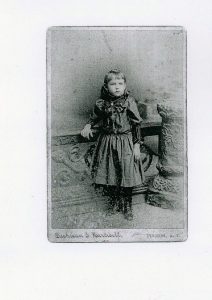
Louise Pusch
My mother, Louise, was born in 1913. One of my favorite stories she told was about the time when the Apache were still coming to the ranch to trade for flour and sugar. When they arrived, she would hide behind my grandmother’s skirt. Whenever I look at this picture, I imagine her doing exactly that.
Until I began preparing the posters for this presentation, another photo was my favorite—one of her sitting in a studio with a large white bow in her hair. But now my favorite is this one of her sitting in a basket out at the ranch. The baskets were probably used by George and the family for various purposes, but I didn’t realize they also held children. It was essentially the precursor to a playpen—a basket.
There were three of us children. This photo shows my mother with Janet and my father holding Janet as a baby. The other two are Nancy and me. Janet was about five years old when Nancy and I were born. We had a neighbor who owned a company that made dresses called “squaw dresses,” and my mother had us wear them. I found another photo of her in a white dress trimmed with red rickrack. That’s another one of my favorites. I’m the little one in this picture.
We moved to Broadway and Swan when I was one year old. At the time, my grandmother thought it was far out of town; today it’s midtown. We drove to the ranch via River Road, which felt like a country lane.
Henrietta later served four years as superintendent of the Arizona Children’s Home and accepted donations from the Rodeo Vigilantes.
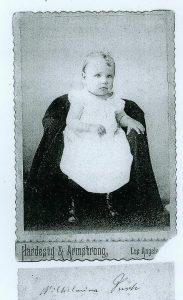
Wilhelmina Pusch
Willamina married Gus Cannaby, who joined the military in 1909. They married in 1917. He served in the Mexican Border Campaign, World War I, and World War II, eventually retiring as a colonel and serving as command quartermaster of the Fifth Air Force in the Pacific. Between WW1 and WW2, he managed the Knox Lumber Company. They lived on 1947 Hawthorne Street near the University of Arizona while he was in service, with Willamina caring for the son-in-law while Gus was away.
Aunt Mabel (“May-Bell”) also attended the University of Arizona. At the time, the entire student body fit into one picture. There is an old picture of some students playing football in front of Old Main, which was the only university building at the time. Aunt Mabel married James Henkins, from Uniontown, Pennsylvania. He came to Arizona in 1912. He worked at Maxwell in automobile sales. There’s a newspaper article from 1915 which says he sold “four cars in four days.” He later came to own his own dealership called “Hup-mobiles.” [Gestures to picture]. Here’s a picture of Aunt Mabel sitting in the passenger seat in one of the Hup-mobiles. Uncle Jim most likely took this picture. The Hup-mobiles were made between 1909 and 1940. Newspaper accounts described him as an “enterprising young businessman” and Mabel as a well-known member of Tucson’s social set, stating, “she has endeared herself to all who know her.” [Gestures to picture]
In the pictures I’ve gathered of them having picnics at the ranch, the men dressed in suits and ties, the women in fancy dresses and long skirts. What I found interesting is this glassware and china. They had to – they didn’t have plasticware like we have now. They’re sitting on Indian rugs instead of blankets. [Gestures to rug]. This rug has been passed down in the family. My twin, Nancy had it and used it, and it was used before she got it. This one probably doesn’t have as much wear as the one in the picture.
Later they moved back to Uniontown, Pennsylvania, where Jim became a well-known lumberman. After Mabel’s death, I discovered letters addressed to the couple from the FBI praising his support of law enforcement. When Uncle Jim and Aunt Mabel would come out here, Jim would bring his camera. At that time, in the 50s, cameras were about 4 inches long. They would come out here every year for about 4 months. They were probably some of the first “snowbirds.” Aunt Mabel’s birthday was the 24th of November, my mother’s the 18th of December. They would have a luncheon for all the aunts, and we were not allowed to come in the front door after school, we had to come through the back – the front door led right to the kitchen. But if there was any dessert left on the counter, we could have it. They stayed from just before Thanksgiving through rodeo and then go back. They came on the train. The train station downtown – it was always a big deal for us to go down there and meet the train.
The next [person] I’d like to talk about is Fred. Fred attended Tucson High and played football under Coach “Pop” McKale. The same coach at the UofA – the one the stadium is named after. He also served in World War I. I have a letter stating he was one of the first young men to enlist. When he got back, he worked as a civil engineer, deputy sheriff of Pima County, bailiff for the Superior Court, and county assessor. He had a short marriage to Elsie. He lived at 1600 E Spring St., just a block north of Grant Rd.
The last son to talk about is Walter. Walter graduated from the University of Arizona – the only son who I have proof of graduation. He managed the Steam Pump Ranch until 1925. He later moved to California with his wife Katherine, and his son Walter III still lives in California, as does his other granddaughter. In California, Walter worked as the petroleum equipment association executive and was very prominent in that business. A lot of the articles that my aunt Katherine has talked about him and his great work in the petroleum industry.
The last stories that I’d like to share involve horses. February to me is always “rodeo month,” the children still get two days off for rodeo like we always did. In high school, my sister Nancy and I rode horses at a stable near 22nd Street and Harrison. There was a man named John [inaudible] who had a stable there. He would ride his station wagon around town and pick up kids and take them out to his stable to ride horses on Saturdays. We always went out in a group, never by ourselves – he didn’t allow his horses to go out by themselves. One year we thought we ought to ride in the rodeo parade. But there was the problem of getting the horses down from 22nd Street and Harrison to downtown. So, Nancy and I and a few others drove from Harrison and 22nd to a set of corrals near the freeway. We ended up stopping traffic ourselves at intersections to get the horses through – like police do at funeral processions. I was maybe 15, 20 years old. One of the other riders dropped something, and Nancy got down to pick it up. When she went to get back on her horse, the other rider took off, and Nancy’s horse tried to take off too. Eventually she got on and caught up with the rest.
In about 1954, there was a man who would come around the neighborhood with a pony and offer to take our picture for a fee. He had a cowboy hat and scarf as props. We each got our pictures taken individually – Nancy was really upset that I got to go first. [Scroll down the page to Barbara’s interview to see a picture of the girls on the pony.] While researching, I found an old historical photo of a similar pony with who I think is Walter’s father and wondered if it might have been related to the same family business.
For a man who left Germany at 18 and came to a country he didn’t know, I believe George Pusch made a significant impact not only in Tucson, but in Oro Valley and Arizona. More importantly, he made and left a wonderful family legacy. Thank you.
Thank you for having me. For those of you — probably most of you know but don’t know — I’m George Pusch’s great granddaughter. On the family tree here, if you follow the blue line, Henrietta was my grandmother, Louise was my mother, Henrietta’s only child, and there were three of us. Janet’s my older sister, and Nancy and I are twins. So that’s where I am on the family tree.
I want to start talking today just a little bit about George Pusch, and it all started with a pair of red top cowboy boots. George came to the United States and worked as a butcher in New York and saved his money. He was paid $7.50 a month as a butcher, and he bought a pair of red top cowboy boots. I imagine they might have looked like this for $7.50. He wanted to come West and be a cattleman. He didn’t want to be a cowboy — he wanted to be a cattleman.
He arrived in Tucson in 1874 and with John Zellweger started the steam pump branch, the PZ brand, and what later became the Pusch Land and Cattle Company. He had a lot of not only cattle here on the Feldman Ranch up on the San Pedro, but he also grazed cattle on different government lands. In 1880 he married Mathilda Pusch, my great grandmother. These two pictures are when they’re younger, obviously, and older. Mathilda loved to garden and be in the garden. My older sister Janet follows her. She has acres, always has a garden every year, has cattle, and she has Mathilda’s narcissus and amaryllis flowers that were Mathilda’s that she still grows today.
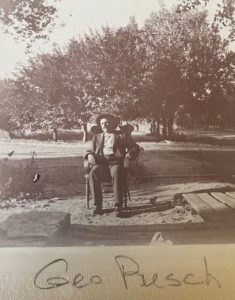
George Pusch
George loved to be out on the ranch. This is a picture when he is much older, maybe even after he was ill later in life, but he liked to be on the ranch in the corrals with the cattle. In this poster you’ll see pictures of the corral.
One of the stories always heard about George was one of his favorite expressions was “Py Gott.” When he was in the corral one time, one of the steers started to charge him and he ran for the fence — you can see several of these pictures, see fences — his belt came loose, his pants came down, he tripped. One of the cowboys ended up shooting the cow, and when he got up he said, “Py Gott, that was a close one.”
On the table here, George, when he would travel from town to the steam pump ranch or to the Feldman Ranch or up to Florence, he would trade. He always carried flour and sugar in his wagon, and he would trade with the Native Americans. They never bothered him. I always heard stories of wagons they had seen that had been attacked, but he never was, and he never carried a gun. He carried flour and sugar. Also here at the ranch, when they would come to the door and ask for food, Mathilda always told the cook to give them food, not to argue with them at all.
Some of the items up here on the table are things that have been passed down through generations. This rug is a Ganado red rug, a Navajo rug. Ganado is up on the reservation by the Hubbell Trading Post. The baskets — these three baskets — are Western Apache baskets. The smaller one and this large one are Tohono O’odham as we know them today, and there were probably some of the items that were traded for flour and sugar.
George was also a businessman, very well known, big — a lot of business. He had a butcher shop. He learned that it was more profitable to sell his cattle in a butcher shop — the meat in the butcher shop — than sell the cattle. He also had a slaughterhouse. He had Tucson Ice and Coal Storage, which sold ice and coal. [Gestures to paper]
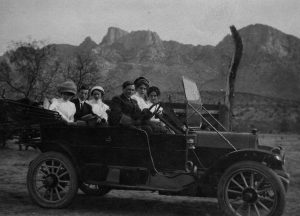
Pusch Family in Ford Model T or a similar car from 1910s or 1920s
This is on the historical society’s website. It’s just a note paper. He’s writing a note to one of his children and he says, “Regards with all your [unclear audio].” I can’t read it anyway. It’s “Dear Papa George Pusch.”
With the ice and coal, growing up we always had this ice pick in the family, and I thought it was going back to George. There’s a phone number on it of 34 in Tucson. The first commercial phone was put into existence in 1881. Here it has on four sides — two of the sides say Arizona Fuel and Supply, another side says Ice and Coal, and the third side says Phone Number 34. I have to do more research to see if there’s some connection to George, but that was always handed down.
Now I want to talk about George’s children. [Gestures to picture]
This picture is probably the most complete one I have of all the children. The only one missing is George’s youngest son Walter here in yellow. This is Fred. I added Henrietta, my grandmother, and Mabel. This is Frank. This is Gertrude, George’s oldest daughter’s son, and Willamina — we called her Aunt Mimi. One of the aunts that I knew the best is Gertrude, the oldest daughter — we called her Aunt Tutsie — and George Jr., his wife Roberta, and Uncle Gus, or Gus Cannaby. He was Aunt Mimi’s husband.
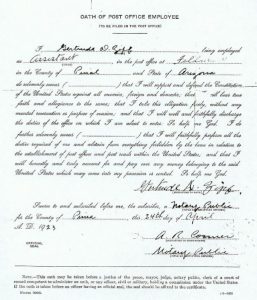
Oath of Post Office Employee Gertrude Pusch-Zipf April 24, 1923
The first daughter I’m going to talk about is Aunt Tutsie – Gertrude, and she was one of the first students at the University of Arizona. She married Henry Zipf. He was a postmaster for four and a half years. She also worked as an assistant. There’s a document in the historical society’s papers that shows her signing where she worked for the post office. [Gestures to picture]
The way I remember Aunt Gertrude is probably this picture. This is Aunt Mabel and Aunt Tutsie. And this picture was taken at my wedding in 1972. On her lap is my oldest sister’s son James, Jimmy, and he’s down in the blue. He’s the fourth generation. He has four children who are now the fifth generation, and they live in Tucson.
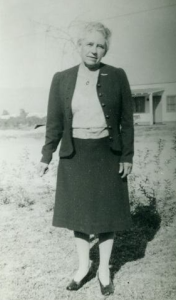
Gertrude Pusch-Zipf in Skirt and Sweater in Front of a House
Aunt Tutsie loved to be out on the ranch. She loved to go hiking. She’d go up in the Pusch Ridge area. One of the stories Henry tells is her going up hiking and running across some Apaches that were camped there, and she just sat down and started talking to them. The other story was of her riding a black stallion which was very frisky, and the story was that they thought she was going to end up dying on that horse. In truth, she lived to be 92. She died at her dining room table having dinner with her son Henry and I think one or more of her grandchildren. She just slumped down in her chair and passed away.
George Jr., the second child — let me back up a second. I missed two of the children. George Sr. had two children that did not live very long — Tillie and Jinnie. One lived 18 days; one lived 19 days. I learned that Tillie is short for Mathilda when I’ve been doing some research. One of the relatives back in Germany has done a very extensive family tree, and on it he has Jinnie and Mathilda.
George Jr. was married to Roberta but had no children. He managed the Cañada del Oro Ranch, which was just south of here. The fence out here to the south was the border of that ranch and this ranch. That’s the ranch that I remember. That’s the ranch I grew up knowing that we would go to. We were always told and knew about the Steam Pump Ranch and would go to the fence and look over and see the steam pump and things like that, but we always were told about the history of this ranch.
In this picture there are — I call it the Four Sisters picture. Down here are Henrietta (my grandmother), Mabel, Gertrude, and Willamina. The sign was on Oracle Road, and the 4H member was Frank the foreman’s son.
In this next picture about the Cañada del Oro Ranch — the picture in the corner up here is Frank’s house, the foreman’s house. In the background you also see a hay barn. We would go up there and climb the hay bales, jump down. We’d also ride horses. It’s where I learned to ride. We’d ride the other side of Oracle, but mostly we would ride to the west out here to the river and around. There wasn’t anything here. There were just cattle.
The other thing we would do — it’s better in this picture — when we weren’t riding horses, where they’re standing is where the house is, right back here. Right behind this large tree is where the house was. On the north side of the house was a propane tank. When we couldn’t ride horses, we rode the propane tank. We’d take a running start and jump up on the propane tank like it was a bareback horse. To give you a perspective of where that ranch was, where the ranch house was — this is the Four Sisters picture, and it’s a present-day picture. I took this picture back in January. Oracle Road at the time was just a two-lane road. If you look at the mountain range, they’re the same in both pictures. This is the light just north of the steam pump. It goes into Home Depot. When I took this picture, I was standing in front of Bedmart (Mattress Firm?) in the doorway, and over here is Big O Tires. So that gives you a perspective of where the ranch was.
The next daughter, the second daughter, was Henrietta, my grandmother. She was known as Eda, and she attended the university also. I have several references of her being in a sorority. One of my goals is to get down and do some more research and find out exactly — the only one I have a reference on is the youngest son as far as graduating, so I want to find out more.
She married Hugh Ballinger, who was in World War II. He also worked with George at the Steam Pump Ranch. He did the books for the Steam Pump Ranch. The five years prior to his death he worked for the Internal Revenue Service. I didn’t know Eda or my grandfather. Eda died in ’51 when I was two, so I only have the stories of her. One of the stories I have — and we have a discrepancy in my family with my two sisters — one of us thinks it’s my mother’s story and one thinks it was my grandmother’s — the story of when they were out at the ranch and the Native Americans would come and ask for food. She would hide behind [inaudible] skirt. Eda, the last four years before she passed away, she worked for Arizona — she was superintendent at the Arizona Children’s Home. This, I don’t know for sure, but I believe may be a publicity picture of her greeting the children at the Arizona Children’s Home. I like to think that my love for children came from her.
My mother, Louise Marie Ballinger, lived here at the Steam Pump Ranch until she was school age. I think that’s partly because my grandfather did the books and things for the ranch, but they lived here. Once she became school age and needed to go to school, they moved into town.
I read an article about her after she got married — an announcement in the paper about her marriage — and it said she got married at the historic Steam Pump Ranch run by her uncle George Jr. and Roberta. I really think they were talking about the Cañada del Oro Ranch because I don’t think George managed [inaudible] ranch.
When I was doing research on these pictures, this was my favorite picture of her with the big white bow in her hair. I have one taken in a studio, so this was probably either taken before or after she went to the studio. Since I’ve done this research and found a whole lot more pictures of her, this picture of her sitting in a Native American basket — I knew they held food, but I didn’t know they were used for playpens for children.
When we were born — when I was born back in 1950 — we moved to Broadway and Swan to East Cooper Street. My grandparents were very worried because that was so far out of town.
One of the other stories that I’ve learned very recently was that this is Janet with my father. Aunt Mabel’s birthday is November 28th, and my mother was pregnant and due very soon around that date. I don’t know whether they didn’t want her to have it on the same day or not, but they had her go quail hunting and walk all over so she’d go into labor. She had Janet on November the 26th. [Gestures to picture]
When we were growing up, my mother wore these types of dresses very often. Back then they were called squaw dresses. This is one of my favorite pictures of all of us — that’s myself.
Willamina, or Aunt Mimi as we knew her, was born on West Jackson Street, and West Jackson Street is about where the convention center is now. If you are on Stone and right past Broadway, the first street is Jackson Street. So, I have an email out to get more pictures of Aunt Mimi. [Gestures to picture]. This is Uncle Gus and Aunt Mimi’s house. They lived at 1924 East Hawthorne. If you’re standing on Campbell at the university mall, the street right across the street is Hawthorne. Uncle Gus was in the military. He was in the Mexican campaign, he was in World War I, he was in World War II, ended up as a colonel. The memories I have of both of them are just very calm, very relaxed. When I think of Uncle Gus, I don’t know where he was from, but I have an impression of him as being a southern gentleman. I didn’t know Aunt Mimi that long. She died in ’58. I was nine. She died of breast cancer.
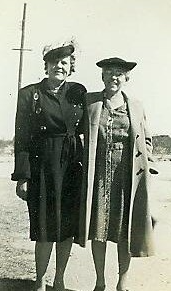
Mabel Pusch-Hankins and Gertrude Pusch-Zipf
We get to Aunt Mabel. Aunt Tutsie and Aunt Mabel were probably the two aunts that I knew the best, and they lived the longest. Aunt Mabel lived 93 years. Aunt Mabel attended the University of Arizona, and she met Jim Henkins. Jim was a very enterprising young man. He worked for Maxwell Car Sales. He sold four cars in four days in 1915, and then he later had a Hup-mobile dealership. [Gestures to picture]
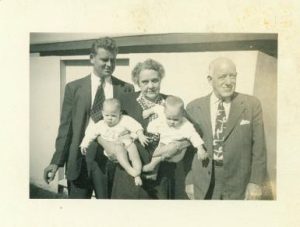
Henry G “Hank” Zipf, Mabel Pusch-Hankins, Jim Hankins with Nancy and Barbara Armstrong twins
The picture of Aunt Mabel here, I believe this is a Hup-mobile, and she’s standing beside one here in this picture. That’s Nancy and I. This is Jim Henkins, her husband, Aunt Mabel, and Hank, Henry and Gertrude’s son.
They lived in Tucson and then later moved to Uniontown, Pennsylvania, where Jim was from, and he became a lumberman. They came back to Tucson every year. They arrived here before Thanksgiving, and all the women would have a party at our house — my mother’s house — with a birthday party because my mother’s birthday was December the 18th. So, they would have a party for Aunt Mabel. We were always instructed that we couldn’t come in the front door, that we had to go around the back door and come in the back door. They would always leave us a dessert. They would take big chocolate cookies and put whipped cream in between them and stack them up, and there was always a dessert in the fridge for us as a reward for coming in the back door.
When Aunt Mabel was married, the newspaper article mentions that she was married in the spacious drawing room of the South Fourth Avenue house. This is a picture of the house. This is George and Mathilda’s house in town. As you can see, it did snow back in Tucson back then. Three of the children are on the front steps here. We don’t know which ones they are, but this is the house that she got married in.

George Pusch House at 428 S. Fourth Avenue, Tucson, AZ
Other than the other picture I showed you with all the family members, I don’t have any other pictures of Fred. He was married for a short time. He was also in World War II. One of the newspaper articles states that he was one of the first young men to enlist in World War II. [Gestures to picture]
This is a picture of Fred standing in the doorway of the steam pump, and this is the side that faced Oracle Road. Oracle Road was first an Apache trail, then Camp Grant Road, and then it became Oracle Road.
In the wedding announcement, Uncle Jim was listed as an enterprising young businessman, and Aunt Mabel, one of the most well-known girls in the young social set, has endeared herself to all that know her. When I put these pictures together, I imagine Aunt Mabel and all the children and Aunt Tutsie — she’s in several of these — and my grandmother. My grandmother is right here in this picture. I imagine them coming out to the ranch and partying. What I found interesting is sitting out at the ranch in suits and ties and hats and all that stuff.
Yes, that is water. The Cañada del Oro River ran all the time back then. In the poster of my grandparents there’s a picture of my mother swimming with my grandfather in the river. [Gestures to picture]
Walter Sr. is the one that I have a record of that graduated from U of A. I have started to do a little bit of research. He was in the class of 1920. This is a list of the class. These are from the 1918 yearbook, and this is a picture of the class of 1920. I haven’t gotten to look at the rest of the yearbooks. I just started with the oldest one. When I put in a search for Pusch, it came up with 1918 as the first one. He was also in Sigma Nu fraternity. This picture of the fraternity, I have yet to pick him out. I’m going to work on that. What I thought very interesting, because he managed the Pusch Land and Cattle Company ranch until 1925 when he moved to California, he was in the Agricultural Club at the U of A. That’s a picture of the club. They probably still have the same Ag house on campus that they had then. Once he moved to California, he worked as a petroleum equipment executive, and his grandson, Walter Pusch III, still lives in Northern California.
The last picture is a picture back in December when Lois and Roxy were kind enough to give my family the tour of the ranch. This is third generation, my sisters and I. The fourth generation, my older sister’s children — neither Nancy nor I had any children. And this is the fifth generation, my older sister’s grandchildren.
I wanted to thank you for doing this, for keeping this going, for Oro Valley for buying the ranch. I’ve learned a lot in doing the research, and I’m going to learn a lot more and do more research. I just find it very fascinating.
When Aunt Mabel passed away, she was the last of George’s children to pass away. When she passed away, I did family photo albums. We received all her photos and things, and I just felt this need to do photo albums. Now I’m in the process of updating those with all the new information that I have.
George, as a young man of 18 coming to the United States and working hard, following his dreams, made a significant impact on Arizona, Oro Valley. I really believe he left a wonderful family legacy, and you, Oro Valley Historical Society, have helped continue that legacy, so thank you very much.
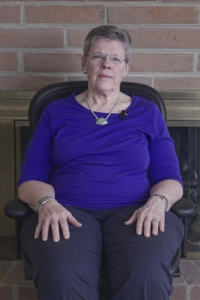
Barbara McIntyre, Great-granddaughter of George Pusch
I’m Barbara McIntyre, I am a third generation native of Tucson, Arizona. My great-grandfather was George Pusch. He arrived in Tucson in 1874.
I had a really, really good childhood. My parents—when I was one—moved to Broadway and Swan in Tucson, and my grandmother was very worried for us because it was so far out of town. But it was actually in a development that my father did. My father was a civil engineer, and he developed subdivisions and named the streets in the subdivisions that he did. The subdivision we lived in, at Broadway and Swan, has three streets named after members of my family. There’s Niven Avenue, which was my father’s maiden name. There’s Paseo Luisa, named after my mother. And there’s Janet Avenue, named after my older sister. If you go further east in another development he did at Wilmot and Broadway, just south of Wilmot and Broadway, there’s a street called Barnan, which is for Barbara and Nancy, named after my twin sister and myself.
When my father was doing subdivisions, it was out in the desert, and one day he came home and brought home a Gila monster. So, what did I do with the Gila monster? I took it for show and tell, of course. He was there to supervise.
Also, when he built the house, he built a large barbecue area in the backyard. We would have friends over and family over, and I remember growing up always having parties out there, or even just a few friends out there. This barbecue had a large barbecue grill and a spit on the top of it, but when he made it that was removable. You could remove it, and he had a ping-pong table made. So, all the years we were growing up, sometimes we would take it off and play ping-pong.
My mother is the descendant of George Pusch. She was his granddaughter. She was a stay-at-home mom. She did volunteer work. She worked with the Society for the Prevention of Blindness, and she was a U of A graduate. She was in the Kappa Kappa Gamma sorority, and she did work with them.
I had two sisters: Janet, who was five years older—my older sister—and a twin sister, Nancy. When I went to school, I went to Bonillas Elementary School and Alice Vail Junior High School. We would walk to school. I remember there was only one year that I didn’t walk to school. That was in second grade because it was overcrowded, and I was bused to Roskruge Elementary School, which was great fun for me. We had to be at school earlier, which wasn’t—I don’t like mornings. Then in high school I went to Rincon High, and I was on the golf team one year. I also did other sports like field hockey. One thing I really remember that I really liked was my sewing class. One year we had to make a dress, and then we had to do a fashion show for it. But I still like to sew today. I still do quilting. I started quilting when I retired, and I did quilting.
While I was in high school, we also went out to a stable to ride horses that was out south of 22nd Street on Harrison. One year the owner of the stable thought it would be great if we could go ride in the Rodeo Parade. So we had to get the horses from 22nd and Harrison down to the freeway to a corral. We drove the horses down 22nd Street, which I thought was great fun. I always thought I wanted to go on a cattle drive, and that’s the closest I ever got to that.
Growing up in Tucson was just great. I remember playing as a kid. We had to be in our yard by sundown, but we could still play outside. Our neighbor had clover on his grass right next to our yard, so he let us play on that. It was just really nice and fun to play on.
When we were little, we had chores. As we grew up, we had more chores, but I remember having to hang the clothes on the line. We had two backyards. Our first yard was where we had the barbecue and grass, and we had two olive trees. One of them had a table around it that we could sit at. When we got older, when the trees would drop the olives, we had to sweep them up, which wasn’t fun. But in the back backyard, is what we called it, we had some fruit trees. We had some citrus trees, and we had a fig tree.
My older sister had some animals out there, and she had a pond for some turtles. We also had desert tortoises in our backyard that actually hatched eggs and some little tortoises one time. Back there also was the clothesline. We had a washer but there was no dryer, so we had to go out and hang clothes up on the line out there.
One of the things we loved to do was to go camping. We went to Mount Lemmon, not necessarily camp, but we had a friend that had a cabin. The very first cabin that they had that we stayed in had no bathroom, so we had an outhouse that we had to go up the hill to. Then they had built a bigger cabin, and the larger cabin we’d go up and they’d let us stay in it. Then we’d go up with them sometimes and we’d help them repair it. I can remember putting varnish on the wood on the cabin to help them keep it up. They were really great letting us stay there. We loved to go camping. We went to Mount Lemmon a lot to go camping.
Then one summer we took, it had to be a month or more, that we went up through the western states. We started up from here, went up all the way to Yellowstone and saw some friends in Montana, and then worked our way back down the western states. The one standout memory of that whole trip was in Yellowstone National Park. We had a tent that my parents stayed in with our dog Poncho. My older sister slept outside on a cot, and my twin sister and I slept in the station wagon in the back of the station wagon. One night two bears came into camp and wanted some food, and they decided to fight. They fought over my sister’s cot that she was sleeping in. Luckily nothing happened to any of us, and my dad yelled out to her to just lay real still, which she did. But that was a very exciting part of that camping trip.
After high school I went to the University of Arizona. I had always wanted to go to school and become a teacher, and that’s what I did. My degree was in elementary education. I also took a lot of courses in anthropology and Native American studies.
While at the U of A the main extracurricular activity that I did was working with Camp Wildcat. Camp Wildcat was a student organization, is still a student organization today. They started in 1965 and it’s totally run by students. It’s a nonprofit organization and they take underprivileged children camping and bring them down to the U of A to do camps, mock camps. I still work with them today. I am now on the board of Friends of Camp Wildcat.
In the research that I’ve done about my family, I have found that several of the great aunts and uncles, along with my mother, either went to the university or graduated from the University of Arizona. I have records of my grandmother being in a sorority. I have newspaper articles that say that they had parties at the house that they had in Tucson for the sororities.
I have a picture of my Aunt Gertrude, and I believe it’s Aunt Mabel standing in white dresses and white hats, and they have a U of A banner that they’re holding. It looks like they have hanging from their skirts a little notepad, which could be a dance card from back when they used to have dances and they’d have people write down what dance they were going to have with them.
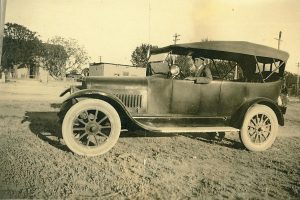
Walter Pusch in Buick or Dodge Brothers touring car from the early-to-mid 1920s
I’ve gone and done some research at the U of A, and the only great uncle or aunt that I could find that graduated was Uncle Walter. He was the youngest of the George and Mathilda Pusch’s children.
One year left of college, I got married. I met Jim McIntyre when I was in high school, and when I was a freshman at college, he was in the Navy, and he came home on leave and called. We started dating, and we’ve been married for 47 years. We’ve lived in Tucson all but 17 years of that. In those 17 years we moved to California for one of his jobs.
By the time I was born the Steam Pump Ranch had been sold out of the family, but we knew the history of the Steam Pump Ranch. We knew why Pusch Ridge was called Pusch Ridge.
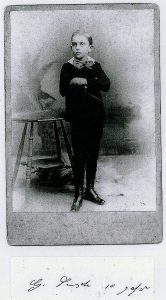
George Pusch Jr -about 10 years old
My great uncle George, the oldest of the George and Mathilda Pusch children, ran a ranch that was right next door to the Steam Pump Ranch. It was called the Cañada del Oro Ranch. They actually shared a fence. The fence that is still part of the Steam Pump Ranch today to the southwest is the fence that the two ranches shared. It was really one of my favorite places to go growing up.
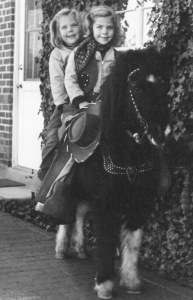
Barbara and Nancy on a Pony
One of my favorite memories growing up was when I was about five or maybe six. There was a man that came around the neighborhood with a pony, and he had a cowboy hat and vest and scarf that you could wear if you got on the pony and he’d take a picture. My mother said yes, and in our backyard my twin sister and I got on the pony. I had the scarf around my neck and the vest, and I got to hold the hat. My sister sat behind us, and I still have that picture today.
My mother was an only child and her parents. My grandfather passed away before I was born, so I didn’t know him. My grandmother, I was two when my grandmother died. George and Mathilda Pusch had seven children that survived, and my great aunts and uncles.
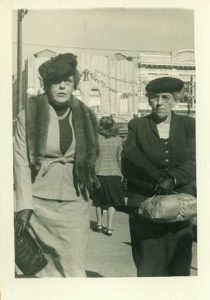
Mabel Pusch-Hankins and Gertrude Pusch-Zipf
One of the favorite things I liked to do as a child was to sit around and listen to them talk. They would talk about growing up in the Steam Pump Ranch, growing up in what it was like in Tucson, and just stories of the family. I could sit around for quite a while and listen to them talk. Two of my great aunts were especially ones that I liked to be around. My Aunt Gertrude, which I will call Aunt Tutsie because that’s what we called her, and I wish I knew how she got the name Tutsie, but we’d call her Aunt Tutsie. I don’t believe she ever knew how to drive because my mother would always go and take her shopping and take her to the doctor. Saturday morning was spent taking Aunt Tutsie to the grocery store, to the drugstore. When my mother passed away, I was 18, so my twin sister and I then took over turns taking Aunt Tutsie out shopping or to the doctor. I just loved it. We would just have a great time and go to lunch.
When my husband and I got married, our first house happened to be just around the corner from her. One time we had gotten a call from her, and she had locked herself out of the house, so my husband and I went over there. Luckily, she left the kitchen window unlocked, so we had to climb in the kitchen window to unlock the house for her. She stayed in that house until the day she passed away by herself. She maintained it. She was 92 when she passed away. She was just an amazing woman.
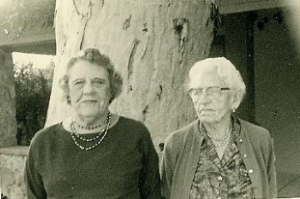
Maybelle Pusch-Hankins and Gertrude Pusch-Zipf
My other aunt, Aunt Mabel, or “May-bell,” she lived in Pennsylvania and we looked forward every year for her to come out at Thanksgiving. She and her husband Jim would come out at Thanksgiving, and they would stay until the end of February. After the Rodeo Parade was when they left. They would arrive by train, so we would go downtown and meet the train. They stayed in the Pioneer Hotel downtown, and during their visit there was always a very special day when we got dressed up and went downtown and had lunch with her in the hotel. It was always a big special event.
Her birthday was in November, and my mother’s was in December, so during the first part of December all the great aunts and my mother would get together at our house, and my mother would make a luncheon for them. When we got home after school, the rule was that we had to go in the back door into the kitchen, but we came out into the living room and met everybody and said hi and visited for a while. Once we left, we went back in the kitchen, and waiting for us was one of the desserts my mother always made. One of the favorite ones was really thin chocolate cookie wafers with whipped cream in between, and when you made them the night before and left them overnight, they would get nice and soft. It was just a really yummy dessert.
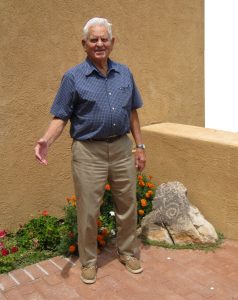
Henry “Hank” G Zipf and Petroglyph
Gertrude’s son Henry Zipf had lived in Oro Valley for a while, and when Jim Kriegh, who was one of the co-founders of the Oro Valley Historical Society, was working on developing the organization, I got a call from Henry. Everyone calls him Hank, but I always called him Henry. He called and asked if I was interested in helping out, and I said certainly. They really wanted to show that there were other descendants of George Pusch that were interested in maintaining the history of Oro Valley and the Steam Pump Ranch and the Pusches.
My twin sister and I agreed to help, and we met with Jim Kriegh and Hank. At that meeting I had prepared some 8 by 10 photos of some of the Pusch family antiques that we had, some Navajo rugs, Papago and Apache baskets, and some china that had come over by covered wagon from Germany. Those photographs and some of our stories and things we told were a big help, and they asked us to then go to one of the council meetings that they were having about the Historical Society.
After the Historical Society was started, they then started to save the Steam Pump Ranch. Once they did that, I became a docent at the Steam Pump Ranch at different events that they have. I’ve always loved my family history. If someone would ask me where I was from, I would always say third generation Tucsonan and then go into a bit of the Pusch family history.
When we lived in California, my husband and I would come back here for holidays and for vacations. In 1985 my Aunt Mabel died in Pennsylvania. She was the last of my great aunts and uncles to die, and we received all of her effects. When I started going through the photographs, I just had this need to do more family history, to document it somehow. So, when we would come back to Tucson, I would go to the Arizona Historical Society, and I did research on the family.
I got photograph copies of photographs, copies of newspaper articles, and I ended up making three photo albums, one for each of us, my sisters and I. They are basically the same photo albums. Some of the pictures are different in each one. For example, there may be pictures of my older sister, but there are different pictures of my older sister, and then the documents are divided. One of us will have the original. For example, we found in my great aunt’s things my older sister’s birth announcement and also two telegrams when my twin and I were born. My older sister has her original birth announcements and we have copies. The photo albums are great to look at. You can look at one and then you look at the other and it’s similar but it’s different. They’re just really good family history. That started me on my quest for family history.
When I became a docent, going to the Arizona Historical Society, I always thought when I retire, I want to be a docent. Being a docent for the Oro Valley Historical Society is ten times better. I was a teacher, so it feeds that teacher in me, and also, I get to share my family history and my family stories, which is very near and dear to my heart. I thoroughly enjoy and love all the work that I have been doing with the Historical Society.
This is a Papago, or a Tohono O’odham basket, and the stories I heard were of the Apaches. This is an Apache basket, and this may be Tohono O’odham. These two I think also, this one and this one back here, are both Apache baskets. I’m sitting on a Navajo rug. One of the things besides these were our family heirlooms and antiques. The stories that go along with these are what are very special to me also. The baskets and the rugs and things, the stories that I heard.
One of the stories I heard growing up was that George and Mathilda Pusch were always friends to anybody that came to the ranch, be it the cavalry, the traders, miners, the stagecoaches, the Native Americans. When the Native Americans would come to the ranch, or when they were traveling from Oro Valley to the Feldman Ranch in Mammoth, they would carry flour and sugar with them and they would trade. They would trade for the baskets. They would trade for the rugs.
One of the stories my mother always told that I remember is them going to, and she always told me Oracle, which was really probably the Feldman Ranch up in Mammoth. But she said when they would go up to Oracle, they would see wagons that had been attacked, but George never was. The story was he never carried a gun, but he always had the flour and sugar to trade. One time Henry, Hank, my cousin told the story of them stopping the wagon and circling the wagon. They then stopped and rode over, and two of the girls had blonde hair. I don’t know if my grandmother was one of them or not, but they were not used to seeing blonde hair, so they went over to the wagon and they ran their fingers through the girls’ hair.
Those were always some of the stories that I heard growing up.