
The people, risks, and reinvention behind Steam Pump Ranch
Jim—retired history teacher, author, and past OVHS president—has spent decades researching the people and stories that shaped Oro Valley.
Jim Williams
Filmed on February 21, 2020
Jim Williams: I am not going to take any questions during the presentation. When I am finished, I will be glad to answer any questions, but I would rather just kind of go through it to keep my train of thought. I have given you a map. I am going to refer to this map later on, so we will talk about that. I have given a number of presentations for my book, and when Steam Pump Ranch comes up, I try to emphasize the importance of Steam Pump Ranch because, as I see it, it is the only place in southern Arizona where you have two buildings of two different historic eras. You have two ranch houses of 1940s-style Spanish Revival—you know, cowboy era sort of thing, Gene Autry era—and then you have the original ranch house. I do not know of any other place in southern Arizona where you have those two on the same property. Maybe there are a couple, but it is pretty unique.
My research was quite different than anything I have done before because I hadn’t done any serious research on anything like an article or book for a few years, and I found an awful lot of very, very valuable resources online. Now, when I was teaching my students, I told them to stay away from most of the online resources because they really weren’t very good 12 or 15 years ago. Most of them were almost like encyclopedia stuff. But now you can pull up all kinds of original documents.
For example, ancestry.com is very valuable because there are 65 people profiled in my book and there is a profile that comes from there and from some Mormon websites. Between the two of them, you can pull up a lot of information about people. I used the Arizona Historical Society; obviously, they have got a lot of material there. Also, newspapers.com. If you subscribe to newspapers.com, you type in somebody’s name, Tucson, Arizona, 1878, and every article that ever referred to that person in 1878 pops up and you can immediately refer to those. When I did graduate school and undergraduate school work with newspapers, it was torture. Torture. Because you had to work with microfilm and microfiche and you had to know where you were looking. Now you just sort of type in parameters and it can send you there. So that was very valuable. And then we have things like this one up here. This comes from the General Land Office site. The General Land Office was the one that sold all the land here in Oro Valley other than what the state later owned after 1911. 90% of what was sold here was sold by the General Land Office, and you can pull up those records.
This is a man named Frederick Buente who had some land in what is now Rancho Vistoso. If you pull up his record, you can also pull up a map which shows you exactly where that property is today with all the streets and everything. So, you can see where everything fits, and it tells you a lot about the streets and everything here. So, I had the benefit of a lot of research material that wasn’t available 10 or 15 years ago, and that allowed me to delve into some areas that would have been impossible. General Land Office records—you had to go to Washington D.C. or, if you request them, they are $50 a copy. It gets a little expensive if you are doing local history research.
George Pusch, I am pretty sure he was born in 1847. There are a couple of sources that suggest maybe a year earlier or a year later, but I will go with 1847. On ancestry.com, I typed in George Pusch and ship records, and zing—right there it comes up: October 1865. He came over in the bark Tireland and there he is right there: George Pusch, 18 years old from Echzell, Hesse. The family always had recollections that he had come from Hesse. The writing is rather difficult to read, but this is a page—I think he was back on about page four or five—and it tells you it is the bark Tireland, the date, etc. So he came over in October 1865.
Johann Zellweger came over on a different ship. He came from Switzerland. He came from London, England, not from Bremen as did Pusch. So I doubt seriously they knew each other before they ever got here. There was no interfacing. They came from a different part of the continent. He arrived actually a little bit before Pusch, maybe a week or two weeks at the most before Pusch did. And there he is right there, Johann Zellweger, age 18, and the rest of it is listed beyond there on the records.
So, we know they got here. Pat Spoerl found the census records for the territory in 1874, and she gave me the material. There is George Pusch, and the list was further down the list. I couldn’t get all of it on one copy here, but Pusch obviously was here in 1874. There are a couple of sources I found that suggest he might have even been here earlier than that in Tucson. I don’t have those with me right now. By the way, I am going to donate all these papers to the Historical Society this summer, and Sue and I are going to talk about how we are going to file and organize these. But everything that I have, I wanted to organize so, you know, if I have a heart attack or something like that, this goes somewhere.
The first newspaper reference to Pusch and Zellweger is an ad in the paper in September of 1876. Also, I think in August of 1876, Pusch and Zellweger, proprietors of the Maish and Driscoll building on Meyer Street, which is kind of about now where the convention center is. Meyer Street sort of cut through where the convention center is, and it tells you about what they are going to do and how they are going to sell first-class meat, etc. That is the first newspaper reference that I found to them. But of course, they could have been here for a little while longer and running a business because when they retired in 1917, they said their business started in 1875. So it may have been an informal business and not advertised before this, but we definitely know by September of 1876 they were operating a business.
There are a number of newspaper articles in the local Citizen. You remember when there used to be a Citizen here? There was a second paper, an afternoon newspaper here. This is the beginning of that newspaper. These men are growing wealthy steadily and they are considered to be among the solid ones. They have steadily, and we may almost say rapidly, prospered by 1879. They are also selling horses at that time. There were a number of documents I found where Pusch was trading horses for the next 20 or 30 years.
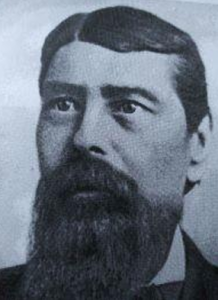
Portrait of Francisco Romero
Cattle ranching—of course, this is a much later picture. This was in the newspaper also, a kind of a logo that they had sometimes when they didn’t have an ad in the paper. They just published that little insignia, a kind of logo for their area, but it says “Ranch Santa Catalina.” The cattle ranching started in this period out here. The Romeros certainly had the first cattle ranch; they were here in 1869, and we know they had several hundred head of cattle. But there were many other ranchers in this immediate area by the 1880s: Francisco Romero and his family, Sutherland, Samaniego, Pierre Charouleau. Charouleau was a Basque who came here. Samaniego was Hispanic, Romero was Hispanic, Sutherland was Anglo.
There are a number of notices in the papers from about 1886 until maybe 1910 of what they call rodeos. Rodeo means a gathering of animals, and when they talk about having a rodeo, that meant that people like Pusch, Samaniego, Charouleau, and Romero would work together. Their cattle would be all loose—and at some point, it seems mostly the references are in the fall and the winter—they would get these cattle together, take them to market, bring them all in, and then divide them by their brand.
The idea that anybody owned land out here is a falsehood. This is all federal land. Nobody owns it; nobody has title to it. I only found one person between basically Ina Road and SaddleBrooke—one person—that got titled to land from the federal government in that period, and it wasn’t any of these people. So, these are all squatters. They have all come in, they build a house, they build a corral, they let the animals loose, they bring them back, and they all kind of work cooperatively.
I know we have been displaying this map, and I think it is time to put this map away because this map kind of claims that the Pusch family controlled everything from here all the way up to the San Pedro Valley. That is not possible because there were many other people that lived between here and there. Number one, they didn’t own it because nobody owned it. Number two, there are many other people who live in the same area, and they are all letting cattle loose and bringing the cattle in. At its maximum, the Steam Pump Ranch was never more than 1,120 acres.
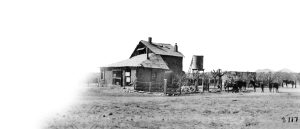
Pump House at Steam Pump Ranch
So, at this point, it is really zero acres. The closest I found to a reference to the Steam Pump early was in 1879 when the newspaper refers to Pusch and Zellweger building a large redwood tank on their property north of town, which is here. My guess is: why would you build a large tank unless you had some source of bringing a large volume of water into it? They didn’t make any mention of the steam pump. The first mention of the steam pump that is definite is in 1883 when Pusch and Zellweger made a financial deal.
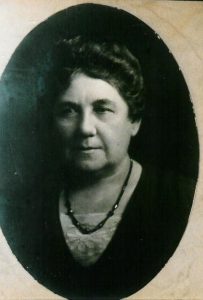
Mathilda Pusch, c.1912
Mathilda, from the Baltimore passenger lists of 1820 to 1864—we know that she came over here at age 23, at least that is what she put down on the documents. She departed from Bremen, Germany. She was from Prussia, so she traveled from Prussia to Bremen. That is a big trip right there. That is crossing all the way across what is modern Poland and Germany, getting a ship, coming to Baltimore, and then taking a train all the way from Baltimore to Tucson, because there was a train by that time period, I believe. But there is Mathilda right there on the records, age 23 from Prussia. My guess would be she came out for an arranged marriage. I don’t imagine she traveled all the way from Prussia to here without a purpose. It is just too big of an effort to do something like that.
Pusch and Zellweger broke their partnership in 1883, and they registered with the county government a bill of sale. That is important because it is not a deed; it is not really the ownership of property. What they were transferring was animals, a steam pump, and other things. The transfer was for $32,000, which would be the equivalent of about a half a million dollars today. I don’t know whether—you know, a lot of times things are transferred and records are kept, but that is not the exact amount of money that was really transferred. Sometimes people buy properties and they put $10 down that they paid for the house. Who knows? But that is what they put down. Then there was a second sale of their slaughterhouse, their meat market, and their livestock in 1887. This is the first reference where it says “steam or caloric pump” that we know for sure, but I think it was probably there before that.
Steam Pump Ranch on the early maps: Roskruge’s map of 1893 shows the intended railroad that was going to be built through here, and about the only thing out here is the Romero property and Steam Pump Ranch. 1904, all of a sudden, you see all these lines. Those are survey lines. This property has now been surveyed by the federal government, and it is up for sale. You also see rows—paths. This one would have gone back to Romero’s property, and this one would have gone up to Sutherland’s, further in the northern end of Catalina State Park.
Things are getting a little more complicated. Then over here, 1922, you have the Steam Pump Ranch. I know it is hard to see down there, but there is a second Pusch ranch north of here up in Rancho Vistoso. It would be in Honey Bee Canyon, and there is evidence today of that ranch still there—some ruins. The Sutherland ranch, the Lockas’ ranch—Matt Lockas was another early settler here. These people all go back to the 1880s at a minimum, 1870s in some cases. So, things get more complicated.
Pusch legally obtained property here in 1903. So, from the 1870s until 1903, he didn’t own anything. The federal government owned the land. When they decided to survey it, then it became available. He only claimed 40 acres. Why he only claimed 40 acres, I am not sure; he could have claimed up to 160. Those are the General Land Office records. There is one of those maps that showed where it is today. Here is First Avenue at Oracle Road, and on your map, it is letter A. That little square and the dot represents where the house is today—where the house was. For some reason, they built the house down here, probably because it was the closest to this stream over here. You know, this water was flowing fairly regularly at that time; the water table was higher, the springs flowed more of the year, and there probably was water flowing in many of these little washes until the 20s and 30s. Even the Santa Cruz River flowed until the 1930s. There was a major flow there. But you look back, and you can look up all the records of Pusch, and they are all online today.
So, the original property is one little 40-acre square in the middle of Section 7. Section 7 is one of 36 sections that made up a 36-square-mile township. Not like a township like back east, right? You know, some of you came from communities where there were townships. A township back there is a governmental unit; this is simply a unit for surveying and selling of land. It was not intended to be a township right away. You have Oracle Road and First Avenue—by the way, until a while ago it came straight down to this point. But I put in the modern road so we can kind of see where it is. So, you see where the CDO wash is, where La Reserve is, and where the Hilton Conquistador is on the map. I hope everyone got one; if not, please share and pass one back to the people in the back. I don’t have any extra copies.
Edward Perrin was an interesting character. He was a land speculator. He had been a Confederate officer and a surgeon in the Civil War for the Confederacy, and he spent three years after the war getting a pardon because if you could not get a pardon, you could not do business with the federal government. You could buy and sell land, and there was a lot of land to buy and sell in the West. He probably came from a family of means, being a surgeon before the Civil War, but he moved to San Francisco after the war and decided to get involved in land speculation. In Arizona alone, there were over 300 land purchases by Edward Perrin, and there are hundreds and hundreds more in California. He was a speculator as many people were, and he had some kind of relationship because he grabbed a piece of land. And there it is again. What’s in dark there is the piece of land that he took in 1904 as a homestead, and then he immediately transferred it to Pusch. In fact, he signed an agreement to give it to Pusch before he ever owned it officially. Both he and Pusch got their land in what is called a “forest transfer.” They had land in California; the federal government wanted it for a forest preserve, so they traded that land for this land, and Perrin, for whatever reason, immediately gave his chunk to Pusch. So Pusch now has the 160 acres—these four sections of 40 each. That was the legal amount you could get at that point. Later on, they changed the rules.
There is just a picture of the Steam Pump. Family recollections frequently mentioned that this was not the main ranch. This was a stopover point. The main ranch was the big ranch in the San Pedro Valley because there is a flowing river up there. It still flows; it’s the only river within Arizona that flows. Flowing rivers mean more water for cattle, more water for grain for feed, etc. So, people would come here more as a stopping point, more as a place to get away from the city but not really spending a lot of time here.
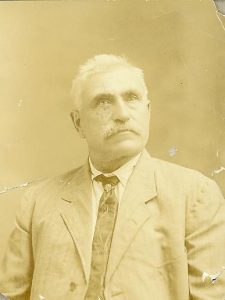
George Pusch
In his later years, Pusch had a heart condition. He suffered several major heart problems around the beginning of World War I, and the family took the business away from him. He closed the butcher business, and the Star noted it in November of 1917 that they were retiring after 42 years. That would mean they started in 1875. Pusch was ill. Zellweger retired to his ranch—he had land up in Pinal County, and they were phasing out. Again, the Society has all these records.
The family basically converted all the properties into a corporation and then they issued shares of stock. His wife got virtually all the shares. The oldest son and the oldest daughter, I think, got one share. So, they didn’t have a controlling interest; she had a controlling interest in everything. But my view is they probably made a mistake because they took everything they had and they put it all in one bundle. Then, when they had this bundle, they went to purchase another piece of land, which would be letter C on your map, and that’s called the Moqui land grant. The Moqui is what we today call the Hopi nation. That was a common name. They had been given land, and it was taken away for the railroads, and then the railroads were told to give it back. The Santa Fe and Pacific Railroad was forced to give it back to the government, who then sold it in 1916 or 17, and eventually, the Pusch Land and Cattle Company got control of that land. So now the ranch extends all the way down to where the Hilton El Conquistador is today.
So, you can see this addition, after George Pusch was no longer involved, turned it into a real ranch. This is the first time it really has some size. But again, keep in mind that it takes 30 acres in the desert here to support one head of cattle. So how many cattle could you really have? You’re not talking about a huge herd, even if you have 1,100 acres. So that’s letter C, 1918, I put on there.
There is Steam Pump Ranch as it was about 1920. And there’s the original ranch right here, the original small part. So, most of it’s on the other side. The Pusch family incurred a lot of debts in the 1920s. Barbara [Read, History with Barbara McIntyre] shared some papers with me last year about what the family was dealing with in the 1930s. But if you look through all of the papers that we have in the Society here, they had made loans; they had loans due to the department store; they had loans due to a man by the name of Lee Orndorff. They were forced to sell Steinfeld a share of the cold storage company they had. They were mortgaged in all of their properties downtown, including their mother’s house, because everything had been put into the corporation. When they started incurring debts, they got in trouble. There are all kinds of letters back and forth and documents of special meetings that were being held in the company, the Pusch Land and Cattle Company. But in essence, it was “we owe a lot more money than we have,” and the price of cattle maybe isn’t high enough for the cattle we already have. Sometimes the price of cattle would drop so much that they weren’t worth taking to market; they weren’t saleable.
William Henry “Idaho Bill” Sutherland
This is what happened. The Sutherlands lost all their property in the 1920s—everything. A lot of people just kind of built, built, built, and then they lost the whole thing. Partly, a lot of these people were kind of gamblers. They were willing, if they owned this house, to mortgage it to buy something else. Most of us don’t do that. It’s called leveraging, which is a great thing if it works, but if it doesn’t work, you lose everything. It’s like those people in 2006-2007 who had leveraged all those mortgages, and when the people couldn’t pay, all of a sudden, you lose everything. You don’t just lose what you owe; you lose everything.
Orndorff—his parents owned a hotel in town called the Orndorff Hotel. They also owned a big hotel in El Paso, which is still a major hotel today. I don’t think the family still owns it. He lived here for many years.
Audience member: Can I give you a tiny bit of information on that?
Jim: No, we’re going to keep going. Anyway, the Pusch family was forced to sell Steam Pump Ranch in April of 1925. I have the deeds and I have the newspaper notice. A lot of our literature has said they owned the property until 1933; they didn’t. They lost the San Pedro Ranch in 1925. They lost Steam Pump Ranch in 1925. They lost control of the cold storage company in 1925 or 26. So basically almost everything was gone at that point. And importantly, Lee Orndorff held a mortgage against this property. So when Joseph Nickerson bought the property, he was buying it with a mortgage already attached to it, which is a problem. If you owe money, you have to pay money on the mortgage as well as whatever you paid for the property.
Nickerson’s property was about 1,120 acres. It’s pretty much the same as what it had been since 1920. Nickerson was a resident of Feldman; he lived on the ranch in San Pedro. He was widowed at 63. I don’t have a photograph of him, but he did have a house servant, so he was probably a little well-off. He was a gambler; he created an oil company in 1928. He thought he could find oil in this part of the country, and he was capitalized at $500,000. The Depression came in 1929. He was sued for debt by the Tucson Industrial Finance Corporation in 1930, and he had major back taxes due on the property here starting about 1931. So he was quickly in the same situation that the Pusch family was in, in that he was losing financially on all of this. The ranch fell into disrepair.
This is an ad from 1931 or 32. Lewis Nickerson, his brother, was the resident here for a number of years, and Buster Bailey confirms that in his notes. They had a prohibition bust here because they had a still on the property in 1933. There were stills all over this area and a number of the homesteaders went to federal court because they were prosecuted for illegal moonshine. But you can see: “For sale cheap, old Steam Pump Ranch.” It was pretty much an abandoned property at this point. A bank got the property—a bank in San Francisco, the Pacific Coast Stock Land Bank—from Nickerson and other people because $24,000 was due on their mortgage. Orndorff purchased it because, remember, he had a $10,000 mortgage on the property. He had an interest in the land already. It was kind of like a part-ownership, and he eventually got control of it in 1937. Then he began to sell it gradually to John Procter, starting in 1938, and then in 1940 and 1941. I have all the deeds for this—copies of those deeds.
Finally, the early purchases by Procter look to me like this is what he was buying first: where the ranch house was. So probably in 1937 and 38, he bought these pieces. The deeds are a little hard to figure out exactly; they’re not very clear. He and Orndorff both worked for the Pioneer Hotel, and they were relatives. Procter, I believe, was a nephew of Orndorff, and Orndorff had a financial interest here and then he gradually transferred it to Procter.
Finally, in 1943, the newspaper noted that the El Presidio Hotel Corporation, which was controlled by Procter, bought all 1,200 acres of Steam Pump Ranch from Orndorff. Interestingly, they said that Procter did not live in the Pusch ranch house, but he lived in a house that he built across the street and up to the north. I found on a map from the 1950s there’s a house right up there. So, he didn’t want to live in the old ranch house. I imagine that ranch was pretty dilapidated at that point and he didn’t want to live in it, and he obviously had not built his own house yet—the house that he wanted to build on the property.
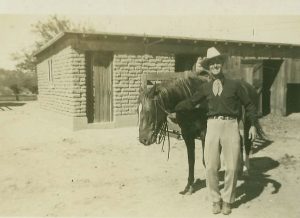
Jack Procter with Horse in Front of Horse Barn
Procter added to the property. These are two homestead tracts that he bought in 1940. See, here’s Hilton down here. So, this is kind of right where the road starts to curve and goes up the hill. And this is another one out here. And he added these two sections. And I don’t know who he purchased those from. And he had some other land up here further, but it wasn’t contiguous to this. He had some other land that he had purchased from another homesteader. A lot of wealthy people were coming into the 30s—wealthier people—and they were buying out the homesteaders. You know, the homesteaders, many of them had very little, and they were happy to get whatever they could.
This was the era of Walter McDonald’s Rancho Vistoso, Rancho Romero that was owned by the McAdams family (which is most of Catalina State Park), the Procter Ranch, Steam Pump Ranch, and the Rooney Ranch, which was south and west of the property. The Rooney Ranch kind of came up and around like this and around the Procter Ranch, which is more over here. So, they keep adding and they keep taking land and consolidating. Power lines didn’t come here until 1941. So, if you really wanted to live the nice ranch life, you wouldn’t want to live here much before 1941 because there would have been no electricity. It would have been kerosene lamps and candles, and you would have had no electrical conveniences. Yet the pictures that we see of them living in their house all show things like lamps and electrical outlets, etc.
Procter was a community leader. He was on the State Highway Commission. He managed the Pioneer Hotel. The Pioneer Hotel is interesting; it was a New Deal relief project. The New Deal helped pay for the building of the Pioneer Hotel because it almost went bankrupt. It was being built as the Depression started and it was going bankrupt, and the government stepped in. The federal government stepped in and saved it. He was president of the Chamber of Commerce. He was active in the rodeo. And of course, he had a ranch of probably over 1,500 acres. So, that’s about the biggest that Steam Pump Ranch legally ever was, probably in the 1940s.

Laurence Francis Rooney Sr.
Then, in the 50s and 60s, he began to sell the property off. And we know that he sold quite a bit of it to the Rooney family. The area again, if you look at your map, you see where the curve is here; there’s the Hilton down here. So most of this land was on the other side of Oracle Road. By then, by the late 60s, he had sold that to the Rooney family, and they developed it gradually with La Reserve and other things that are in that area. And of course, we think of Rooney and Pinch as being the shopping center down here, but half of their land was on one side of Oracle, the other half was on the west side of Oracle, but it went all the way up to Tangerine. So, they had a pretty big spread at one point.
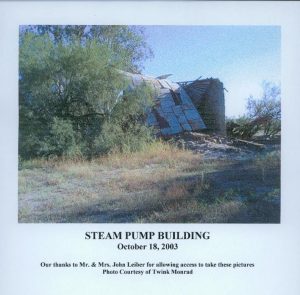
Pump House Building at Steam Pump Ranch October 18,2003
And of course, these are Twink’s pictures of what the property looked like when the Society got involved. I know a lot of people have never seen these because, you know, but that’s what the ranch house and the steam pump looked like when the Society took it over. So you can see a lot has been done to improve it.
So, I hope I’ve informed a few things of what happened. But I did a lot of research on deeds downtown and found out what the real history was of the transfer of the property from people to people. But still, between 1870-some and 1970, there’s really only two families that pretty much owned the property with a gap in the middle of about 15 years where the property was in flux between a number of different owners, banks, Orndorff, and other people who owned it. Well, partly because it was the Depression, but the Pusch family lost their properties before the Depression. They lost almost everything before 1929. So, you can’t blame the Depression on their property. It had more to do with ranching and mortgaging and taking chances and that kind of thing than it had to do with the ups and downs of the ranching industry. You know, sometimes people made a lot of money, sometimes people all went bankrupt. So, any questions or comments?
Question: Very nice presentation, Jim. Back when the passenger list when George came over from Bremen, were there any in your research—did you find anybody else from the same town or any associates?
Jim: I didn’t really look at it real closely. Mostly it just says the town or the province they came from, and I didn’t see anybody, but I will gladly give those documents, and you can look at them. But I didn’t see a reference to anybody else. And it looks to me like when they got off the ship, because there’s no order to it—it’s not alphabetical or anything—it’s probably as you walked off the ship, you walked up to a desk, and you were registered right there. But I think that’s pretty definite that he and Zellweger did not come over together. They probably didn’t know each other and met in New York City at some point. Anything else?
Question: What I was going to tell you is that Cheryl Lee has been working with Joyce and I on Celebrate Oro Valley, and she did tell us about Orndorff. That he was an uncle and that he had actually invited Jack to come manage the Pioneer. But her story—which only differs ever so slightly from yours—was that the Steinfeld’s hit financial difficulties and asked him to come in and financially take over the completion of the building of the Pioneer Hotel. And you talked about it being something else.
Jim: Well, it was built ultimately financed by the Reconstruction Finance Corporation of the federal government.
Question: Yeah. So somehow her story, or what that family believes, is that Orndorff came in, completed that project, and then the Steinfeld’s slowly but surely paid him back off. But that’s the reason he invited his nephew to come in and manage, who was already managing somewhere else.
Jim: Well, Barbara shared some letters with me from last year that you had been given by a relative, and Orndorff really in the 30s was trying to take their mother’s house. He wanted their mother’s house, and he wanted to give each child $500 to clear the debts they owed.
Response: Wow. Mama’s house.
Jim: Yes. They were at the point that they were basically going to lose literally everything they had—everything that they had ever accumulated, even their mother’s house.
Response: Wow.
Jim: And Orndorff had a deed against—he had a mortgage against this property, so he eventually got control of it. He lived in the Pioneer Hotel; he had a suite there as did the Procter’s. They had a suite and he had a suite, and periodically he would come in and out. He was, from what I gather, kind of like an advisor—a business advisor—to the company. But he and Procter were very close financially related, family relationship and everything, and Procter through him eventually got this ranch.
Audience member: Just a note about the Pioneer Hotel: if you haven’t been here very long, it was a very ritzy hotel downtown. We basically had two hotels: we had the Pioneer and we had the El Conquistador that was built on Broadway just east of Country Club. But they had all the big balls downtown. We had the Turquoise Ball and the Heart Ball and several others, and everything was at the Pioneer Hotel. And unfortunately, they did not build it with firewalls, and they didn’t enclose the stairs with firewalls, and there was a fire in 1977 that killed the Steinfeld’s. They were in their penthouse suite. And the place was very nice, but people were afraid to stay there after that, so then it was converted to being an office building. And it’s still an office building.
Response: Well, if I can tell you, that giant magazine that we get, the Desert Leaf, had a story—I believe it’s in November—that they’re totally restoring the ballroom and the dining room, and they had photographs of what they’re doing. So, I hope to have tours next year to that set up. So, but yeah, it’s going to be beautiful, you can tell.
Audience member: I remember taking our kids down to the Rodeo Parade when before they were in school. Of course, now they’re in their 50s, but we’d go down there and we’d have breakfast at the Pioneer Hotel and then we’d go to the parade. So, it was fun. Jim, did you want to make a comment?
Question: I was wondering what happened to the railroad? Did it ever—was it ever built out this way?
Jim: No, it was never built, though there are actually a couple—I have not seen them—but there are a couple of gradings that are up around the Hilton where they actually graded for the railroad. I know some people have seen them, but I haven’t.
Response: I haven’t, but one of the former presidents of the Society and I went and hiked through the wash out here and there is—and I think I talked to you about this—but there’s an old fence line or equipment. There’s an old fence line that you can still see out there where it looks like they used the railroad ties. So, they probably went and got them when it wasn’t going to be built anymore and used those as their fence posts, and it’s still out there. Cheryl said when they lived on the property when they were first here, that fence was still all around the property. So, they went and found a lot of those; they must have been abandoned.
Audience member: Well, it was a narrow-gauge rail that was going to go from Tucson north to Oracle and Florence, I believe. But it basically went bankrupt just right around Linda Vista. And so, what they ended up doing was they sold all the ties and the rails, and basically the ranchers around here used them for fencing.
Question: Jim, when you did the research on the boats that they came over on—Zellweger and Pusch and Mathilda—did you find any on Sophie, Zellweger’s wife?
Jim: Didn’t look.
Response: The story that I’ve always heard is that Mathilda came over because she came to visit Sophie and that then she met George. And I thought she got married—Mathilda got married after Sophie did—but I saw something recently where it’s just switched. Mathilda got married first and then Sophie.
Jim: Yeah, I know that’s the family story, but the reality of somebody coming from Germany to visit somebody here in 1880 was almost impossible.
Response: Well, in the 80s she was, too.
Jim: Yeah, there would have been a reason to come.
Question: I have a question about the San Pedro Ranch. It is referred to as the Feldman Ranch. It’s referred to as Feldman, Arizona. I believe that Mathilda’s maiden name was Feldman, and I believe that she had a brother that ran the ranch.
Jim: When I was working with Barbara Marriott in her books, she disregarded that there was any family relationship between the Feldman’s and Mathilda and her brother and said there were a lot of Feldman’s up there. I don’t know whether her research was inaccurate or what we have been hearing. There was a brother that ran the ranch; that was always true.
Response: But your guest speaker that you had last year when you held this meeting at the fire station, if you remember, that was his discussion point. And he talked about the Feldman community was not named after the Feldman family like we all think. And the P-Z Feldman Ranch was called Feldman because it was placed in that community, not because of association with the family. That was just an interesting coincidence. At least that’s what that lecture said a year ago.
Question: Any idea the number of head of cattle before 1900 that George Pusch had?
Jim: Well, I think in 1900, before they still had open range, though if you look at the early maps, people are already barb-wiring in good land. Like this land across the street here was all barb-wired and flat all the way up here; that was all barb-wired in even in 1900. So, it’s really hard to tell. There’s a lot of little paper records of these cows and those cows, selling these and selling this, but there’s nothing really definite. But I think they had a lot more cattle in San Pedro than they had here. This was a stopping point, right? And a lot of the references to rodeos are references to more up there in that area, starting and doing the roundup up there. I would think there, because there was water and a river up there, you could have feed for your cattle; you could raise feed and there would be grass because of the rivers, whereas here would have been much drier. You know that area was homesteaded way up there before here because this was considered sort of a dry gulch. There wasn’t much here, but up there, people homesteaded back in the 1880s, and there were no homesteads here until 1903 or 1904. So, I would think there had been relatively small numbers of cattle here because of the lack of standing water and rivers, but that’s just a guess.
Question: But wasn’t that why the steam pump was put in? To water the cattle? And that’s why the ranch was a big stopping point, because there was water.
Jim: Right. But if you let your cattle run, which they all did, then they come back here. So, there would have had to be dams or windmills or something somewhere else where they could have captured and held some water, and that would have been limited what they could have had at that time.
Response: Another thing that Cheryl talks about, again during the time she lived on the ranch, was about the place where the hotel is right over here—not where we currently have this little retention basin just next to the stables, but there was a big body of water there and they had all kinds of plant growth and so on and so forth. Her kids went and played, so there was a lot of water held in a giant retention basin there even as late as when they left.
Audience member: Well, thank you very much for doing all that research. I know you enjoy it.