
A Restored Treasure from the Pusch–Zipf Family
Around 2017, Oro Valley Historical Society volunteer Peg O’Connell researched this turn‑of‑the‑century German‑crafted doll and coordinated its full restoration. The doll is believed to have belonged to Gertrude Pusch Zipf, daughter of George and Mathilda Pusch, and was generously donated to OVHS by the Henry G. Zipf family.
The doll’s affectionate nickname, “Tutsie,” was suggested by Barbara McIntyre, Gertrude’s great‑granddaughter. “Tutsie” was a family nickname for Gertrude, making the restored doll a touching link between generations.
Darlene Rain, Tucson resident and award‑winning doll maker, carefully reassembled Tutsie, restoring her structure while preserving her original character.
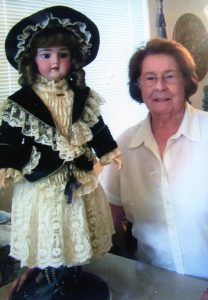
Ruth Fahden and Tutsie
Tutsie’s clothing was researched and designed by Ruth Fahden, member of the Tucson Doll Guild, the Doll Artisan Guild, and the United Federation of Doll Clubs. Ruth studied the era of the doll and created historically appropriate garments — including a remarkable detail: a piece of fabric from Gertrude Pusch’s wedding gown is sewn into Tutsie’s outfit.
Tutsie was manufactured in Waltershausen, Thüringia, Germany by Heinrich Handwerk and his wife Minna, who produced dolls from 1876 to 1902. Handwerk dolls are celebrated for their “Bebe” dolly‑faced bisque heads paired with composition jointed bodies.
The bisque heads themselves were crafted by Simon & Halbig, renowned for their exceptional quality and fine workmanship. Their collaboration with Handwerk resulted in dolls that remain highly valued by collectors and historians today.
Gertrude’s niece shares stories in History with Barbara McIntyre
Gertrude Pusch: A Life Shaped by Steam Pump Ranch
Gertrude Pusch’s Restored Steamer Trunk